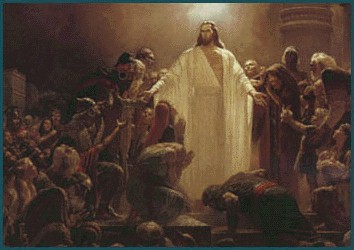
 Keep
your eyes open!...
Keep
your eyes open!...

CHRISTMAS, 2025
THE TRIB TIMES WILL
RETURN IN MID JANUARY 2026, GOD
WILLING (James 4:15).
MERRY CHRISTMAS TO ALL FROM THE
ZAMBRANO
GRANDKIDS! BLESSINGS FOR A
JOYOUS NEW YEAR!
(Luk
2:15-16) And it came to pass, after the angels departed from them into
heaven, the shepherds said one to another: Let us go over to Bethlehem
and let us see this word that is come to pass, which the Lord hath
shewed to us. And they came with haste: and they found Mary and Joseph,
and the infant lying in the manger.
BISHOP ERIK VARDEN, O.C.S.O.:
The God who comes to save us is the God who made us. His saving is our
re-creation. His intent is not just to fix faults, to repair a system
error wrought by human sin and folly. He comes to make us new, to let
us be born from on high, not of the flesh but of power divine. He comes
to make us children of God, to infuse us with the very breath of God.
FR MARIO ATTARD OFM CAP: Christmas with Padre Pio
CHURCHPOP: The Untold Story of the Pope Behind the Famous Christmas Truce of 1914
ST. AUGUSTINE OF HIPPO: Let the Humble Hold Fast to the Humility of God
Therefore the Prophets rightly announced the one to be born, but the
heavens and the angels the one already born. He lay in the manger who
holds the world: and he was both an infant and the Word. Him whom the
heavens cannot contain, the womb of a single woman bore. She who bore
our king rules us; in whom we are (cf. Acts 17:28), she carried him;
she who nourished our bread (cf. John 6:35).
O manifest weakness, and wondrous humility, in which the whole divinity
was thus hidden! The power that governed the universe lay in the
manger: and he was both an infant and the Word. He whom the heavens
cannot contain was carried in the womb of a single woman. She who bore
our king carried him; she who nursed our bread fed him.
May he perfect in us his gifts, who did not shrink from taking on even
our beginnings; and may he himself make us children of God, who for our
sake was willing to become the Son of Man.
O manifest infirmity, O wondrous humility, in which all the greatness
of God lay hid! The mother to whom His infancy was subject, He ruled
with His power; and to her at whose breasts He nursed, He gave the
nourishment of truth.
May He who did not shrink from taking a beginning even like unto ours,
perfect in us His gifts; and may He also make us children of God, He
who for our sakes wished to become a child of man.
NATIVITY MASTERPIECE: Sandro Botticelli’s Mystic Nativity 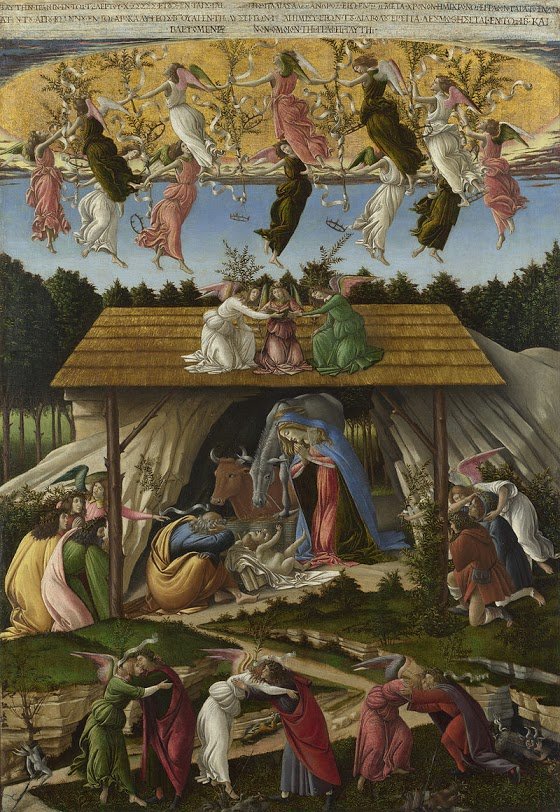
Botticelli’s Mystic Nativity is as beautiful as it is mysterious. It is
a good reminder for us this Christmas time. Botticelli lived in a
turbulent time, was pulled many directions at once, consumed with fear
of war, death, plague, famine, and the state of his eternal soul…yet
what Christ came to give was primarily the gift of peace. Peace
with God and peace with men. Peace on earth and goodwill toward
all men.
VATICAN.VA: MESSAGE OF HIS HOLINESS LEO XIV FOR THE
CELEBRATION OF THE WORLD DAY OF PEACE 1 JANUARY 2026
Ladder
of Divine Ascent excerpt: Step 5- "On painstaking and true repentance"
33. He who really keeps account of his actions
considers as lost every day in which he does not mourn, whatever good he
may have done in it.

FOURTH WEEK OF ADVENT, 2025
(Mat
1:20-24) But while he thought on these things, behold the Angel of the
Lord appeared to him in his sleep, saying: Joseph, son of David, fear
not to take unto thee Mary thy wife, for that which is conceived in
her, is of the Holy Ghost. And she shall bring forth a son: and thou
shalt call his name Jesus. For he shall save his people from their
sins. Now all this was done that it might be fulfilled which the Lord
spoke by the prophet, saying: Behold a virgin shall be with child, and
bring forth a son, and they shall call his name Emmanuel, which being
interpreted is, God with us. And Joseph rising up from sleep, did as
the angel of the Lord had commanded him, and took unto him his wife.
BLOG: Patristic Wisdom: Looking to the Fourth Sunday in Advent
CHURCHPOP: The Catholic Meaning of 'The Twelve Days of Christmas': The Secret Code Explained
BISHOP BARRON VIDEO LINK: https://x.com/BishopBarron/status/1870885604348604793
Friends, on this Fourth Sunday of Advent, we come to the Advent figure
par excellence: the Blessed Virgin Mary, the Mother of God. What I want
to do in this homily is to look at some of the Church’s classical
titles of Mary. These are not simply pious exclamations, but rather
very substantive insights into her role in bringing Christ to
birth—both in history and in us today.
YOUTUBE ADVENT HOMILY: H.O.P.E, P.E.A.C.E, J.O.Y., L.O.V.E.
SCRIPTURE REFLECTION:
Matthew's account shows us what it takes to bring Jesus into our world.
Hearing this brief passage, we realize that this gospel is much more
than a history lesson in "how the birth of Jesus came about."
It's also a lesson in how we can
not only get ready for Christmas, but how we can continue to bring
Christ into our world, especially in this troubled time.
First, we need to be able to
believe. Be willing to take a leap of faith. Set aside skepticism and
be open to wonder. This passage begins with a miracle, a virgin
conceiving a child. Understand that our God is the God of astonishment
and possibility. Expect the unexpected. The Holy Spirit can spark
amazement and miracles -- and even bring about something as improbable
as a virgin being with child.
In our cynical, materialistic age,
when Christmas is dominated by consumerism and consumption, here is a
reminder that this feast begins with mystery and is fueled by love --
God's love for our fallen world. This is how faith takes root and grows.
Secondly, we need to be fearless --
and, of course, be open to the advice of angels. What does Joseph hear
in his dream? An angel speaks to him the same words Gabriel spoke to
Mary at the Annunciation: "Do not be afraid." If we want to welcome
Christ, if we want him to come into our world, we need to be brave
enough and bold enough to let it happen. Defy cynicism and fear and
doubt. We can all benefit from taking time to do what Joseph did and
make room for God to do his work. Embrace the consoling truth of the
Messiah's name, "God is with us." That's a welcome message for this
season and any season.
Finally, we need to be awake.
Joseph was only able to do what the angel told him after he'd awakened
from sleep. He welcomed a new day and saw the path before him with
fresh clarity and focus. And from that moment on, he quietly,
purposefully set out to do what God wanted and he surrendered to the
Lord's will for his life.
Likewise, we need to shake off our
slumber and welcome Jesus as we would a new day. Joseph gave his child
the name by which he'd be known; in a similar way, we're also called to
make known the name of Jesus. That means more than just singing "Away
in a Manger" on Christmas Eve. It means making that name matter,
announcing it to the world in what we do, how we live and how we love
-- not just in late December, but all year long.
CATHOLIC DAILY REFLECTION:
Joseph’s dream was no ordinary dream. The Holy Spirit accompanied the
angel and instilled the certitude of faith in Joseph’s mind, empowering
his will to obey God’s will. Joseph became the father and guardian of
the Savior of the World. On December 8, 1847, Pope Pius IX declared
Saint Joseph to be the Universal Patron and Protector of the Catholic
Church. Just as he protected the Son of God, so he intercedes for us
who are members of Christ’s body, the Church.
As our Advent season enters its final week, we are reminded of the role
that Jesus’ foster father played not only in the life of the Holy
Family, but also about the role Saint Joseph continues to play in the
life of the Church and in each one of our lives. His intercessory power
from Heaven is great, and we should not hesitate to call upon his
prayers, especially when we need protection, struggle with fear, or
face some grave challenge.
ADVENT
RESOURCES
CATHOLIC ANSWERS TRACT: Catholic Answers Guide to Preparing for Christmas
ICBC: Advent
Calendar 2025
DYNAMIC CATHOLIC: Best
Advent Ever!
CREIGHTON UNIVERSITY'S ONLINE MINISTRIES:
Praying Advent and Celebrating Christmas
USCCB: Advent 2025
MY CATHOLIC LIFE: Advent & Christmas Prayers & Reflections
POPE LEO XIV:
Human life is characterized by a constant movement that drives us to
do, to act. Nowadays speed is required everywhere in order to achieve
optimal results in a wide variety of fields. How does Jesus’
resurrection shed light on this aspect of our experience? When we
participate in his victory over death, will we rest? Faith tells us:
yes, we will rest. We will not be inactive, but we will enter into
God’s repose, which is peace and joy.Ladder
of Divine Ascent excerpt: Step 5- "On painstaking and true repentance"
32. After your fall, do not believe him who says
to you of small shortcomings: 'If only you had not done that great fault!
But this is nothing in comparison'. Often small gifts appease the great
anger of the Judge.
THIRD WEEK OF ADVENT, 2025
(Php 4:4) Rejoice in the Lord always: again, I say, rejoice.
VATICAN NEWS: Lord's Day Reflection: Rejoice in the Lord always!
THE CATHOLIC THING: Advent: Turning Point Universe
BOOK EXCERPT: Slowing Down to the Speed of Joy: The Simple Art of Taking Back Your Life by Matthew Kelly
YOUTUBE ADVENT HOMILY: H.O.P.E, P.E.A.C.E, J.O.Y.
RHODE ISLAND CATHOLIC: The One Reason to Rejoice Always
This weekend the Church will celebrate “Gaudete Sunday.” It’s the
Sunday when we light the third candle—the rose one—on our Advent
wreaths, signifying that the season is more than half over and that
Christmas is fast approaching. On this Third Sunday of Advent the
Church tells us to do what St. Paul asks of us in 1 Thessalonians
5. The Church tells us to rejoice. In fact, she not only
tells us to do that, she commands us to do it. “Gaudere,” in
Latin, is the verb that means “to rejoice,” but “Gaudete” is the
imperative plural form of the verb—which means it’s a command.
It’s a command that’s being given to each and every one of us and to
every person on planet earth.
“REJOICE!”
The problem is there are always reasons we can find not to
rejoice. The evil in the world—the murders of innocent people;
the rioting; the terrorism; the wars; the greed; the abuse of various
kinds—all these things make rejoicing difficult, as do the personal
trials and sufferings that we’re forced to deal with on a daily basis.
So, what’s the answer? Is it possible to fulfill that command to
rejoice even when bad things are happening in the world and in our own
personal lives?
The answer, happily, is yes! Yes, it’s possible to “gaudete”—to
rejoice—in times of suffering. Yes, it’s possible to rejoice in
times of trial. Yes, it’s possible to rejoice even in the worst
of circumstances.
It’s possible because, in the midst of all the reasons—all the many
reasons—that each of us has not to rejoice, there is always one reason
for us to rejoice.
And that reason is Jesus Christ and what he has done for us.
Here, the distinction needs to be made between “feeling joy” and
“rejoicing.” Feeling joy is an emotional response to something that
pleases us. Children, for example, will see their presents under
the tree on Christmas morning and they will feel joy. That will
happen quite naturally. And, if they’ve been particularly good
during the previous 12 months, they will feel a lot of joy!
Rejoicing is different. Biblically speaking, rejoicing is not an
emotion or an emotional response to something that we find attractive
or pleasing. Rejoicing in the Bible is an act of the will.
It’s a conscious and deliberate decision: a conscious and deliberate
decision to praise and glorify God regardless of what we happen to be
dealing with at the present time.
And it’s a decision which is made on the basis of things that we know are true.
None of us always “feels joy.” But even when we’re not feeling joy, we
can still make the conscious and deliberate decision to rejoice, based
on what we know, by faith, to be true.
And there we have the key to it all. If we want to be able to
rejoice on the Third Sunday of Advent, we have to make the effort—the
conscious and deliberate effort—to look beyond all the reasons that we
have not to rejoice and then focus our attention on those things that
our faith tells us are true.
For example …
� We need to focus our attention on the fact that Jesus Christ is Lord.
� We need to focus our attention on the fact that Jesus loves us with an unconditional love even when we fail him.
� We need to focus our attention on the fact that Jesus is with us
always and that he will never allow us to be tested beyond our strength.
� We need to focus our attention on the fact that Jesus will always
forgive us if we repent—he does so ordinarily in the Sacrament of
Reconciliation.
� We need to focus our attention on the fact that everything, including
our sufferings, will work for our ultimate good if we love the Lord and
stay close to him.
If our minds and hearts are focused on truths like these and not on all
the reasons we have to be sad and depressed, then we will be able to
rejoice—not only on the Third Sunday of Advent but always, as St.
Paul says we should.
ADVENT
RESOURCES
CATHOLIC ANSWERS TRACT: Catholic Answers Guide to Preparing for Christmas
ICBC: Advent
Calendar 2025
DYNAMIC CATHOLIC: Best
Advent Ever!
CREIGHTON UNIVERSITY'S ONLINE MINISTRIES:
Praying Advent and Celebrating Christmas
USCCB: Advent 2025
MY CATHOLIC LIFE: Advent & Christmas Prayers & Reflections
Ladder
of Divine Ascent excerpt: Step 5- "On painstaking and true repentance"
31. Before our fall, the demons say that God is
a friend of man; but after the fall, that He is inexorable.
SECOND WEEK OF ADVENT, 2025
(Isa 11:1-3) And
there shall come forth a rod out of the root of Jesse, and a flower
shall rise up out of his root. And the spirit of the Lord shall rest
upon him: the spirit of wisdom, and of understanding, the spirit of
counsel, and of fortitude, the spirit of knowledge, and of godliness.
And he shall be filled with the spirit of the fear of the Lord, He
shall not judge according to the sight of the eyes, nor reprove
according to the hearing of the ears.
YOUTUBE ADVENT HOMILY: H.O.P.E, P.E.A.C.E
CHURCHPOP: The
Catholic Church celebrates the Immaculate Conception of the Blessed
Virgin Mary on December 8. Here are seven quotes from the saints that
magnify the importance of the Immaculate Conception of Mary and her
role in God’s plan for salvation:
https://x.com/Church_POP/status/1732939871784730656
OUR LADY OF GUADALUPE
CERC REVIEW: The Amazing Truth of Our Lady of Guadalupe
SHRINE OF OUR LADY OF GUADALUPE: Facts about the Apparition
MYSTERIES OF OUR LADY OF GUADALUPE
If you take the position of the stars and the flowers on
her dress and place them on a musical staff, they create a perfect,
harmonious melody. It is literally a song from Heaven.
Listen:
https://x.com/trad_west_/status/1995208954473775253
ARCHBISHOP SAMUEL J. AQUILA: The Light That Shines in the Darkness
"The people who walked in darkness
have seen a great light; upon those who lived in a land of gloom a
light has shone.” Isaiah 9:2
Every December, as our homes and neighborhoods begin to sparkle with
lights, our hearts are drawn again to this ancient prophecy from
Isaiah. The glow that fills our streets and sanctuaries is more
than seasonal cheer; it reflects a far greater truth. That great,
true light has indeed shone among us: the light of Jesus Christ, the
Word made flesh.
The Incarnation, God taking on our humanity, is the most magnificent
mystery of all history, after the mystery of the Holy Trinity
itself. Through Mary’s humble “yes,” the eternal Son of God
entered our world, not as a distant ruler but as a child. The
angel’s message to Mary reveals the wonder of that moment: “Do not be
afraid, Mary, for you have found favor with God. Behold, you will
conceive in your womb and bear a son, and you shall name him
Jesus. He will be great and will be called Son of the Most High
... and of his kingdom there will be no end” (Luke 1:30–33).
In that instant, Heaven and earth met. The infinite became an
infant. The light Isaiah foretold broke into human history, not
as a blaze of fire or thunder from above, but as the gentle radiance of
a newborn’s face. The light of a star brought the Magi to worship
Jesus. And Jesus, the Light of the World, continues to shine in
our hearts, in our families, in our Church, in the world and even in
the joyful traditions that accompany this sacred season.
Our Christmas decorations, lights and celebrations can be true acts of
faith when they are done with hearts turned toward Christ. The
lights that shimmer on trees and homes recall the light that pierces
all darkness. The songs we sing echo the angels’ joy. The
beauty of our churches adorned for the Nativity, the warm glow of
candles and the joy of family gatherings — all these things express the
grandeur of the gift we have received.
There is something profoundly right about celebrating Christmas
beautifully. If God himself entered our world, if the Creator,
the one who created beauty itself, chose to dwell among his creatures,
then surely the only fitting response is one of wonder and joy!
To celebrate fully, to decorate with care, to give generously and to
rejoice together are all ways of proclaiming the truth that God is with
us.
The Incarnation reveals the heart of God’s love. He did not
remain far off but came close, sharing in our humanity so that we might
share in his divinity. This is why Christmas is not merely a
season of nostalgia or tradition, but the feast of divine love made
visible. Every light we hang, every song we sing, every prayer we
whisper before the manger is a small echo of that cosmic joy.
Mary’s faith shows us how to receive this mystery. Her “yes”
opened the way for God’s light to enter the world. As we prepare
our homes and hearts for Christmas, we are invited to echo her response
and to make room for Christ amid our celebrations. When we gather
around the table or kneel before the Nativity scene, we participate in
the same wonder that filled the stable at Bethlehem.
The Incarnation is not an event locked in history; it is a living
reality. In every Eucharist, the same Jesus who was born in
Bethlehem becomes truly present among us: Body, Blood, Soul and
Divinity. The joy of Christmas, then, continues all year long in
the life of the Church, where Christ still dwells with his people.
This year, let us allow the beauty of Christmas to draw us deeper into
the mystery it proclaims. Let our decorations be expressions of
love for the Savior. Let our carols be prayers of
thanksgiving. Let the light that fills our homes remind us of the
eternal Light that no darkness can overcome.
For “the people who walked in darkness have seen a great light.” That
light has a name, Jesus Christ. He is our joy, our peace, our
hope and our salvation. May the radiance of his love fill your
homes and hearts this Christmas, and may your celebration shine
brightly with the glory of the Word made flesh.
May your light, Jesus living in you, bring Jesus to every encounter you
have, whether it is with family, the homeless, the elderly, the sick,
the immigrant, the imprisoned, the rich, the poor or the
stranger. May your love for your neighbor bring each person to an
encounter with Jesus.
THE CATHOLIC THING: The Greatest Advent Hymn
ADVENT
RESOURCES
CATHOLIC ANSWERS TRACT: Catholic Answers Guide to Preparing for Christmas
ICBC: Advent
Calendar 2025
DYNAMIC CATHOLIC: Best
Advent Ever!
CREIGHTON UNIVERSITY'S ONLINE MINISTRIES:
Praying Advent and Celebrating Christmas
USCCB: Advent 2025
MY CATHOLIC LIFE: Advent & Christmas Prayers & Reflections
ST. SERAPHIM:
“God is a fire that warms the heart…Hence if we feel in our hearts the
cold which comes from the Devil – for the Devil is cold – let us call
on the Lord. He will come to warm our hearts with perfect love
and the cold of him who hates the good will flee before the heat of His
countenance.”
Ladder
of Divine Ascent excerpt: Step 5- "On blessed and ever-memorable obedience"
30. Do not be surprised that you fall every day;
do not give up, but stand your ground courageously. And assuredly, the
angel who guards you will honour your patience. While a wound is still
fresh and warm, it is easy to heal; but old, neglected and festering ones
are hard to cure, and require for their care much treatment, cutting, plastering
and cauterization. Many from long neglect become incurable, but with God
all things are possible.
FIRST WEEK OF ADVENT, 2025
(Rom 13:11-12) And
that, knowing the season, that it is now the hour for us to rise from
sleep. For now our salvation is nearer than when we believed. The night
is passed And the day is at hand. Let us, therefore cast off the works
of darkness and put on the armour of light.
YOUTUBE: Understanding the True Meaning of Advent
THE CATHOLIC THING: Time & Eternity
VATICAN NEWS: St. Charbel Makhlouf, a symbol of coexistence and support for Lebanon
ALETEIA: Pope in Turkey suggests Advent resolutions
EXCERPT CATHOLIC OUTLOOK: First Sunday of Advent, Year A
“But why are we listening to such a scary Gospel on the first day of
Advent?” some may reasonably ask. “We thought we’d be preparing
for Christmas!”
In its earliest form, Advent was simply a preparation for
Christmas. But it quickly acquired an eschatological character
(from the Greek eskhatos meaning “last”.) From the beginning of the
seventh century, Advent was understood not only as a time of
preparation for the Christmas solemnity, but also, and especially, as a
time of expectancy for the return of Christ in glory. This was
especially so in the Gallic liturgy, and may have come about through
the influence of Irish missionary monks who, in their preaching, laid
stress on the coming of Christ in judgment, and thus on the need to do
penance.
The word “Advent” originally designated not the period of preparation,
but the feast of Christmas itself. The coming of Christ in the
flesh and its liturgical commemoration was the adventus Domini: the
advent of the Lord. From thi,s you can see that right from the
start, the Church saw the liturgy as a happening, not just as a
memory. But then the term memory took on a deeper meaning.
What we remember in the liturgy actually becomes present.
In the New Testament, Adventus translates the Greek parousia, which
refers to Christ’s coming. For this reason, the season of Advent
came to signify both his birth in history and his return at the end of
time.
Gradually, the word Adventus assumed a distinctly liturgical meaning—it
came to be applied to the weeks of preparation for Christmas and of
expectation of the glorious return of Christ.
Many of us today might find it difficult to understand the idea of two
comings intermingled with the Advent liturgy. But the early
Fathers of the Church did not see this as a problem—they had a unified
vision of the mysteries of Christ. Pope St Leo the Great, in his
sermons for Christmas and Epiphan,y leads his hearers and readers
beyond the mystery of the Incarnation to the contemplation of Christ
now enthroned in glory and to his return at the end of time. The
Church evokes the coming of Christ in all its aspects—past, present and
future— and so the season of Advent recalls the coming on earth of the
incarnate Word, deepens our awareness of Christ’s Presence in the
Church every day, and heightens our hope and longing for his return.
So, we are really speaking now of three comings. St Charles
Borromeo, archbishop of Milan (+1584), explains: “The Church desires us
to understand that Christ, who came once in the flesh, is prepared to
come again. When we remove all obstacles to his presence, he will
come at any hour and moment to dwell spiritually in our hearts,
bringing with him the riches of his grace.” And St Bernard (+1153): “In
the first (coming), Christ was our redemption; in the last, he will
appear as our life; in this middle coming, he is our rest and
consolation.” The Incarnation is the beginning of a process which is
not yet finished. Christ will return in glory to crown his work
of salvation. It is a promise.
The Christ Pantocrator mosaic in the Cathedral of Cefal� in Sicily
is often described as one of the most majestic images of Christ in
Western Christian art. The cathedral was commissioned by King
Roger II of Sicily in 1131, reportedly in fulfilment of a vow he made
after surviving a storm at sea. At that time, Sicily was a
multi-ethnic kingdom under Norman rule where Latin, Byzantine and Arab
cultures coexisted. An enlightened monarch, Roger encouraged this
cultural blend. He invited artisans from Constantinople to create
mosaics in the churches and palaces of his kingdom.
The title Pantocrator means “Ruler of all” or “Almighty” in
Greek. It presents Jesus as the eternal Judge, Teacher, and
Saviour—a cosmic ruler rather than merely a human figure. His
raised hand in blessing invites us into a relationship with him, while
the open Gospel proclaims the truth of his Word: “I am the light of the
world. Whoever follows me will not walk in darkness” (Jn 8:12).
Christ’s face is serene but powerful, intended to convey omniscience
and compassion. The mosaic is enormous—six metres and spans the
entire semi-dome of the cathedral’s apse. Historically, it is an
important reminder of the great portraits of Christ in the churches of
Constantinople now lost to us.
This judge of all is not to be feared. His eyes and thoughts are full of mercy for humankind.
ADVENT
RESOURCES
CATHOLIC ANSWERS TRACT: Catholic Answers Guide to Preparing for Christmas
ICBC: Advent
Calendar 2025
DYNAMIC CATHOLIC: Best
Advent Ever!
CREIGHTON UNIVERSITY'S ONLINE MINISTRIES:
Praying Advent and Celebrating Christmas
USCCB: Advent 2025
MY CATHOLIC LIFE: Advent & Christmas Prayers & Reflections
Ladder
of Divine Ascent excerpt: Step 5- "On painstaking and true repentance"
29 (cont.). Previous habit often tyrannizes even
over him that mourns. And no wonder! The account of the judgments of God
and our falls is shrouded in darkness, and it is impossible to know which
are the falls that come from carelessness, and which from providential
abandonment, and which from God's turning away from us. But someone told
me that, in the case of falls which come to us by Divine providence, we
acquire a swift revulsion from them, because He who delivers us does not
allow us to be held for long. And let us who fall wrestle above all with
the demon of grief. For he stands by us at the time of our prayer, and
by reminding us of our former boldness before God, he tries to devastate
our prayer.

 Links
Links  E-mail
Dr. Zambrano
E-mail
Dr. Zambrano  Home
Home
 Jubilee
2000: Bringing the World to Jesus
Jubilee
2000: Bringing the World to Jesus
 The
Tribulation Times Archives:
The
Tribulation Times Archives:
FAIR
USE NOTICE: This site contains copyrighted material the
use of which
has not always been specifically authorized by the copyright owner. We
are making such material available in our efforts to advance
understanding of environmental, political, human rights, economic,
democracy, scientific, and social justice issues, etc. We believe this
constitutes a ‘fair use’ of any such copyrighted
material
as provided for in section 107 of the US Copyright Law. In accordance
with Title 17 U.S.C. Section 107, the material on this site is
distributed without profit to those who have expressed a prior interest
in receiving the included information for research and educational
purposes. For more detailed information go to: http://www.law.cornell.edu/uscode/17/107.shtml.
If you wish to use copyrighted material from this site for purposes of
your own that go beyond ‘fair use’, you must obtain
permission from the copyright owner.