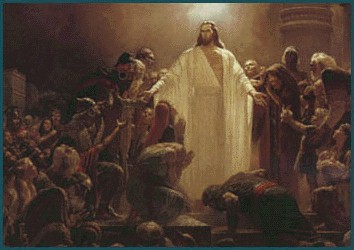
 Keep
your eyes open!...
Keep
your eyes open!...

August 28, 2025
(Tit 2:11-13) For
the grace of God our Saviour hath appeared to all men: Instructing us,
that, denying ungodliness and worldly desires, we should live soberly
and justly and godly in this world, Looking for the blessed hope and
coming of the glory of the great God and our Saviour Jesus Christ.
BLOG: What’s Useful, What’s Contemplative: Augustine for AI
VIDEO LECTURE: What would Augustine say about Artificial Intelligence? By Dr. Jordan Wales
Dr. Jordan Wales explores the implications of artificial
intelligence (AI) through the lens of St. Augustine's writings,
emphasizing human dignity, personhood, and the ethical challenges posed
by AI. He argues that AI lacks true consciousness and self-gift,
presenting dangers of reducing human empathy and collective moral
responsibility in the face of increasingly relatable AI entities.
1000 REASONS TO BELIEVE: St Augustine's analogies highlight images of the Trinity in man
CHURCHPOP: 11 Inspiring Quotes from the Magnificent Saint Augustine, Doctor of the Church
-
“Pray as though everything depended on God. Work as though everything depended on you.”
- “If you believe what you like in the Gospels, and reject what you don’t like, it is not the gospel you believe, but yourself.”
- “Faith is to believe what you do not see; the reward of this faith is to see what you believe.”
- “Seek not to understand that you may believe, but believe that you may understand.”
- “The confession of evil works is the first beginning of good works.”
- “There is something in humility which strangely exalts the heart.”
- “God had one Son on earth without sin, but never one without suffering.”
- "To fall in love with God is the greatest romance; to seek Him is
the greatest adventure; to find Him, the greatest human achievement."
- “God loves each of us as if there were only one of us.”
- “Patience is the companion of wisdom.”
- “For you made us for yourself, and our hearts are restless until they find their rest in you.”
THE CATHOLIC THING: How St. Augustine Converted to Christianity
Ladder
of Divine Ascent excerpt: Step 2- "On Detachment"
6. It is worth investigating why those who live
in the world and spend their life in vigils, fasts, labours and hardships,
when they withdraw from the world and begin the monastic life, as if at
some trial or on the practising ground, no longer continue the discipline
of their former spurious and sham asceticism. I have seen how in the world
they planted many different plants of the virtues, which were watered by
vainglory as by an underground sewage pipe, and were hoed by ostentation,
and for manure were heaped with praise. But when transplanted to a desert
soil, inaccessible to people of the world and so not manured with the foul-smelling
water of vanity, they withered at once. For water-loving plants are not
such as to produce fruit in hard and arid training fields.

August 27, 2025
(Dan
12:4) But you, Daniel, shut up the words and seal the book, until the
time of the end. Many shall run to and fro, and knowledge shall
increase.
UCAP:
“Artificial Intelligence must serve humanity, not enslave it. As
Catholic journalists, our task is to ensure technology uplifts truth,
dignity, and peace.”
YOUTUBE: The Spiritual Dangers of Artificial Intelligence (Holy Trinity Monastery, Jordanville, NY)
CATHOLIC WORLD REPORT: Bishop Barron warns about fake AI videos impersonating him
HLI: Human Dignity in a Technological World
EXCERPT NCR: Here’s How AI Is Being Used to Persecute Christians
Artificial intelligence is giving governments and hostile actors the
ability to identify, monitor and silence Christians in ways that are
quieter, faster, and harder to expose. What once required vast
manpower can now be done instantly, at scale and with precision that
human surveillance could never match.
In China, authorities have installed cameras at the entrances of
churches and, in some cases, inside sanctuaries. These cameras
are tied to facial recognition systems that can identify worshippers
and feed that information into state databases. Incredibly,
Church attendance can quietly damage a person’s career, block
university admission, or limit travel. A national policing
platform known as the Integrated Joint Operations System aggregates
biometric data, travel history and communications to flag “suspicious”
individuals. First deployed against Uyghur Muslims, the same
system has been used to monitor Christian communities.
This surveillance extends online. In one documented case, members
of a Christian book group tried to recommend The Imitation of Christ by
Thomas � Kempis on WeChat, China’s dominant social media and messaging
app, used by more than a billion people. The moment they typed
the word “Christ,” the platform flagged it as a violation and blocked
the post, classifying the term alongside pornography and “incitement.”
They were only able to share the title by replacing a letter with a
number. This is AI-driven censorship in practice: real-time
scanning and suppression of Christian content before it ever reaches an
audience.
Persecution of Christians is not a thing of the past. It is
growing and changing. Around the world, believers still face
brutal violence: Villages are attacked in Nigeria, pastors are jailed
in India, and mob assaults in Pakistan result after false blasphemy
accusations. But alongside these visible attacks, a new form of
repression is advancing.
Iran’s methods look different but rest on the same principle: total
visibility. Drones, fixed cameras and facial recognition software
scan public spaces, with images tied to government records.
Officially, the system enforces Islamic dress codes, but the same
infrastructure can be, and in authoritarian contexts inevitably will
be, used to track Christian converts and underground churches.
United Nations investigators have documented how these tools are
already embedded in universities, workplaces, and transportation hubs.
Between June 2023 and May 2024, governments in at least 41 countries
blocked websites that hosted political, social or religious
content. For Christians in restrictive environments, digital
communication is not optional, it is the only way to receive teaching,
join in worship, or hear from their pastors. When algorithms
automatically remove sermons, throttle livestreams, or hide faith-based
content, the result is the same as locking church doors.
Another weapon is deepfake fabrication. With only a short audio
clip or a few photographs, AI tools can create convincing fake videos
or recordings. Criminal networks already use these for
extortion.
In countries where blasphemy accusations can lead to imprisonment or
violence, a fabricated statement from a Christian leader could be
deadly. Even in free societies, such attacks can ruin reputations
and divide communities before the truth is known.
Pope Leo XIV has already warned that “artificial intelligence requires
proper ethical management and regulatory frameworks centered on the
human person, and which goes beyond the mere criteria of utility or
efficiency.” When technology serves power instead of the person, the
result is not progress but oppression. His call for a “moral
architecture” for AI is not an abstraction, it is a blueprint the
Church must now put into practice.
CNA: Catholic bioethics expert on AI: ‘It’s not too late to put the genie back in the bottle’
Ladder
of Divine Ascent excerpt: Step 2- "On Detachment"
5. Having resolved to run our race with ardour
and fervour, let us consider carefully how the Lord gave judgment concerning
all living in the world, speaking of even those who are alive as dead,
when He said to someone: Leave those in the world who are dead to bury
the dead in body. His wealth did not in the least prevent the young man
from being baptized. And so it is in vain that some say that the Lord commanded
him to sell what he had for the sake of baptism. This story is more than
sufficient to give us the most firm assurance of the surpassing glory of
our vow.
August 25, 2025
(Mat 10:22) And you shall be hated by all men for my name's sake: but he that shall persevere unto the end, he shall be saved.
DAILY COMPASS INTERVIEW: Schneider: ‘Mass immigration is a plan to Islamise Europe’
CNA: Nigeria, Iran, China top priority countries for new religious freedom commission chair
ZENIT: Four countries are no longer predominantly Christian, according to new research. Which ones are they?
CATHOLIC WORLD REPORT: Report states an average of 30 Christians murdered each day in Nigeria in 2025
A new report by the Catholic-inspired International Society for Civil
Liberties and the Rule of Law, Intersociety, asserts that at least
7,087 Christians were massacred across Nigeria in the first 220 days of
2025—a daily average of 32 Christians killed per day.
The report published on August 10th also states that 7,899 others were
abducted for being Christian. According to Emeka Umeagbalasi, the
head of Intersociety, the killings and abductions are driven by some 22
jihadist groups that have made the West African nation their home.
The report claims these groups aim to eliminate an estimated 112
million Christians and 13 million adherents of traditional religions,
particularly targeting the South-East and South-South regions.
It also says the overriding intention is to wipe out Christianity from
Nigeria within the next 50 years. That would be reminiscent of
the 19th-century jihad led by Fulani herdsmen that established the
Sokoto Caliphate, a powerful Islamic state that controlled much of what
is now northern Nigeria. Today, the Sultan of Sokoto remains
Nigeria’s highest-ranking Islamic authority.
According to Intersociety’s data, since 2009, approximately 185,009
Nigerians have been killed, including 125,009 Christians and 60,000
“liberal Muslims”.
The report states that 19,100 churches have been destroyed, over 1,100
Christian communities displaced, and 20,000 square miles of land
seized. Additionally, more than 600 Christian clerics have been
abducted, including 250 Catholic priests and 350 pastors, with dozens
killed.
While attacks against Christians have been documented across the
country, Benue State was the worst hit, accounting for no fewer than
1,100 Christian killings, including the Yelewata massacre of June 13-14
2025, that led to death of 280 Christians, and the Sankera massacre of
April 2025, during which more than 72 defenseless Christians were
hacked to death.
“These Islamic terror groups are using violence and genocidal means to
obliterate Nigeria’s indigenous ethnic groups and their identities,
especially the 3,475-year-old Igbo cultural heritage established since
1450 BC,” the report states.
RELATED HEADLINES
Almost 50,000 displaced in latest round of jihadist attacks in Mozambique
Over 70 priests in DR Congo release message pleading for peace
Pakistan: Two years on, justice still not done
Ladder
of Divine Ascent excerpt: Step 2- "On Detachment"
4. Let us listen to what the Lord said to the young
man who had fulfilled nearly all the commandments: 'One thing though lackest:
sell whatsoever thou hast and give to the poor and become a beggar who
receives alms from others'.
August 21, 2025
(Deu 30:19-20) I
call heaven and earth to witness this day, that I have set before you
life and death, blessing and cursing. Choose therefore life, that both
thou and thy seed may live: And that thou mayst love the Lord thy God,
and obey his voice, and adhere to him (for he is thy life, and the
length of thy days,) that thou mayst dwell in the land, for which the
Lord swore to thy fathers Abraham, Isaac, and Jacob that he would give
it them.
POPE LEO XIV:
"While our world continues to be wounded by wars in the Holy Land, in
Ukraine and in many other regions of the world. I ask all the faithful
to spend Aug. 22 in fasting and prayer, asking the Lord to grant us
peace and justice and to dry the tears of those who suffer because of
the armed conflicts underway."
"May Mary, queen of peace, intercede so that people would find the path of peace".
EXCERPT HOMILY POPE LEO XIV:
And so, dear brothers and sisters, the Resurrection enters our world
even today. The words and choices of death may seem to prevail, but the
life of God breaks through our despair through concrete experiences of
fraternity and new gestures of solidarity. Prior to being our final
destiny, the Resurrection transforms — in soul and body — our dwelling
on earth. Mary’s song, Magnificat, strengthens the hope of the humble,
the hungry, the faithful servants of God. These are the men and women
of the Beatitudes who, even in tribulation, already see the invisible:
the mighty cast down from their thrones, the rich sent away empty, the
promises of God fulfilled. Such experiences should be found in every
Christian community. They may seem impossible, but God’s Word continues
to be brought to light. When bonds are born, with which we confront
evil with good and death with life, we see that nothing is impossible
with God (cf. Lk 1:37).
Sometimes, unfortunately, where
human self-reliance prevails, where material comfort and a certain
complacency dull the conscience, this faith can grow old. Then death
enters in the form of resignation and complaint, of nostalgia and fear.
Instead of letting the old world pass away, one clings to it still,
seeking the help of the rich and powerful, which often comes with
contempt for the poor and lowly. The Church, however, lives in her
fragile members, and she is renewed by their Magnificat. Even in our
own day, the poor and persecuted Christian communities, the witnesses
of tenderness and forgiveness in places of conflict, and the
peacemakers and bridge-builders in a broken world, are the joy of the
Church. They are her enduring fruitfulness, the first fruits of the
Kingdom to come. Many of them are women, like the elderly Elizabeth and
the young Mary — Paschal women, apostles of the Resurrection. Let us be
converted by their witness!
Brothers and sisters, when in this
life we “choose life” (Dt 30:19), we are right to see in Mary, assumed
into heaven, our own destiny. She is given to us as the sign that the
Resurrection of Jesus was no isolated event, no mere exception. In
Christ, we, too, can “swallow up death” (cf. 1 Cor 15:54). To be sure,
it is God’s work, not ours. Yet Mary is that wondrous union of grace
and freedom, which urges each of us to have trust, courage and
participation in the life of God’s people. “He who is mighty has done
great things for me” (Lk 1:49): may each of us know this joy and
proclaim it with a new song. Let us not be afraid to choose life! It
may seem risky and imprudent. Many voices whisper: “Why bother? Let it
go. Think of your own interests.” These are voices of death. But we are
disciples of Christ. It is his love that drives us — soul and body — in
our time. As individuals and as the Church, we no longer live for
ourselves. This — and only this — spreads life and lets life prevail.
Our victory over death begins here and now.
LIFE AND DEATH HEADLINES
Baby boy born at only 31 weeks goes viral in heartwarming video
‘Pregnancy robots’ could give birth to human children in revolutionary breakthrough — and a game-changer for infertile couples
Research reveals that 270 million human beings have died because of in vitro fertilization
Ladder
of Divine Ascent excerpt: Step 2- "On Detachment"
3. After our renunciation of the world, the demons
suggest to us that we should envy those living in the world who give alms
and console [the needy], and be sorry for ourselves as deprived of these
virtues. The aim of our foes is, by false humility, either to make us return
to the world, or, if we remain monks, to plunge us into despair. It is
possible to belittle those living in the world out of conceit; and it is
also possible to disparage them behind their backs in order to avoid despair
and to obtain hope.
August 20, 2025
(2Co
12:10) Therefore, I am content with weaknesses, insults, hardships,
persecutions, and constraints, for the sake of Christ; for when I am
weak, then I am strong.
CNA: Latin patriarch of Jerusalem: Satan wants to rule where Jesus lived
From the
Benedictine Monastery of Abu Gosh in Israel, the cardinal stated that
while everyone wants an end to the conflict, its end will not mark “the
end of hostilities and the pain they will cause,” as the desire for
revenge will persist, and “we will have to struggle with the
consequences of this war on people’s lives for a long time to come.”
In this regard, the cardinal
recalled in his homily the importance of the Holy Land for Christians
and for humanity, as the region where Mary said yes to God’s will and
where Christ was born. It is also the place where the Lord
defeated sin with his resurrection.
“It really does seem that our Holy
Land, which preserves the highest revelation and manifestation of God,
is also the place of the highest manifestation of Satan’s power.
And perhaps precisely because it is the place where the heart of
salvation history is located, it is also the place where ‘the Ancient
Adversary’ tries to assert himself more than anywhere else,” he noted.
The Latin patriarch of Jerusalem
was reflecting on the passage from the Book of Revelation that depicts
the enormous dragon with seven heads and 10 diadems, which “is a very
clear representation of the power of evil in the world, of Satan.”
“It strikes me that it is clear
from this passage that the dragon, Satan, will never cease to assert
himself and rage in the world, especially ‘against those who keep God’s
commandments and bear witness to Jesus,’” he noted.
This, he explained, leads
Christians to be aware that “the power of evil will continue to be
present in the life of the world and in our own lives,” but this does
not mean resignation, since the solemnity of the Assumption “also tells
us that there is someone before whom evil is powerless.”
“The power of the dragon cannot
prevail in the face of a birth, a mother who gives birth, who generates
life. The dragon cannot triumph over the seed of life, the fruit
of love,” he pointed out.
In this regard, the Latin patriarch
of Jerusalem noted that the Church is called to plant a seed of life in
the world. “Evil will continue to express itself, but we will be
the place, the presence that the dragon cannot overcome: a seed of
life,” he affirmed.
Pizzaballa noted that while “we
know that sooner or later the dragon will be defeated,” Christians
today are called to persevere, “because we know that the dragon will
continue to rage through history.” However, he said that “the blood
caused by all this evil” throughout the world “flows under the altar,
mingled with the blood of the Lamb, united to the work of redemption to
which we all are part of.”
MAGISTER EDITORIAL: Not Just Gaza. Who Wants to Drive the Christians From the Holy Land, and Why
VATICAN NEWS: Hebrew-speaking Catholics travel from Israel to Rome with a prayer for peace
“We are happy that we could meet the Holy Father. I told him that
we are Hebrew-speaking Catholics, we have seven communities in Israel,
and we ask him not to forget us,” said Fr. Piotr Zelazko,
Patriarchal Vicar of St. James for Hebrew-speaking Catholics in
Israel, speaking to Vatican News.
Another pilgrim, Nadav, stressed that the roots of the Church are in
the Holy Land. “Our patron, St. James, was a Jew and spoke
Hebrew. We are a sign of hope, and we pray for peace in the Holy
Land between Israelis and Palestinians,” he affirmed.
The St. James Vicariate was established in 1955 and today
embraces seven Hebrew-speaking communities in Israel. It is a
small but vibrant part of the Latin Church in the Holy Land.
“We have parish life, youth groups, and summer camps for
children... We are a minority, but we try to be a bridge between
Jewish society and the Church,” Fr. Zelazko said, encouraging the
faithful worldwide to support the mission of the Vicariate.
The Hebrew-speaking Catholic community has enjoyed the support of
successive Popes. St. John Paul II played a vital role,
welcoming members of the community, becoming the first Pope to visit a
synagogue in Rome, and praying at the Western Wall in Jerusalem.
His gestures broke down barriers and opened new paths for
Catholic-Jewish dialogue. The Vicariate’s jubilee also coincides
with the 60th anniversary of Nostra aetate, the Vatican II declaration
on the Church’s relations with other religions.
Hebrew-speaking Catholics, living in a land scarred by conflict, seek to bear witness to peace.
“The world in the Middle East needs people who show that peace is possible,” Fr. Zelazko said.
Their presence in Rome and their prayer in the language of the Apostles
serve as a reminder that the Church’s roots are in the Holy Land—and
that this small community has a great mission today: to be beacons of
unity, peace, and hope.
Fr. Gabriel Romanelli, parish priest of the Holy Family Catholic Church in Gaza,: “We are well, thanks be to God, we continue to pray for peace.”
Ladder
of Divine Ascent excerpt: Step 2- "On Detachment"
2. After our call, which comes from God and not
man, we have left all that is mentioned above, and it is a great disgrace
for us to worry about anything that cannot help us in the hour of our need,
that is to say, the hour of our death. For as the Lord said, this means
looking back and not being fit for the Kingdom of Heaven. Knowing how fickle
we novices are, and how easily we turn to the world through visiting, or
being with, worldly people, when someone asked Him: 'Suffer me first to
go and bury my father,' our Lord replied, 'Let the dead bury their dead.
August 18, 2025
(Php 4:6-7) Be
nothing solicitous: but in every thing, by prayer and supplication,
with thanksgiving, let your petitions be made known to God. And the
peace of God, which surpasseth all understanding, keep your hearts and
minds in Christ Jesus.
POPE LEO XIV ANGELUS:
All of this reminds us that being or doing good does not always receive
a positive response. On the contrary, because its beauty at times
annoys those who do not welcome it, one can end up encountering harsh
opposition, even insolence and oppression. Acting in truth has its
cost, because there are those in the world who choose lies, and the
devil, who takes advantage of the situation, often seeks to block the
actions of good people.
Jesus, however, invites us with his
help not to give in and conform ourselves to this mentality, but to
continue to act for our good and the good of all, even those who make
us suffer. He invites us not to respond to insolence with vengeance,
but to remain faithful to the truth in love. The martyrs witnessed to
this by shedding their blood for their faith. We, too, can imitate
their example even in different circumstances and ways.
CATHOLICSTRENGTH: The Infallible Efficacy of Prayer According to Saint Thomas Aquinas
FATHER JEFFREY F. KIRBY: We turn to God in our need, and we ask for help
It’s easy to say we trust someone, even God. The real test to such a
claim is whether or not we are willing to suffer and endure hardship
for the sake of the one we claim to trust. There is no greater
credibility than suffering. This is true in many relationships. It’s
true of our relationship with God.
In a fallen world that oftentimes betrays the fruits of God’s spirit,
we must be willing to die to ourselves and our wayward desires and
wants if we are going to truly live the abundant life of Jesus Christ.
We see this call to self-abnegation in many areas, especially in the
call to prayer.
The Catechism of the Catholic Church teaches: “Filial trust is tested –
it proves itself – in tribulation.” While there are many expressions of
prayer – adoration, contrition, thanksgiving, and supplication – and
many forms of prayer – vocal, meditative, and contemplative – the
struggle with prayer seems most concentrated in the area of petition
and intercession.
We turn to God in our need, and we ask for help, and yet he seems
absent, removed, or disinterested. We beg for his presence and
providence, and nothing seems to happen, or things apparently get
worse. It is in these moments that our faith is most tested, and our
struggles are most acute.
The Catechism observes: “The principal difficulty concerns the prayer
of petition, for oneself or for others in intercession. Some even stop
praying because they think their petition is not heard.”
In response to such disappointment and desolation, we are challenged to
go deeper and exercise an even greater faith. The Catechism tells us:
“Here two questions should be asked: Why do we think our petition has
not been heard? How is our prayer heard, how is it ‘efficacious’?” And
even more to the heart, the Catechism asks: “Why do we complain of not
being heard?” The Catechism is calling us to step back and attempt to
see the bigger picture. We are invited to recognize that more is
happening than what we can see, perceive, or understand. Simply because
something is not answered when and how we want, does not mean that the
petition has gone unanswered. God is working and oftentimes we only see
the results of his work later.
Such an observation requires faith, even the most sincerest of faith:
“Lord, I believe, help my unbelief.” We open our hearts to God and
express our hurts and disillusionment. We ask him to strengthen us so
that we can trust in his providence, even when we can’t see it.
The Catechism teaches: “In the first place, we ought to be astonished
by this fact: when we praise God or give him thanks for his benefits in
general, we are not particularly concerned whether or not our prayer is
acceptable to him.” When our understanding of prayer is elevated and we
realize that prayer is union with God and our prayer becomes
expressions of praise and thanks, we aren’t as obsessed with getting
what we want and when we want. Our hearts are filled, and we rejoice to
be with God. We know that whatever happens, or doesn’t happen, he is
with us, and we are with him. It is this union of prayer that is our
foundation and our focus.
The Catechism continues: “On the other hand, we demand to see the
results of our petitions. What is the image of God that motivates our
prayer: an instrument to be used? or the Father of our Lord Jesus
Christ?” In this teaching, the Catechism goes right to the heart of the
matter.
If our prayer and our relationship with God is just about trying to
gett what we want (however good we think it is) and then using God – or
even attempting to manipulate or overwhelm him – than we are not truly
praying. We are attempting to bully God and force him into some type of
quid-pro-quo that he never promised.
If our prayer, however, that shaped by the prayer of the Lord Jesus and
we approach God as our loving Father, than we can make our petitions
and then surrender to the goodness of his divine will. We know that God
will take care of us and that his will is infinitely better than our
own. God sees more and knows more than we do and he will do what is the
absolute best for all, even if this sometimes includes suffering and
hardship in this life.
Trust is not easy to live. It is sharpened by suffering. Prayer teaches
us this valuable lesson and opens the door for us to truly trust and
rely on God.
Ladder
of Divine Ascent excerpt: Step 2- "On Detachment"
1. The man who really loves the Lord, who has made
a real effort to find the future Kingdom, who is really pained by his sins,
who is really mindful of eternal torment and judgment, who really lives
in fear of his own departure, will not love, care or worry about money,
or possessions, or parents, or worldly glory, or friends, or brothers or
anything at all on earth.
August 15, 2025
(Luk 1:46-49) And
Mary said: My soul doth magnify the Lord. And my spirit hath rejoiced
in God my Saviour. Because he hath regarded the humility of his
handmaid: for behold from henceforth all generations shall call me
blessed. Because he that is mighty hath done great things to me: and
holy is his name.
SAINT POPE JOHN PAUL II: "The Assumption of Mary is a singular participation in the Resurrection of Christ.”
VATICAN.VA: APOSTOLIC CONSTITUTION OF POPE PIUS XII MUNIFICENTISSIMUS DEUS DEFINING THE DOGMA OF THE ASSUMPTION
X THREAD: St. Michael’s Lent, the Nine Choirs of Angels & Why It All Begins on the Assumption
THE TABLET: The Profound Significance of Mary’s Assumption into Heaven
The meaning of the Assumption of Mary, for us
- Mary’s Assumption anticipates our ultimate union with
Christ. The Catechism of the Catholic Church states: ” ‘The
Immaculate Virgin, preserved free from all stain of original sin, when
the course of her earthly life was finished, was taken up body and soul
into heavenly glory, and exalted by the Lord as Queen over all things,
so that she might be the more fully conformed to her Son, the Lord of
Lords and conqueror of sin and death’ (508). The Assumption of
the Blessed Virgin is a singular participation in her Son’s
Resurrection and an anticipation of the resurrection of other
Christians” (CCC, 966).
- Mary’s Assumption is a “type” of the Church and a model for all
Christians. The Second Vatican Council reminded us: “By reason of
the gift and role of her divine motherhood, by which she is united with
her Son, the Redeemer, and with her unique graces and functions, the
Blessed Virgin is also intimately united to the Church. As
St. Ambrose taught, the Mother of God is a type of the Church in
the order of faith, charity, and perfect union with Christ. For
in the mystery of the Church, which is itself rightly called mother and
virgin, the Blessed Virgin stands out in eminent and singular fashion
as exemplar both of virgin and mother” (“Lumen Gentium,” 63).
- Mary’s Assumption is an example and teacher of prayer. In
his apostolic exhortation “Marialis Cultus,” St. Pope Paul VI
observed: “The last description of Mary’s life presents her as
praying. The apostles ‘joined in continuous prayer, together with
several women, including Mary the mother of Jesus, and with his
brothers’ (Acts 1:4). We have here the prayerful presence of Mary
in the early Church and in the Church throughout all ages, for, having
been assumed into heaven, she has not abandoned her mission of
intercession and salvation” (MC, 18).
- Mary’s Assumption teaches us trust and hope. In a homily
given in Washington, D.C., Pope St. John Paul II preached: To
succeed in your intentions, entrust yourselves to the Blessed Virgin
Mary always, but especially in moments of difficulty and
darkness. “From Mary we learn to surrender to God’s will in
things. From Mary we learn to trust even when all hope seems
gone. From Mary we learn to love Christ, her Son and the Son of
God. … Learn from her to be always faithful, to trust that God’s
Word to you will be fulfilled, and that nothing is impossible with
God.”
- Mary’s Assumption completes her work on earth and invites us to
join her in eternity. In 2017, Pope Francis spoke to 20,000
pilgrims in St. Peter’s Square, on the solemnity of the
Assumption: “She brings a new ability to overcome with faith the most
painful and difficult moments; she brings the ability of mercy, to
forgive each other, understand each other, support one another. …
We ask her to keep us and support us so that we may have a strong,
joyous and merciful faith. May she help us to be holy, so that we
might meet with her, one day, in Heaven.”
O Mary, mother of God, mother of the Church, assumed into heaven, pray for us and lead us there.
FATHER V VIA X:
A most blessed Solemnity of the Assumption of the Blessed Virgin Mary
into Heaven! May the particular graces of this day be yours in
abundance.
“It was fitting that she, who had kept her virginity in childbirth,
should keep her own body free from all corruption even after
death. It was fitting that she, who had carried the Creator as a
child at her breast, should dwell in the divine tabernacles…it was
fitting that God’s Mother should possess what belongs to her Son and
that she should be honoured by every creature as the Mother and the
Handmaid of God.” (St John Damascene)
“As the most glorious Mother of Christ, our Saviour and our God and the
giver of life and immortality, has been endowed with life by Him, she
has received an eternal incorruptibility of the body together with Him
who has raised her up from the tomb and has taken her up to Himself in
a way known only to Him.”(St Modestus of Jerusalem)
“And with regard to ourselves, how deservedly do we keep the Feast of
the Assumption with all solemnity. What reasons for rejoicing,
what motives for exultation have we on this most beautiful day!
The presence of Mary illumines the entire world so that even the holy
city above has now a more dazzling splendour from the light of this
virginal Lamp. With good reason,thanksgiving and the voice of
praise, resound today throughout the courts of Heaven. Let us not
complain, for here we do not have a lasting city but we seek one that
is to come, the same which the blessed Mary entered today.” (St Bernard
of Clairvaux)
Ladder
of Divine Ascent excerpt: Step 2- "On Detachment"
3. After our renunciation of the world, the demons
suggest to us that we should envy those living in the world who give alms
and console [the needy], and be sorry for ourselves as deprived of these
virtues. The aim of our foes is, by false humility, either to make us return
to the world, or, if we remain monks, to plunge us into despair. It is
possible to belittle those living in the world out of conceit; and it is
also possible to disparage them behind their backs in order to avoid despair
and to obtain hope.
August 14, 2025
(Rev 12:12) Therefore,
rejoice, O heavens, and you that dwell therein. Woe to the earth and to
the sea, because the devil is come down unto you, having great wrath,
knowing that he hath but a short time.
POPE LEO XIV:
“I’m always hoping for a ceasefire. There must be an end to the
violence and so many deaths. Let’s see how they can reach an agreement
because the war has been going on too long.”
REVIEW: The Catholic Church and the Real History of Ukraine
ACN: Greek-Catholic
Bishop of Donetsk: “Before the war, we had over 80 parishes, but more
than half closed, are under occupation, or were destroyed”
CHURCH TIMES: Violent clashes break out at cathedral in Ukraine
CATHOLIC CULTURE: Ukrainian Catholic leader calls for prayer, fasting for peace on August 14
Major Archbishop Sviatoslav Shevchuk, the head of the Ukrainian Greek
Catholic Church, lent his support to an initiative to observe August
14, the day before the Feast of the Assumption, as a day of prayer and
fasting for peace.
“I invite all of you—all the faithful of our Church and all people of
good will—to live the last day of the Dormition Fast, a day of prayer
and fasting for peace, with particular depth and seriousness,” he said
at the conclusion of a Divine Liturgy in Kyiv on August 10. “We believe
that the Lord will hear those who fast, pray, and work, and will be
with us, helping us to survive and victoriously end this unjust war.”
In announcing the initiative, the International Union of Superiors
General stated that “in a world torn apart by war and inhumanity—in
Gaza, Sudan, Ukraine, Myanmar, Haiti, Democratic Republic of the Congo
and in so many other countries wounded by both visible and invisible
conflicts—we cannot remain silent spectators ... In particular, we
propose that 14 August be lived as a day of fasting and prayer, seeking
the intercession of the Mother of God, Our Lady of Peace.”
THE KYIV INDEPENDENT: Russian-linked church faces potential ban in Ukraine as it remains reluctant to officially cut ties with Moscow
Three and a half years into Russia's full-scale invasion, the Ukrainian
branch of the Russian Orthodox Church is finally facing its judgment
day.
Under a law passed in 2024, the branch — the Ukrainian Orthodox Church
of the Moscow Patriarchate — is supposed to either sever its ties with
Russia or be banned.
Neither has happened so far.
Due to the invasion, the church has faced an escalating crisis due to
its affiliation with Russia and some of its priests' collaboration with
the Russian authorities. The church has claimed to be independent from
Russia and denied any wrongdoing.
Father Serhiy, a chaplain at the competing Orthodox Church of Ukraine,
which has no ties with Russia, and a top official at the church's
charity department, compared the Russian-affiliated church with a
dangerous wound.
"If there is a wound that threatens someone's life, it should be
amputated," Serhiy told the Kyiv Independent. "Otherwise the person
will die."
He argued that "the aggressor state's church should not exist on Ukrainian territory."
Ladder
of Divine Ascent excerpt: Step 2- "On Detachment"
2. After our call, which comes from God and not
man, we have left all that is mentioned above, and it is a great disgrace
for us to worry about anything that cannot help us in the hour of our need,
that is to say, the hour of our death. For as the Lord said, this means
looking back and not being fit for the Kingdom of Heaven. Knowing how fickle
we novices are, and how easily we turn to the world through visiting, or
being with, worldly people, when someone asked Him: 'Suffer me first to
go and bury my father,' our Lord replied, 'Let the dead bury their dead.
August 11, 2025
(Rom 5:3-5) And
not only so: but we glory also in tribulation, knowing that tribulation
worketh patience; And patience trial; and trial hope; And hope
confoundeth not: because the charity of God is poured forth in our
hearts, by the Holy Ghost who is given to us.
POPE LEO XIV:
“Perhaps at times more prominence is given to the virtues of faith and
charity; yet, hope has a vital role on our earthly pilgrimage”.
BULL OF INDICTION OF THE ORDINARY JUBILEE OF THE YEAR 2025: SPES NON CONFUNDIT
CERC: Living in Hope: Saints Joachim and Anne
MARK MALLET BLOG: True Hope
Knowing something of the future is not so much a matter of hope but of
bolstering your faith, of seeing with your own eyes that God’s Word is
true and, therefore, you need only put your trust in Him, especially
when these things begin to unfold. But faith in God has to go
deeper than mere intellectual assent if it is to generate hope.
It has to take me into the heart, into the “interior life” where I
encounter the indwelling Trinity. Through a life of prayer, that
is, conversation, listening to God’s Word, pouring my heart out before
Him and letting Him respond — in other words, genuine friendship — I
encounter Him. And in that encounter of truth, mercy,
forgiveness, instruction, and especially love, hope is renewed, it
grows, its light overcomes the darkness and divine strength flows where
there was once weakness. And this hope should ultimately overflow
into charity toward those around us.
ANTONIO CARDINAL BACCI MEDITATION: The Mystery of Life
1. “Life,” said the poet Tommaseo, “is only a remembrance, a
hope, and a passing moment.” How true this is. This life which
preoccupies us so much is only a point of time which continually passes
and evades us. We live on memories and on hopes, but in reality
our life is no more than an elusive period of time flowing into the
ocean of eternity.
Yesterday we did not exist, and tomorrow we shall be no more.
Yesterday God called us forth from nothingness, and tomorrow He will
summon us from this fleeting existence in order to reward or punish us
in eternity. It is the great mystery of life that so much depends
on a vanishing moment of time. We have two alternatives. We
can direct our course in life towards God, in which case we shall one
day be happy with Him forever. Or we can travel in the opposite
direction in pursuit of sensual satisfaction and transitory worldly
success, in which case we shall one day be rejected by God and shall be
doomed to everlasting unhappiness. Let us reflect on the
importance of our choice.
2. We know that the past can never return and that the future is
so uncertain that it may not even exist for us. We realise that
our life is nothing more than a passing moment. If we meditate on
these truths, how can we be attached to worldly objects? Even if
we could attain the objects of our desire, they would soon be snatched
away from us. Let us aim at those lasting values which are not
passing, which can remain with us during life, comfort us at death, and
accompany us into eternity. We know what these substantial values
are - holiness, the grace of God, the conquest of our sensible
appetites, and the final enjoyment of God in Heaven. These things
do not pass away, but will remain with us forever.
3. These reflections reveal to us the transience of this life and
make sorrows and hardship seem easier to endure, and even welcome if we
know how to offer them to God. What difference will the
sufferings of a past existence make? What will remain tomorrow of
the trials which we have encountered today? Only a consoling
memory, as long as we have offered them to God. Let us examine
all our affections, desires and sufferings in the light of
eternity. Viewed in that relationship, they can all become a
source of self-sanctification.
Ladder
of Divine Ascent excerpt: Step 2- "On Detachment"
1. The man who really loves the Lord, who has made
a real effort to find the future Kingdom, who is really pained by his sins,
who is really mindful of eternal torment and judgment, who really lives
in fear of his own departure, will not love, care or worry about money,
or possessions, or parents, or worldly glory, or friends, or brothers or
anything at all on earth.
August 8, 2025
(Luk 18:15-17) And
they brought unto him also infants, that he might touch them. Which
when the disciples saw, they rebuked them. But Jesus, calling them
together, said: Suffer children to come to me and forbid them not: for
of such is the kingdom of God. Amen, I say to you: Whosoever shall not
receive the kingdom of God as a child shall not enter into it.
LIFESITE: Bishop Eleganti says the West ‘eradicates’ itself through abortion, Muslim migration
THE PILOT: Ireland's abortion rates rise 62% over 5 years; Catholic advocates call it 'a tragedy'
STATISTICS: Percentage of Pregnancies Aborted by Country (countries listed by percentage)
AMERICAN LIFE LEAGUE COMMENTARY: A Call to Holiness
In a recent homily, Cardinal Robert Sarah told parishioners:
Adoration of God
will never disappoint us. It was the patient and silent adoration
of Saint Anne that allowed Mary, the mother of the Savior—the most
beautiful, pure and holy of all creatures—to be born.
Those of you whose hearts are filled with suffering and sorrow: your
adoration will bear fruit in hope. Relentless adoration tears
away the darkness and brings the light of hope.
He is reminding us that above all else, in our efforts to defend the
vulnerable, we must first and always adore God, without whom any effort
we undertake is futile. And it is clear that he is also calling
us to be the Lord’s witnesses among those who have yet to hear His word
and be touched by His grace.
As a wise writer pointed out
in telling the story of the Martyrs of Gorkum, “none are beyond the
reach of God’s mercy,” and “only God can judge where our neighbor truly
stands in relation to Him.”
Saint Ignatius of Loyola, one of my personal favorites in the world of
saints, is another who inspires us to fight for truth in the midst of
evil. Through his life and writings, he “charges us to set the world aflame with the love of God.”
These short references to the driving force behind effective pro-life
people remind us that we never know how God will use what we have done
to move the hearts of those who may never have considered the facts
about respect for human persons in their quest to be acceptable to the
world, no matter the cost.
Why else would Planned Parenthood—the nation’s butchers of choice—sue the federal government
to make sure that our tax dollars are used to carry out their bloody
business? One of the judges apparently advocating for Planned
Parenthood’s services said, “Patients are likely to suffer adverse
health consequences where care is disrupted or unavailable.”
This judge is not talking about the babies whose lives would be saved
but rather the expectant mothers whose desire to have their babies
killed would be impaired. If this is not a prime example of the
shewed thinking in our society today, then please tell me what
is! The only way such ideas take root is in those places where
God has been denied and the little ones have become the sacrifices to
Moloch, the false god of child sacrifice.
These craven appetites of abortion proponents appear to have no limit,
as they even demand abortion shield laws—proposals designed to protect
the act of abortion and its legitimacy under the law. Abortion
advocates never apologize for their deadly practices, they simply use
their power and their money to change laws, grow their businesses, and
leave more dead children in their wake.
This sort of activity could be devastating to a godless nation, but as
we know, through our prayers, our efforts, and our desire to help our
fellow men see the truth as God intended, we are turning the
tide. Excuse me, God is turning the tide, as He uses us to spread
His inalienable truth. This is why we must never forget the words
of Cardinal Robert Sarah: “Adoration of God will never disappoint us.”
CNA: U.S. bishops invite Catholics to pray for end to taxpayer-funded abortion
Ladder
of Divine Ascent excerpt: Step 1- "On Renunciation of the World"
14. Some build bricks upon stones. Others set pillars
on the bare ground. And there are some who go a short distance and, having
got their muscles and joints warm, go faster. Whoever can understand, let
him understand this allegorical word.
August 6, 2025
(Mat 24:23-25) Then
if any man shall say to you, Lo here is Christ, or there: do not
believe him. For there shall arise false Christs and false prophets and
shall shew great signs and wonders, insomuch as to deceive (if
possible) even the elect. Behold I have told it to you, beforehand.
POPE LEO XIV:
“Remember: no algorithm will ever replace an embrace, a look, a real
encounter—not with God, not with our friends, not with our families.
Think of Mary!”
FIRST THINGS EDITORIAL: Why the Catholic Church’s Voice on AI Could Be the Most Consequential
RELIGION NEWS: Pope Leo is focused on AI. What should his guidance offer the world?
From the start of his pontificate, Pope Leo XIV signaled his interest —
and concern — over the rapid development of Artificial Intelligence,
prompting many Vatican observers to believe a major papal document
might be coming to address autonomous systems and their impact on
humanity.
The Vatican has been carefully observing the rise of AI, which has made
dramatic leaps just this year. The new version of ChatGPT, released by
OpenAI in February, claims improved emotional understanding, and
Google’s AlphaEvolve is creatively solving mathematical problems.
Google’s Veo 3 creates state-of-the-art AI videos with synched audio.
AI-controlled F-16s are now rivaling human pilots, and China is
deploying intelligent robots to do an increasing number of tasks, from
waiting tables to providing health care. Experts say Artificial General
Intelligence — machines capable of simulating human reasoning — may be
only a few years away.
A mathematician, canon lawyer and theologian, Pope Leo has shown he
understands the stakes. Speaking to cardinals in the Sistine Chapel
only 48 hours after his election, he said he was inspired to take the
name Leo to follow in the footsteps of Leo XIII, who in 1891 issued
“Rerum Novarum” (“On Revolutions”) to address the upheavals of the
Industrial Revolution.
“In our own day, the church offers to everyone the treasury of her
social teaching in response to another industrial revolution and to
developments in the field of Artificial Intelligence that pose new
challenges for the defense of human dignity, justice and labor,” the
pope said.
CNA: ‘Media nuns’ urge AI mindfulness: ‘Human beings create, machines only generate’
EXCERPT THE CATHOLIC THING: Some Ethics of Some AI
Let’s make perhaps the best case for AI. Two days ago, Mark Zuckerberg revealed his vision of AI as playing the role of a “person superintelligence” for everyone:
If trends continue, then you’d expect people to spend less time in
productivity software, and more time creating and connecting. Personal
superintelligence that knows us deeply, understands our goals, and can
help us achieve them will be by far the most useful. Personal devices
like glasses that understand our context because they can see what we
see, hear what we hear, and interact with us throughout the day will
become our primary computing devices.
He envisions a social network where persons interact in a heightened
way, in real life, with the help of AI, rather than in the “flat” way
found online in Facebook.
It would be easy to tailor Zuckerberg’s “personal superintelligence” to
the life of a devout Catholic. Your own personal AI assistant could
compose a daily schedule for you, which prioritized time for prayer. It
could plan your movements so that you passed by churches and could
easily attend Mass. It would remind you to say the Angelus at noon and
do a general examination before bed.
It could suggest spiritual reading for you, or, better, send to your
tablet the spiritual reading that it “heard” your spiritual advisor
recommend. It would remind you of name days, and feast days, and
significant dates for friends and relatives – even composing greetings
for you to send easily by text or email.
Who knows, after lots of training on the sermons of Fulton Sheen,
Ronald Knox, and others, it might even generate new meditations, to
help you pray. It might whisper ejaculatory prayers to you throughout
the day. (“Jesus, Son of David, have mercy on me!”)
In your conversations it might prompt you, through an earpiece, to say
appropriate apostolic things. In your actions, if you had any doubts
about what to do, it could give sound advice, by bringing to bear all
of the casuistry it had been trained upon.
Would we be better off with such a personal superintelligence helping us?
Sed contra: But we already have a personal superintelligence as an
assistant, known as a “guardian angel,” who adopts a rather strong
“hands off” policy. Our angel allows us to fail repeatedly through
negligence, clearly wishing that we grow in all of these things,
slowly, on our own.
If our guardian angel does none of these things except sometimes, with
a very light touch, in response to a deliberate request, then neither
should we want an AI assistant to help us with them.
The relevant philosophical point is that doing (“acting”) is different
from making. And tools have their main use in making. Insofar as we use
a tool for simply living, we treat ourselves as if we are other than
ourselves. We need to become good in who we are, which is even prior to
what we do.
THE CATHOLIC REGISTER: Choose your AI path wisely There are two divergent roads — the golden path or the dark path
Ladder
of Divine Ascent excerpt: Step 1- "On Renunciation of the World"
13. The man who renounces the world from fear is
like burning incense, that begins with fragrance but ends in smoke. He
who leaves the world through hope of reward is like a millstone, that always
moves in the same way. But he who withdraws from the world out of love
for God has obtained fire at the very outset; and, like fire set to fuel,
it soon kindles a larger fire.
August 3, 2025
(Luk 4:18-19) The
spirit of the Lord is upon me. Wherefore he hath anointed me to preach
the gospel to the poor, he hath sent me to heal the contrite of heart,
To preach deliverance to the captives and sight to the blind, to set at
liberty them that are bruised, to preach the acceptable year of the
Lord and the day of reward.
X VIDEO (30 SEC): Pope Leo with Jesus in the Blessed Sacrament as a million young Catholics adore Him
VATICAN NEWS: Witnesses of faith on a Jubilee pilgrimage of hope
CHURCHPOP: My Experience Venerating Pier Giorgio Frassati’s Incorrupt Body at the Jubilee of Youth
HOMILY OF HIS HOLINESS POPE LEO XIV: Jubilee of Youth Holy Mass
Dear young people, After last night’s Prayer Vigil, we gather again
today to celebrate the Eucharist, the Sacrament of the Lord’s total
gift of himself to us. We can imagine ourselves today retracing the
journey made on Easter evening by the disciples on the road to Emmaus
(cf. Lk 24:13-35): they set out from Jerusalem frightened and
disappointed, convinced that, after Jesus’ death, there was nothing
more to expect, nothing in which to place their hope. But they later
found him along the way, welcomed him as a travelling companion,
listened to him as he explained the Scriptures, and then recognized him
in the breaking of the bread. Their eyes were opened, and the joyful
news of Easter found a place in their hearts.
Today’s liturgy does not mention this episode directly, but it does
invite us to reflect on what it recounts: the encounter with the risen
Christ who transforms our lives and enlightens our affections, desires
and thoughts.
The first reading, taken from the Book of Ecclesiastes, invites us,
like the two disciples, to come to terms with the experience of our
limitations and the fleeting nature of all things that pass away (cf.
Eccl 1:2; 2:21-23). On a similar note, the Responsorial Psalm presents
us with the image of “the grass that is renewed… in the morning it
flourishes and is renewed; in the evening it fades and withers” (Ps
90:5-6). These are two strong reminders which may be a bit shocking,
but which should not frighten us as if they were “taboo” issues to be
avoided. The fragility they speak of is, in fact, part of the marvel of
creation. Think of the image of grass: is not a field of flowers
beautiful? Of course, it is delicate, made up of small, vulnerable
stems, prone to drying out, to being bent and broken. Yet at the same
time these flowers are immediately replaced by others that sprout up
after them, generously nourished and fertilized by the first ones as
they decay on the ground. This is how the field survives: through
constant regeneration. Even during the cold months of winter, when
everything seems silent, its energy stirs beneath the ground, preparing
to blossom into a thousand colors when spring comes.
We too, dear friends, are made this way, we are made for this. We are
not made for a life where everything is taken for granted and static,
but for an existence that is constantly renewed through gift of self in
love. This is why we continually aspire to something “more” that no
created reality can give us; we feel a deep and burning thirst that no
drink in this world can satisfy. Knowing this, let us not deceive our
hearts by trying to satisfy them with cheap imitations! Let us rather
listen to them! Let us turn this thirst into a step stool, like
children who stand on tiptoe, in order to peer through the window of
encounter with God. We will then find ourselves before him, who is
waiting for us, knocking gently on the window of our soul (cf. Rev
3:20). It is truly beautiful, especially at a young age, to open wide
your hearts, to allow him to enter, and to set out on this adventure
with him towards eternity.
Saint Augustine, reflecting on his intense search for God, asked
himself: “What, then, is the object of our hope [...]? Is it the earth?
No. Is it something that comes from the earth, such as gold, silver,
trees, crops, or water [...]? These things are pleasing, these things
are beautiful, these things are good” (Sermo 313/F, 3). And the
conclusion he reached was: “Seek the one who made them, he is your
hope” (ibid.). Thinking of his own journey, he prayed, saying: “You
[Lord] were within me, but I was outside, and it was there that I
searched for you […] You called, you shouted, and you broke through my
deafness. You flashed, you shone and you dispelled my blindness. You
breathed your fragrance on me; I drew in breath and now I pant for you.
I have tasted you (cf. Ps 34:8; 1 Pt 2:3) now I hunger and thirst for
more (cf. Mt 5:6; 1 Cor 4:11); you touched me, and I burned for your
peace” (Confessions, 10, 27).
Sisters and brothers, these are beautiful words and they remind us of
what Pope Francis said to young people like you in Lisbon during World
Youth Day: “we find ourselves facing great questions that have no
simple or immediate answers, but challenge us to continue the journey,
to rise above ourselves and to press beyond the here and now. [...] We
are called to something higher, and we will never be able to soar
unless we first take flight. We should not be alarmed, then, if we
sense an inner thirst, a restless, unfulfilled longing for meaning and
a future [...] We should not be lethargic, but alive!” (Address to
University Students, 3 August 2023).
There is a burning question in our hearts, a need for truth that we
cannot ignore, which leads us to ask ourselves: what is true happiness?
What is the true meaning of life? What can free us from being trapped
in meaninglessness, boredom and mediocrity?
In recent days, you have had many beautiful experiences. You have met
other young people from different parts of the world and from diverse
cultures. You have exchanged knowledge, shared expectations and entered
into dialogue with the city through art, music, technology and sport.
At the Circus Maximus, you also approached the Sacrament of Penance and
received God’s forgiveness, asking for his help to live a good life.
Through all this, you can grasp an important point: the fullness of our
existence does not depend on what we store up or, as we heard in the
Gospel, on what we possess (cf. Lk 12:13-21). Rather, fullness has to
do with what we joyfully welcome and share (cf. Mt 10:8-10; Jn 6:1-13).
Buying, hoarding and consuming are not enough. We need to lift our
eyes, to look upwards, to the “things that are above” (Col 3:2), to
realize that everything in the world has meaning only insofar as it
serves to unite us to God and to our brothers and sisters in charity,
helping us to grow in “compassion, kindness, humility, meekness and
patience” (Col 3:12), forgiveness (cf. ibid., v. 13) and peace (cf. Jn
14:27), all in imitation of Christ (cf. Phil 2:5). And in this way we
will grow in an ever deeper understanding of what it means that hope
does not disappoint, because the love of God has been poured into our
hearts through the Holy Spirit who has been given to us (cf. Rom 5:5).
Dear young people, Jesus is our hope. It is he, as Saint John Paul II
said, “who stirs in you the desire to do something great with your
lives [...] to commit… to improving yourselves and society, making the
world more human and more fraternal.” (XV World Youth Day, Prayer
Vigil, 19 August 2000). Let us remain united to him, let us remain in
his friendship, always, cultivating it through prayer, adoration,
Eucharistic Communion, frequent Confession, and generous charity,
following the examples of Blessed Piergiorgio Frassati and Blessed
Carlo Acutis who will soon be declared saints. Aspire to great things,
to holiness, wherever you are. Do not settle for less. You will then
see the light of the Gospel growing every day, in you and around you.
I entrust you to the Virgin Mary, Our Lady of Hope. With her help, as
you return to your countries in the coming days, in every part of the
world, continue to walk joyfully in the footsteps of the Savior, and
spread your enthusiasm and the witness of your faith to everyone you
meet! Have a good trip home!
MORE: Pope Leo: We are with the young people of Gaza, Ukraine and war-torn lands
Ladder
of Divine Ascent excerpt: Step 1- "On Renunciation of the World"
12. When the soul betrays itself and loses the
blessed and longed-for fervour, let it carefully investigate the reason
for losing it. And let it arm itself with all its longing and zeal against
whatever has caused this. For the former fervour can return only through
the same door through which it was lost.
August 1, 2025
(2Co
2:10-11) And to whom you have pardoned any thing, I also. For, what I
have pardoned, if I have pardoned any thing, for your sakes have I done
it in the person of Christ: That we be not overreached by Satan. For we
are not ignorant of his devices.
NCR: The Biblical Roots and History of Indulgences
CATHOLIC ANSWERS: Primer on Indulgences
CHURCHPOP: The Miraculous Origin of the ‘Pardon of Assisi’ — and How to Gain This Plenary Indulgence on August 1 & 2
FRANCISCAN PENANCE LIBRARY: Portiuncola (Porziuncola) Indulgence
The Portiuncola (PORZIONCULA, PORTIUNCULA, or PORZIUNCOLA)
According to a legend, the existence of which can be traced back with
certainty only to 1645, the little chapel of the Portiuncola was
erected under Pope Liberius (352-66) by hermits from the Valley of
Josaphat, who had brought thither relics from the grave of the Blessed
Virgin. The same legend relates that the chapel passed into the
possession of St. Benedict in 516. It was known as Our Lady of the
Valley of Josaphat or of the Angels -- the latter title referring,
according to some, to Our Lady's ascent into heaven accompanied by
angels on the Solemnity of the Assumption. However, a better founded
opinion attributes the name to the singing of angels which had been
frequently heard there.
The Portiuncola today is in the "frazione" of Santa Maria degli Angeli
in the city of Assisi, located about three-quarters of a mile from the
center of the city. The frazione, numbering about 2000 inhabitants, has
grown up around the basilica of Our Lady of the Angels and the
adjoining Franciscan monastery.
In the early 1200's, when St. Francis was repairing the small
Portiuncola chapel, the basilica which now encloses the chapel was
non-existent. The humble Portiuncola was surrounded by the dense woods
which covered the plain of Assisi.
FRANCIS'S CONNECTION WITH THE CHAPEL
Francis, who had previously repaired the chapels of San Damiano and San
Pietro della Spina, was enraptured by the Portiuncola, a nick name
which means "the little portion." He loved its formal name--Santa Maria
degli Angeli (Our Lady of the Angels), its poverty reflective in its
nick name, its isolation and silence, and its proximity to the leper
hospitals where he tended the pitiable residents.
On February 24, 1208, the Feast of St. Matthias, while hearing Mass at
the Portiuncola, St. Francis of Assisi recognized his vocation in the
day's Gospel. Preach the Gospel. Take nothing for the journey. Stay
with those who are worthy in the towns you visit.
Francis made the Portiuncola the headquarters of his Order while
refusing to accept ownership of it from the Benedictines. Francis
settled on presenting the Benedictines a yearly rent of a basket of
fish, thereby feeling comfortable about using the chapel and the huts
the friars built around it.
On October 3, 1226, after blessing his friars and asking to be laid
naked on the ground so as to come to the Father in utter destitution,
Francis died at the Portiuncola after recommending the chapel to the
faithful protection and care of his brethren.
THE PORTIUNCOLA INDULGENCE
The Portiuncola Indulgence is a special favor granted by the Pope to St. Francis at his request.
One night in 1216, Francis awoke and felt a strong impulse to enter the
chapel of the Portiuncola and pray. While at prayer, Our Lord and Our
Lady appeared to Francis and asked him what he desired. Thinking of
others and recognizing his own sinfulness, Francis spoke. "0 God,
although I am a great sinner, I beseech You to grant a full pardon of
all sins to all who, having repented and confessed their sins, shall
visit this church."
Our Lord answered, "Francis, you ask much, but you are worthy of greater things, and greater things you shall have."
The Lord granted the Indulgence and Pope Honorius III ratified it.
Originally the Indulgence was attached only to the Porticuncola.
However, subsequent Popes expanded the churches in which the Indulgence
can be gained.
THE PORTIUNCOLA INDULGENCE TODAY
The Indulgence, if the person gaining it is free from every sin
including venial sin, remits all the temporal punishment due to sin and
may be applied to the person himself or herself or to a soul in
Purgatory. If there is any adherence to sin in the person gaining the
Indulgence, the Indulgence becomes partial.
The Indulgence may now be gained in any basilica, cathedral, or parish
church on August 2. The person wishing to gain the Indulgence must
fulfill the following requirements:
- Intend to gain the Indulgence
- Be detached from all sin
- While in the church pray one Our Father, one Apostle's Creed, and one other prayer of the individual's choice
- Pray for the intentions of the Pope (prayerfully saying an Our
Father and a Hail Mary will suffice although other prayers may be said)
- Receive the Sacraments of Reconciliation and Eucharist within twenty days or less, either before or after August 2.
May we all take advantage of the graces afforded by this Indulgence.
Ladder
of Divine Ascent excerpt: Step 1- "On Renunciation of the World"
11. To lag in the fight at the very outset of the
struggle and thereby to furnish a token of our coming slaughter is a very
hateful and dangerous thing. A firm beginning will certainly be useful
for us when we later grow slack. A soul that is strong at first, but then
relaxes, is spurred on by the memory of its former zeal. And in this way
new wings are often obtained.

 Links
Links  E-mail
Dr. Zambrano
E-mail
Dr. Zambrano  Home
Home
 Jubilee
2000: Bringing the World to Jesus
Jubilee
2000: Bringing the World to Jesus
 The
Tribulation Times Archives:
The
Tribulation Times Archives:
FAIR
USE NOTICE: This site contains copyrighted material the
use of which
has not always been specifically authorized by the copyright owner. We
are making such material available in our efforts to advance
understanding of environmental, political, human rights, economic,
democracy, scientific, and social justice issues, etc. We believe this
constitutes a ‘fair use’ of any such copyrighted
material
as provided for in section 107 of the US Copyright Law. In accordance
with Title 17 U.S.C. Section 107, the material on this site is
distributed without profit to those who have expressed a prior interest
in receiving the included information for research and educational
purposes. For more detailed information go to: http://www.law.cornell.edu/uscode/17/107.shtml.
If you wish to use copyrighted material from this site for purposes of
your own that go beyond ‘fair use’, you must obtain
permission from the copyright owner.