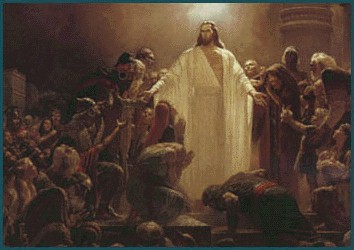
 Keep
your eyes open!...
Keep
your eyes open!...

October 30, 2025
(Mat 25:34-36) Then
shall the king say to them that shall be on his right hand: Come, ye
blessed of my Father, possess you the kingdom prepared for you from the
foundation of the world. For I was hungry, and you gave me to eat: I
was thirsty, and you gave me to drink: I was a stranger, and you took
me in: Naked, and you covered me: sick, and you visited me: I was in
prison, and you came to me.
VIDEO: Hurricane Melissa Live Updates: Scenes Of Ruin Emerge In Jamaica, Cuba As Storm Pummels Caribbean
BBC: Jamaicans take stock after hurricane causes damage, flooding and power cuts
Hurricane Melissa, the strongest
storm to strike Jamaica in modern history, barrelled across the country
on Tuesday, leaving behind a trail of ruin. At its peak, the
hurricane sustained winds of 298 km/h (185 mph) - stronger than
Hurricane Katrina, which devastated New Orleans in 2005 and killed
1,392 people.
Stories of devastation are coming
out - people have shared clips of roads that became rivers, mudslides
on the hills, roofs being ripped from buildings and palm trees tossed
like tooth picks. In the town of Black River on the south-west
coast, police officer Warrell Nicholson was sheltering in the police
station along with some local people despite the building suffering
damage in the storm. "It's been devastating," he told the AFP
news agency.
Further up the coast, Andrew
Houston Moncure was sheltering in the luxury hotel he owns, with his
wife and 20-month-old son. At the height of the hurricane they
barricaded themselves inside the shower, which they fortified with
pillows and blankets. "It was the most terrifying experience,
especially with my son. The pressure is so low you struggle to
breathe, and it just sounds like a freight train going over you," he
told AFP.
An MP in western Jamaica meanwhile
said "it resembled the scene of an apocalypse movie", speaking to
Kingston-based journalist Kimone Francis of The Jamaica Gleaner.
CATHOLIC STANDARD: Hurricane spares Kingston, Jamaica, from worst of its wrath so far, religious brother says
The director of apostolates for a Jamaica-based religious community
serving the poor in Kingston said Oct. 28 that the Category-5
Hurricane Melissa seems to be sparing Kingston the worst of its wrath.
The Missionaries of the Poor, Brother Rebamonte said, are based in the
slums of Kingston and maintain a series of shelters for the homeless,
elderly, mentally disabled, adults and children with disabilities,
pregnant women and others, in addition to offering medical health
services. The order, founded by Father Richard Ho Lung, has a presence
in the Philippines, India, Haiti, Paraguay, Uganda and Kenya.
Because so many of the shelter staff in Kingston sought refuge in
hurricane shelters or relocated out of the area, members of the order
in Kingston are filling in by doing all the work to maintain their
charitable programing throughout the crisis. “The brothers are
sleeping in the shelters because our staff in the shelters are unable
to come to work so we are doing what is necessary and what needs to be
done,” Brother Rebamonte said. “We are grateful for the
protection of God that (Kingston) didn’t get any heavy damage yet.” “I
am hearing of roads being flooded and flooding in coastal
communities. The hurricane is not yet finished; it is still in
Jamaica, and we are expecting it to go away this evening,” he added.
If Hurricane Melissa severely impacts primarily the opposite side of
Jamaica, it may produce a situation where residents there seek refuge
and assistance in the Kingston side of the island, a situation the
brothers are prepared for following the storm. “We have done that in
the past: we have an outreach ministry building reserved for people who
want to take shelter. And the government has worked well
providing people with places of shelter.
CROSS CATHOLIC OUTREACH: Respond to Urgent Needs in the Caribbean
Hurricane Melissa, one of the most powerful Caribbean storms on record,
made landfall in Jamaica as a Category 5 storm on Oct. 28,
bringing 185 mph winds and heavy rainfall. Haiti and the
Dominican Republic also experienced damage, including mudslides,
floods, infrastructure damage and casualties. Families have lost
property, possessions and livelihoods and have a long road to recovery.
Our Catholic ministry partners in Jamaica, the Diocese of Mandeville
and the Compassionate Franciscan Sisters of the Poor, were heavily
impacted. These areas experienced significant damage, including
structural failures, extensive roof damage, washed-out roads, floods,
power outages, and communication disruptions that may last days or
weeks. This storm has also significantly impacted Jamaica’s farms
and agricultural sector, meaning that the food supply could be affected
for months.
That’s why they desperately need your help. Your support will
enable Cross Catholic Outreach to send food, medicines and housing
supplies to our ministry partners in Jamaica, the Dominican Republic
and Haiti.
Our ongoing response includes:
- Jamaica – A shipment of recovery supplies to our ministry
partners impacted by the storm, including the Diocese of Mandeville and
the Compassionate Franciscan Sisters of the Poor.
- Dominican Republic – 2.2 million meals along with cleaning
supplies, clothing, blankets, and over-the-counter cold and flu
medicine through various ministry partners.
- Haiti – 816,480 nutritious Vitafood meals.
Be an instrument of God’s love and
mercy by helping our brothers and sisters across the Caribbean
today. Give generously to help meet their urgent needs!
LINK TO DONATE: https://crosscatholic.org/hurricane-melissa/#donate
Ladder
of Divine Ascent excerpt: Step 4- "On blessed and ever-memorable obedience"
3. Obedience is absolute renunciation of our own
life, clearly expressed in our bodily actions. Or, conversely, obedience
is the mortification of the limbs while the mind remains alive. Obedience
is unquestioning movement, voluntary death, a life free of curiosity, carefree
danger, unprepared defense before God, fearlessness of death, a safe voyage,
a sleeper's progress.

October 27, 2025
(1Pe
4:12-14) Dearly beloved, think not strange the burning heat which is to
try you: as if some new thing happened to you. But if you partake of
the sufferings of Christ, rejoice that, when his glory shall be
revealed, you may also be glad with exceeding joy. If you be reproached
for the name of Christ, you shall be blessed: for that which is of the
honour, glory and power of God, and that which is his Spirit resteth
upon you.
ACN: Religious Freedom: A global victim of authoritarianism, extremism, and war
The international pontifical foundation Aid to the Church in Need (ACN) today launched its biennial report “Religious Freedom in the World 2025,”
offering a global overview of the state of this fundamental
right. The study, covering the period from January 2023 to
December 2024, warns of a worrying decline with two-thirds of humanity
— more than 5.4 billion people — living in countries without full
religious freedom.
The report analyzes the situation
in 196 countries and documents serious violations of this right in 62
of them. Of these, 24 are classified as countries of
“persecution” and 38 as “discrimination.” Only two nations, Kazakhstan
and Sri Lanka, showed improvements compared with the previous edition.
“The right to freedom of thought,
conscience and religion — protected under Article 18 of the Universal
Declaration of Human Rights — is not only under pressure; in many
countries it is disappearing,” warned Regina Lynch, Executive President
of ACN International, during the launch at the Vatican.
The report identifies
authoritarianism as the principal driver of religious repression.
In 19 of the 24 countries in the persecution category, and in 33 of the
38 countries with discrimination, governments apply systematic
strategies to control or silence religious life. In China, Iran,
Eritrea and Nicaragua, the authorities employ mass surveillance
technologies, digital censorship, restrictive legislation and arbitrary
detentions to suppress independent religious communities.
“The control of faith has become a
tool of political power,” states the report’s executive summary, which
denounces an increasingly sophisticated “bureaucratization of religious
repression.”
The report warns that Islamist extremism continues to expand,
particularly across Africa and Asia. In 15 countries, it is the
main cause of persecution, and in another 10, it contributes to
discrimination. The Sahel in Africa has become the epicenter of
jihadist violence with groups such as Islamic State-Sahel Province
(ISSP) and JNIM causing the deaths of hundreds of thousands, the
displacement of millions and the destruction of hundreds of Christian
churches and schools.
Ethno-religious nationalism,
meanwhile, drives the repression of minorities in parts of Asia.
In India and Myanmar, Christian and Muslim communities suffer from
aggression and legal exclusion. In India, the report defines the
situation as “hybrid persecution” — a combination of discriminatory
laws and violence carried out by civilians but encouraged by political
rhetoric.
The decline in religious freedom
has also been aggravated by armed conflicts affecting countries such as
Myanmar, Ukraine, Russia, Israel and Palestine.
Wars and religious-based violence
have triggered a silent displacement crisis. In Nigeria, attacks
by armed groups linked to radicalized Fulani herders have left
thousands dead and entire communities uprooted. In the Sahel —
especially in Burkina Faso, Niger and Mali — whole villages have been
destroyed by Islamist militias. In Sudan, civil war has wiped
centuries-old Christian communities off the map.
CWR: Nigerian church leaders welcome conclusions confirming Christian genocide
Church leaders in Nigeria say they
are gladdened at the conclusion reached by a U.S. fact-finder
that there is a systematic plan to erase Christianity in the African
country.
Mike Arnold, on October 14th,
presented his findings on a decade-long campaign of violence targeting
Christians in Nigeria. The former mayor of Blanco City, Texas,
said he had been gathering the information since 2019.
Reading from a prepared statement
titled “Statement on Widespread Violence and Displacement in Nigeria,”
Arnold said that “villages are systematically razed, churches leveled,
and tens of thousands are dead.” He pushed back on the claim that puts
down the violence to a fight between farmers and grazers over resources.
“This is systematic terror and not
grazing conflicts,” he said, “…the term farmer herder clashes, in many
instances today, are cynical doublespeak. Weaponizing historical
land disputes to mask jihadist conquest. For centuries, herders
and farmers co-existed with rare, very rarely lethal disputes.” Citing
Article II of the UN Genocide Convention, Arnold asserted that the
situation in Nigeria meets the legal threshold for genocide.
“The campaign of violence and
displacement in northern and middle belt Nigeria does indeed constitute
a calculated current and long-running genocide against Christian
communities and other religious minorities without any reasonable
doubt. To continue to deny this is to be complicit with these
atrocities,” he asserted.
He said that denying the existence of genocide against Christians bolsters the resolve of the perpetrators to do even worse.
“To continue to deny this is to be complicit with these atrocities, I say this not in anger, but in truth and grief.”
X REP. MOORE: “A Real Genocide is Happening- 'Christians are Being Slaughtered
While headlines obsess over Gaza and Ukraine, a full-scale genocide is unfolding in Nigeria, and barely anyone cares.
Entire villages torched. Churches turned to ash. Families hunted for their faith.
Since 2009, more than 100,000 Christians have been killed by Boko Haram, ISIS-West Africa, and Fulani militants.
19,000 churches destroyed.
7,000 more Christians murdered this year alone.
35 people a day, wiped off the map.
The Nigerian government calls it “fake news.” @RileyMooreWV calls it Genocide.
He is demanding the U.S. reclassify Nigeria as a Country of
Particular Concern, a move that once slowed the killings, but was
quietly reversed under Biden.
Moore says this is not random violence. It is deliberate, ideological, and ignored.
“These are genocidal numbers, and the silence is shameful.” He also
warns China is waiting in the wings, using Africa’s instability to
tighten its grip through money, weapons, and influence while the West
looks away.
When war hits Europe, the world protests.
When it hits Africa, the world scrolls past.
The genocide in Nigeria is real. The blood is fresh. And the silence is deafening.
Ladder
of Divine Ascent excerpt: Step 4- "On blessed and ever-memorable obedience"
2. But let us not fail, if you agree, to describe
clearly in our treatise the weapons of these brave warriors: how they hold
the shield of faith in God and their trainer, and with it they ward off,
so to speak, every thought of unbelief and change of place; how they constantly
raise the drawn sword of the Spirit and slay every wish of their own that
approaches them; how, clad in the armour of meekness and patience, they
avert every insult and injury and missile. And for a helmet of salvation
they have their superior's protection through prayer. And they do not stand
with their feet together, for one is stretched out in service and the other
is immovable in prayer.
October 24, 2025
(Heb
3:12-14) Take heed, brethren, lest perhaps there be in any of you an
evil heart of unbelief, to depart from the living God. But exhort one
another every day, whilst it is called to day, that none of you be
hardened through the deceitfulness of sin. For we are made partakers of
Christ: yet so, if we hold the beginning of his substance firm unto the
end.
ENCYCLICAL OF POPE PIUS XI ON REPARATION TO THE SACRED HEART: Prayer of Reparation
THE SHIELD OF FAITH: The Scribes and Pharisees of the Church hierarchy
St. Peter was
martyred for being a Christian who would not pray to Emperor Nero’s
false gods. Today at the saint’s burial site, worship of false gods is
now permitted. What is worse, the false god who is worshiped there is
responsible for the martyrdom of a Christian every hour of every day
throughout the world. That’s right, Islamic Jihadists kill a Christian
every hour on average.
Historically the Vatican was built
over the burial place of St. Peter, the first Pope. Today the papal
altar in St. Peter's Basilica stands directly above the traditional and
archaeological site of the saint's tomb.
Catholic News Agency has verified that the Vatican Apostolic Library
has granted the request by Muslim scholar's for a carpeted prayer room [Link] Here they can pray to their god, who presides over the daily murder and persecution of Christians worldwide.
VIA X Diane Montagna @dianemontagna: Walking Together in Hope: 60th Anniversary of the Conciliar Declaration Nostra Aetate
Vatican’s Interreligious Dialogue & Commission for Religious
Relations with Judaism announces it will host an Oct 28 event to
celebrate the 60th anniversary of the Vatican II Declaration Nostra
Aetate on the Church’s relations with non-Christian religions.
According to the statement, “Leaders and representatives of Judaism,
Islam, Hinduism, Jainism, Sikhism, Buddhism, Zoroastrianism,
Confucianism, Taoism, Shintoism & traditional African religions
will gather together with members of the Roman Curia, the Diplomatic
Corps accredited to the Holy See, Catholic delegates engaged in
interreligious dialogue, scholars, interreligious networks and young
people from around the world. The program will include music, personal
testimonies & cultural performances celebrating unity amidst
diversity.
The highlight of the event will be the address by His Holiness Pope Leo
XIV, followed by a silent prayer for peace. The meeting will give new
impetus to the shared mission of planting seeds of dialogue and hope
for future generations.”
Full statement here: https://press.vatican.va/content/salastampa/en/bollettino/pubblico/2025/10/23/251023d.html
VIA X Arcivescovo Carlo Maria Vigan� @CarloMVigano: Ecumenical Prayer, October 23, 2025 – Pope Leo XIV
Thousands of martyrs massacred by the anti-Catholic fury of Henry VIII,
Edward VI, Elizabeth I, James I, Charles I and Charles II must be
wondering – incredulous – how it is possible that the current successor
of Clement VII communicates in sacris with the head of the Church of
England (who is also divorced and remarried like the bloodthirsty
Tudor) and with lay heretics dressed up as prelates. And Charles III,
in addition to being a heretic like Henry VIII, is also a Freemason, a
neo-Malthusian, and openly aligned with the elite of the New World
Order.
If Clement VII headed the Catholic
Church, what kind of church does Leo head, a church that with both
words and actions disavows and betrays the entire Magisterium of the
Popes up to Pius XII and tramples on the heroic witness of English
Catholics during the Anglican persecution?
The ecumenical-environmentalist
prayer in the Sistine Chapel sanctions the abdication of the Roman
Papacy and the humiliation of the Catholic Church before a heretical,
concubine-keeping, globalist Freemason, who retains the title of
Defensor Fidei while prostrating himself before Islam and celebrating
Mohammedan festivals.
These aberrations lead us to believe that the end times are near and
that the apostasy in the Church announced by the Virgin Mary at Fatima
has already begun.
VIDEO LINK: https://www.youtube.com/watch?v=pzSozqRiX1M
Ladder
of Divine Ascent excerpt: Step 4- "On blessed and ever-memorable obedience"
1. Our treatise now appropriately touches upon
warriors and athletes of Christ. As the flower precedes the fruit, so exile,
either of body or will, always precedes obedience. For with the help of
these two virtues, the holy soul steadily ascends to Heaven as upon golden
wings. And perhaps it was about this that he who had received the Holy
Spirit sang: Who will give me wings like a dove? And I will fly by activity,
and be at rest by divine vision and humility.
October 21, 2025
On Capital Punishment
Anne Lastman, founder of VICTIMS OF ABORTION,
has kindly shared many of her prolife articles with this site.
Anne Lastman is a qualified post abortion grief counsellor and sexual
abuse counsellor who has worked in this area for nearly 30 years.
Over her time, Anne has developed a recovery strategy, which works well
for those who persevere with the programme. Anne continues to
study post abortion grief and the related, sexual abuse grief, which
manifest with similar symptoms. Anne not only counsels (generally
from a Catholic/Christian perspective), but speaks and writes on
matters of post abortion trauma and grief, and travels the world
speaking on this issue. Anne also speaks and counsels those who
have suffered sexual abuse, which is often found underpinning the
multiple abortion woman.
Anne was a close personal friend of Cardinal Pell as can be seen from this excerpt from an article
describing Cardinal Pell's hellish experience in prison: " ‘I tried to
visit several times but I was turned away,’ says Anne Lastman, Pell’s
close friend from Perth who had attended much of the court proceedings.
‘It broke my heart knowing he was in there, locked up and alone.’"
In short, Anne is a lioness in defense of life, freedom, and the Catholic faith.
With her background it is to be expected that
Anne is in complete agreement with Pope Leo's recent comments related
to capital punishment:
Pope Leo XIV criticized supporters of the death penalty Tuesday, saying
they are “not really pro-life.” “Someone who says, ‘I’m against
abortion’ but says, ‘I’m in favor of the death penalty,’ is not really
pro-life,” the pope told reporters, via EWTN News.
Most recently Anne shared her thoughts in an article titled "Pope Leo and the Crises Death Penalty".
As you will see upon reviewing the article she is in vehement
disagreement with the recently published opinion in a Crisis Magazine
article, Pope Leo and the Death Penalty Charade.
Pope Leo's view is an extension of
that of his predecessor Pope Francis which is expounded upon at length
in the Patheos article "Pope Francis, The Death Penalty & The Radical Hope of Christ". It was indeed Pope Francis who updated the Catholic Catechism section on capital punishment:
BEFORE REVISION: 1992 2266-2267:
“Preserving the common good of society requires rendering the aggressor
unable to inflict harm. For this reason, the traditional teaching
of the Church has acknowledged as well-founded the right and duty of
the legitimate public authority to punish malefactors by means of
penalties commensurate with the gravity of the crime, not excluding, in
cases of extreme gravity, the death penalty” (CCC 2266). However,
“If bloodless means are sufficient to defend human lives against an
aggressor and to protect public order and the safety of persons, public
authority should limit itself to such means because they better
correspond to the concrete conditions of the common good and are more
in conformity to the dignity of the human person” (CCC 2267).
AFTER REVISION:
2018 2266-2267:
"The efforts of the state to curb the spread of behavior harmful to
people's rights and to the basic rules of civil society correspond to
the requirement of safeguarding the common good. Legitimate
public authority has the right and duty to inflict punishment
proportionate to the gravity of the offense. Punishment has the
primary aim of redressing the disorder introduced by the offense.
When it is willingly accepted by the guilty party, it assumes the value
of expiation. Punishment then, in addition to defending public
order and protecting people's safety, has a medicinal purpose: as far
as possible, it must contribute to the correction of the guilty party(CCC 2266).
Recourse to the death penalty on the part of legitimate authority,
following a fair trial, was long considered an appropriate response to
the gravity of certain crimes and an acceptable, albeit extreme, means
of safeguarding the common good. Today, however, there is an increasing
awareness that the dignity of the person is not lost even after the
commission of very serious crimes. In addition, a new
understanding has emerged of the significance of penal sanctions
imposed by the state. Lastly, more effective systems of detention
have been developed, which ensure the due protection of citizens but,
at the same time, do not definitively deprive the guilty of the
possibility of redemption. Consequently, the Church teaches, in the
light of the Gospel, that “the death penalty is inadmissible because it
is an attack on the inviolability and dignity of the person”,68 and she
works with determination for its abolition worldwide.(CCC 2267)
Capital Punishment in Scripture and Tradition
(Rom 13:3-4) For
princes are not a terror to the good work, but to the evil. Wilt thou
then not be afraid of the power? Do that which is good: and thou shalt
have praise from the same. For he is God's minister to thee, for good.
But if thou do that which is evil, fear: for he beareth not the sword
in vain. For he is God's minister: an avenger to execute wrath upon him
that doth evil.
Archbishop Chaput shared his thoughts on capital punishment in this excerpt from a CNS article:
Archbishop
Charles Chaput clarified the Catholic Church's often misunderstood
teaching on the death penalty, saying that in almost all cases today,
it goes beyond necessity, and into undignified excess.
He compared the Church's teaching on the death penalty to that on acts
like abortion, genocide and euthanasia, saying that in the comparison,
there is an inequality.
"The death penalty", he wrote, "is not intrinsically evil. Both
Scripture and long Christian tradition acknowledge the legitimacy of
capital punishment under certain circumstances. The Church cannot
repudiate that without repudiating her own identity."
"Catholic teaching on euthanasia, the death penalty, war, genocide and
abortion," the archbishop said, "are rooted in the same concern for the
sanctity of the human person. But these different issues do not
all have the same gravity or moral content. They are not
equivalent."
He used war as an applicable example, noting that there are cases in
which acts of war are morally legitimate--similar to the death penalty.
However, he pointed out, what the Church's teaching on the death
penalty involves is, "a call to set aside unnecessary violence,
including violence by the state, in the name of human dignity and
building a culture of life."
"In the wake of the bloodiest century in history," Archbishop Chaput
said, "the Church invites us to recover our own humanity by choosing
God's higher road of restraint and mercy instead of state-sanctioned
killing that implicates all of us as citizens."
He cited the Catechism of the Catholic Church, which states that if
"non-lethal means are sufficient to defend and protect people's safety
from the aggressor [i.e., the convicted murderer], authority [should]
limit itself to such means, as these are more in keeping with the
concrete conditions of the common good and more in conformity with the
dignity of the human person" (2267).
Likewise, he quoted John Paul II, who points out in his Gospel of Life,
that "the nature and extent of the punishment [for capital crimes] must
be carefully evaluated and decided upon, and ought not to go to the
extreme of executing the offender except in cases of absolute
necessity; in other words, when it would not be possible otherwise to
defend society."
The late Pope noted that "today however, as a result of steady
improvements to the organization of the penal system, such cases are
very rare, if not practically non-existent."
The archbishop stressed that "(i)n modern industrialized states,
killing convicted murderers adds nothing to anyone's safety. It
is an excess."
A thorough discussion of the
historical view of the Magisterium on capital punishment is beyond the
scope of this review but can be readily ascertained through the
following online sources:
A Practical Perspective on Capital Punishment
The Paschal Mystery
(Mat
16:21-23) From that time Jesus began to shew to his disciples, that he
must go to Jerusalem, and suffer many things from the ancients and
scribes and chief priests, and be put to death, and the third day rise
again. And Peter taking him, began to rebuke him, saying: Lord, be it
far from thee, this shall not be unto thee. Who turning, said to Peter:
Go behind me, Satan, thou art a scandal unto me: because thou savourest
not the things that are of God, but the things that are of men.
(Joh
12:24-25) Amen, amen, I say to you, unless the grain of wheat falling
into the ground die, Itself remaineth alone. But if it die it bringeth
forth much fruit.......
Our Lord foretold to His disciples
that it would be through His passion, death, and resurrection that He
would bring salvation and eternal life to those who placed their trust
in Him. When Peter rebuked Him, Peter was in turn rebuked for thinking
not as God but as man. God used Jesus's terrible capital punishment as
a tool for the salvation of mankind. Upon His death, a death that
was willingly accepted (Eucharistic Prayer II) the Lord preached to
those spirits that were in prison (1Pe 3:19) and opened up the gates of
heaven forever.
(Joh
19:10-11) Pilate therefore saith to him: Speakest thou not to me?
Knowest thou not that I have power to crucify thee, and I have power to
release thee? Jesus answered: Thou shouldst not have any power against
me, unless it were given thee from above......
Jesus
asserts that Pilate's authority to crucify Him was ordained from above
and not simply a product of circumstance. Though Pilate had the
free will to decide otherwise—as urged by his wife's plea—he chose to
yield to the demands of the chief priests and Sanhedrin leaders,
carrying out the execution.
But what if Pilate had decided to be
merciful, release Barabbas, but—rather than death—sentence Jesus to
life imprisonment without the possibility of parole, even for good
behavior?
Saint Dismas
(Luk
23:42-43) And he said to Jesus: Lord, remember me when thou shalt come
into thy kingdom. And Jesus said to him: Amen I say to thee: This day
thou shalt be with me in paradise.
When crucified at the right hand of the Lord, Saint Dismas acknowledged
his sinfulness, repented and asked the Lord for his personal
salvation. The cross was his vehicle to eternal life.
One must wonder whether, in less
modern and earth-centered times, the threat of impending capital
punishment led condemned prisoners to confession and repentance. In prior
eras, the knowledge of the faith watered by the seed of Baptism would
likely have produced a fear of eternal damnation that itself would have
led to contrition. How many murderers and other criminals saved
their souls for eternity through the sacrament of penance immediately
prior to their earthly demise? Is it truly merciful to deny those
condemned to death this opportunity and instead subject them to
imprisonment for the remainder of their days? How many would
choose to use their remaining time to turn to the Lord if not facing a
final deadline?
Via the Catechism:
1013 Death is the end of man's earthly
pilgrimage, of the time of grace and mercy which God offers him so as
to work out his earthly life in keeping with the divine plan, and to
decide his ultimate destiny. When "the single course of our
earthly life" is completed, we shall not return to other earthly lives:
"It is appointed for men to die once." There is no "reincarnation"
after death.
1014 The Church encourages us to prepare ourselves for the hour of our
death. In the ancient litany of the saints, for instance, she has
us pray: "From a sudden and unforeseen death, deliver us, O Lord"; to
ask the Mother of God to intercede for us "at the hour of our death" in
the Hail Mary; and to entrust ourselves to St. Joseph, the patron
of a happy death.
Ananias and Sapphira
(Act
5:1-11) But a certain man named Ananias, with Saphira his wife, sold a
piece of land, And by fraud kept back part of the price of the land,
his wife being privy thereunto: and bringing a certain part of it, laid
it at the feet of the apostles. But Peter said: Ananias, why hath Satan
tempted thy heart, that thou shouldst lie to the Holy Ghost and by
fraud keep part of the price of the land? Whilst it remained, did it
not remain to thee? And after it was sold, was it not in thy power? Why
hast thou conceived this thing in thy heart? Thou hast not lied to men,
but to God. And Ananias, hearing these words, fell down and gave up the
ghost. And there came great fear upon all that heard it. And the young
men rising up, removed him, and carrying him out, buried him. And it
was about the space of three hours after, when his wife, not knowing
what had happened, came in. And Peter said to her: Tell me, woman,
whether you sold the land for so much? And she said: Yea, for so much.
And Peter said unto her: Why have you agreed together to tempt the
spirit of the Lord? Behold the feet of them who have buried thy husband
are at the door: and they shall carry thee out, Immediately, she fell
down before his feet and gave up the ghost. And the young men coming in
found her dead: and carried her out and buried her by her husband. And
there came great fear upon the whole church and upon all that heard
these things.
Haydock's Catholic Bible Commentary:
There are likewise different opinions among the Fathers, respecting the
salvation of Ananias and Saphira. Some are of opinion, that as
their fault was great, they died, and perished in their sin. but
the ideas we are fond to cherish of the infinite mercy of God, would
rather incline us to say, with St. Augustine, "I can believe that
God spared them after this life, for his mercy is great.
... They were stricken with the scourge of death, that they might
not be subject to eternal punishment." (St. Augustine,
Serm. cxlviii. olim. 10. et in Parmen.) ---
St. Benedict also, in the 57th chapter of his rule, insinuates,
that their death was only corporal. (Haydock) --- It is not
unreasonable, that the first violators of laws, should be punished with
severity. It was thus that the Almighty treated Adam, the adorers
of the golden calf, the first who broke the sabbath-day, &c.
to prevent the effects of bad example. (Calmet)
Via Got Questions:
The sad story of Ananias and Sapphira is not some obscure incident from
the Old Testament regarding a violation of Mosaic Law. This
occurred in the first-century church to believers in Jesus
Christ. The story of Ananias and Sapphira is a reminder to us
today that God sees the heart (1 Samuel 16:7), that He hates sin, and
that He is concerned for the purity of His church (1 Corinthians 11; 1
John 5). As Jesus told the compromising church in Thyatira, “All
the churches will know that I am he who searches hearts and minds, and
I will repay each of you according to your deeds” (Revelation 2:23).
The Book of Daniel
The Book of Daniel illustrates diverse
examples of the authority of God in the ultimate administration of
capital punishment. There are three prominent examples of divine
intervention over individuals who had been condemned to capital
punishment.
1. The Fiery
Furnace (Daniel 3)- King Nebuchadnezzar of Babylon erects a massive
golden statue and decrees that all must bow down and worship it upon
hearing certain music, under penalty of death in a blazing
furnace.Three Jewish exiles—Shadrach, Meshach, and Abednego—refuse to
comply, citing their unwavering faith in God alone. Enraged, the
king orders the furnace heated seven times hotter than usual and has
the men bound and thrown in, yet they emerge unharmed, with not even
the smell of smoke on them; a fourth figure, described as like a son of
the gods, is seen walking with them in the flames. Astonished,
Nebuchadnezzar praises their God and promotes the three men.
2. Daniel in the
Lion's Den (Daniel 6)- Under King Darius of Persia, Daniel rises to a
top position in the kingdom due to his exceptional qualities, sparking
jealousy among other officials who scheme to undermine him. They
convince the king to issue an irrevocable decree that for 30 days,
prayers may be directed only to Darius himself, with violators thrown
into a den of lions. Faithful to his God, Daniel continues his
daily prayers openly, leading to his arrest and consignment to the
lions' den, where Darius spends a sleepless night in remorse. At
dawn, he finds Daniel unharmed, declaring that God had sent an angel to
shut the lions' mouths; the king then has the schemers and their
families thrown in, where they are devoured, and issues a proclamation
honoring Daniel's God.
3. The Story of Susanna Falsely Accused (Daniel 13)- In
Babylon, Susanna, a beautiful and pious Jewish woman married to the
wealthy Joakim, catches the eye of two corrupt elders who frequently
visit their home. Lusting after her, they spy on her bathing in
the garden and threaten blackmail: submit to them or face false
accusations of adultery with a young man. When Susanna refuses,
preferring death over sin, the elders accuse her publicly, leveraging
their status as judges to sway the assembly and condemn her to death by
stoning. As she laments, the young Daniel is inspired by God to
intervene, demanding separate trials for the elders; through clever
cross-examination about the tree under which they claim to have
witnessed the supposed act, their testimonies contradict (one says
mastic, the other oak), exposing their perjury. The elders are
executed under Mosaic law, Susanna is exonerated and praised, and
Daniel gains renown for his wisdom.
Witness of Martyrs
(Luk
12:4-5) And I say to you, my friends: Be not afraid of them who kill
the body and after that have no more that they can do. But I will
shew you whom you shall fear: Fear ye him who, after he hath killed,
hath power to cast into hell. Yea, I say to you: Fear him.
Pope Leo XIV:
“We cannot and do not want to forget,” he said. “Just as in the
first centuries, so too in the third millennium, the blood of the
martyrs is the seed of new Christians.”
Via Catholic Straight Answers:
The spiritual rationale which undergirds the act of martyrdom is one
that each Christian must accept. In teaching the conditions for
true discipleship, our Lord asserted, “If a man wishes to come after
me, he must deny his very self, take up his cross, and begin to follow
in my footsteps. Whoever would save his life will lose it, but
whoever loses his life for my sake will find it. What profit
would a man show if he were to gain the whole world and destroy himself
in the process?” (Matthew 16:24-26). Yes, the Christian must be
prepared to bear the cross of our Lord, even if it means forsaking life
in this world.
In doing so, however, such a Christian will be blessed in the eyes of
God. In the Beatitudes, those right attitudes of living that
bring blessed union with God, the eighth beatitude is repeated, “Blest
are those persecuted for holiness’ sake; the reign of God is theirs.”
Moreover, Jesus personalized this beatitude: “Blest are you when they
insult you and persecute you and utter every kind of slander against
you because of me.” Nevertheless, the point is not just the suffering
here and now for the faith, but the courageous perseverance which gives
way to everlasting life: “Be glad and rejoice, for your reward is great
in Heaven.” (Confer Matthew 5:10-12.)
This spiritual rationale is reflected beautifully in the testimony of
the martyrs of our early Church during the time of Roman
persecution. For example, St. Ignatius of Antioch (d.
110), who was the third bishop of Antioch following St. Evodius
(who had succeeded St. Peter the Apostle), and who had been a
student of St. John the Apostle, was condemned by the Emperor
Trajan and sentenced to being devoured by beasts in the arena. On
the way to Rome where he would die, he wrote seven letters, including
one to the Romans, in which he reflected on his pending death: “Allow
me to be eaten by the beasts, which are my way of reaching God. I
am God’s wheat, and I am to be ground by the teeth of wild beasts, so
that I may become the pure bread of Christ,” and later “Neither the
pleasures of the world nor the kingdoms of this age will be of any use
to me. It is better for me to die in order to unite myself to
Christ Jesus than to reign over the ends of the earth. I seek Him
who died for us; I desire Him who rose for us. My birth is
approaching…” (Letter to the Romans).
Another great witness to the faith during this time was St.
Polycarp, the Bishop of Smyrna, who was a friend of St. Ignatius
and who had also been a student of St. John the Apostle and had
been consecrated a bishop by him. For refusing to offer sacrifice
to the Roman gods and to acknowledge the divinity of the Emperor,
St. Polycarp was condemned to death by burning at the stake at
the age of eighty-six during the reign of Emperor Marcus
Aurelius. As the pyre was about to be lit, St. Polycarp
prayed, “I bless you for having judged me worthy from this day and this
hour to be counted among your martyrs…. You have kept your
promise, God of faithfulness and truth. For this reason and for
everything, I praise you, I bless you, I glorify you, through the
eternal and heavenly High Priest, Jesus Christ, your beloved Son.
Through Him, who is with you and the Holy Spirit, may glory be given to
you, now and in the ages to come. Amen.” (The Martyrdom of
St. Polycarp).
Conclusion
Anne Lastman’s opposition to the death
penalty, as expressed in her critique of pro-capital punishment
arguments, aligns with the Catholic Church’s recent emphasis on mercy,
as seen in Pope Francis’s 2018 Catechism revision declaring the death
penalty “inadmissible” in light of modern penal alternatives and human
dignity. Her perspective, informed by decades of counseling those
grappling with post-abortion and sexual abuse grief, underscores the
potential for redemption even in the gravest sinners. Scriptural
examples, such as Saint Dismas’s repentance on the cross and the divine
justice meted out to Ananias and Sapphira, highlight the transformative
power of facing mortality under God’s authority. While these
insights urge a preference for mercy, the Magisterium’s consistent
historical teaching affirms that the death penalty is not intrinsically
evil and may be appropriate in certain circumstances, balancing the
demands of justice with the call to safeguard society and uphold the
sanctity of life.
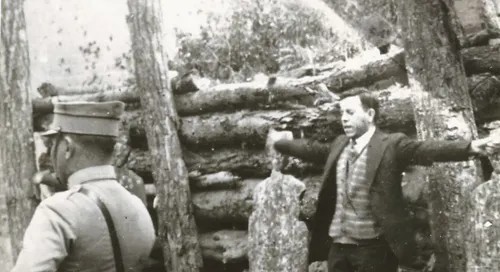
‘�Viva Cristo Rey!’ was the final
confession on the lips of Blessed Miguel Agust�n Pro, one of a number
of martyrs of the Mexican Cristeros war. The firing squad delivered him
into the loving arms of his Savior!
Ladder
of Divine Ascent excerpt: Step 3- "On Exile or Pilgrimage"
11 (cont.). Run from Egypt without looking back;
because the hearts which look back upon it with affection shall not see
Jerusalem, the land of dispassion. Those who left their own people in childlike
simplicity at the beginning, and have since been completely purified,
may profitably return to their former land, perhaps even with the intention,
after saving themselves, of saving others too. Yet Moses, who was allowed
to see God Himself and was sent by God for the salvation of his own people,
met many dangers in Egypt, that is to say, dark, periods in the world.
October 15, 2025
(1Th 5:17) Pray without ceasing.
FATHER ALTIER HOMILY: Center your life on Christ
SUBSTACK: Persistence in Prayer
FATHER JEFFREY KIRBY: Prayer is the blood pressure of the soul
There are many mysteries and
challenges surrounding prayer. As a help to navigating these
realities, the Catechism of the Catholic Church gives us three facts
about prayer: 1) It is always possible to pray; 2) Prayer is a
necessity; and 3) Prayer and Christian life are inseparable.
Our hearts were made for God, and
so wherever our hearts find themselves – no matter the location or the
time – they’re able to turn to God and pray. There is no place or
time that can ban or bar the prayer of God’s people.
The Catechism teaches: “It is
always possible to pray: the time of the Christian is that of the risen
Christ who is with us always, no matter what tempests may arise.
Our time is in the hands of God.”
Saint John Chrysostom explains: “It is possible to offer fervent prayer
even while walking in public or strolling alone, or seated in your
shop, . . . while buying or selling, . .
. or even while cooking.”
Since prayer can be made and offered anywhere, we are called to readily
avail ourselves of its comfort and grace. Life cannot be lived
well without grace and prayer is an active channel to receive the grace
we need in the joys and struggles of our lives.
Prayer should not be seen as an
option. We need prayer just like we need food and oxygen.
In our secular age, we have forgotten this pressing truth. As
believers, we need to counteract the influence of secularism and turn
quickly to the power of prayer.
The Catechism teaches: “Prayer is a
vital necessity. Proof from the contrary is no less convincing:
if we do not allow the Spirit to lead us, we fall back into the slavery
of sin. How can the Holy Spirit be our life if our heart is far
from him?”
The way of grace is the way of prayer. The abundant life is only
found in the mystery of prayer. As believers, we need to live and
give witness to the urgency and power of prayer. Rather than
follow the path of secularism, which denies the existence of God and
the reality of grace, we are called to quickly turn to prayer and drink
from its rich wellsprings.
Without prayer, the darkness and
meaninglessness of sin rule our lives. Without prayer, nihilism
blankets our hearts with darkness. Without prayer, we endlessly
follow our own paths in a circular motion devoid of love and
purpose. Prayer lifts our hearts, empowers our souls, and helps
us to encounter God and know of his love.
The Catechism reminds us: “Nothing
is equal to prayer; for what is impossible it makes possible, what is
difficult, easy…. For it is impossible, utterly impossible, for
the man who prays eagerly and invokes God ceaselessly ever to sin.”
MORE: When our faith is exposed, we see how we’re approaching prayer
EXCERPT CRISIS MAGAZINE: Toward Traditional Catholic Spirituality
Put together, all the teachings of Our Lady at her appearances and the
message are always the same. The message is extremely simple but
infinitely profound: we are all called to continual Repentance,
personal Prayer, and daily Sacrifices. Then we take these
sacrifices with us to Mass each Sunday to be united with the supreme
Sacrifice of our Redeemer. These Sacrifices—made to God in, with,
and through Christ—enable us to receive our Father’s Love in return, to
the measure of our inner spiritual capacity to receive it. This
is the only active participation that really matters. Then we
must use the divine love that we have received at Sunday Mass to make
each day the Mass, through continual daily Repentance, Prayer, and
Sacrifice.
This is the profound, ongoing, mystical dynamic that enables each one
of us to imitate the spiritual life that was lived by Our Lord Himself
when He was on Earth—then to do this with such regularity and
perseverance that our daily lives become the Mass, the place where we
continually offer ourselves in, with, and through Christ to the Father,
in all that we say and do. That is why our Morning Offering—which
we know Christ Himself said, in a prayer that the Jews call the
Shema—is crucial to remind us of the very essence of our daily
spiritual lives in which we exercise the priesthood to which we were
called at Baptism.
This is the profound mystical and daily dynamic that gradually enables
our heartbeats to synchronize with the heartbeats of Christ—as together
with Him, in Him, and through Him we are united with our loving Father,
who created us for this very purpose, beginning in this life and
continuing to eternity in the next life.
However, we are, it seems, at all times surrounded by the usual
culprits who muddy the waters for themselves and others with their
inevitable skepticism, questioning the veracity of any or all the
appearances of Our Lady no matter how cast-iron the evidence. Let
me quote from one of the visionaries who was weary of their
incredulity. She said what really matters is the message, even if
all the signs and miracles and the appearances of Our Lady herself are
denied. Why? Because it is the simple message of the
Gospels. It is the True Catholic Traditional Spirituality that
was first lived by Our Lord Jesus Christ Himself, beginning at Nazareth
and continuing throughout His life on earth, ending with His death and
glorification.
Then see how it was put into practice by the faithful in the early
Church that He founded. Study this simple teaching, love it, live
it, and you will be living the very essence of True Traditional
Catholic Spirituality. It is sadly not precisely the same
tradition as practiced by our parents and grandparents that so many
believe to be the tradition to which we must return. If it was,
why did Our Lady have to appear?
Ladder
of Divine Ascent excerpt: Step 3- "On Exile or Pilgrimage"
11. When we have lived a year or two away from
our family, and have acquired some piety or contrition or continence, then
vain thoughts begin to rise up in us and urge us to go again to our homeland,
'for the edification of many', they say, 'and as an example, and for the
profit of those who saw our former lax life'. And if we possess the gift
of eloquence and some shreds of knowledge, the thought occurs to us that
we could be saviours of souls and teachers in the world, that we may waste
in the sea what we have gathered so well in the harbour. Let us try to
imitate not Lot's wife, but Lot himself. For when a soul turns back to
what it has left, like salt, it loses its savour and becomes henceforth
useless.
October 13, 2025
(Mat
11:28-29) Come to me all you that labor and are burdened, and I will
refresh you. Take up my yoke upon you, and learn of me, because I am
meek, and humble of heart: And you shall find rest to your souls.
POPE LEO XIV:
“We cannot build a just society if we discard the weakest—whether the
child in the womb or the elderly in their frailty—for they are both
gifts from God.”
ANNE LASTMAN VICTIMS OF ABORTION: Abortion Grief Following Abortion for foetal anomalies
VIDEO: Healing the Deepest Wounds a Pastoral Guide to Abortion, Trauma and Grief
RELIGION UNPLUGGED: The Unheard Voices: Men’s Untold Struggles with Post-Abortion Grief
X: Pope Leo, the Culture of Death, and the Crisis of Our Age
Pope Leo XIV said it without hesitation: You cannot be Catholic and
pro-abortion. To defend the killing of the unborn is to side with the
one Christ Himself named “a murderer from the beginning.”
The culture of death begins in the womb. When a society sanctions the
slaughter of its most innocent, it teaches that life is conditional,
negotiable, and disposable.
The logic of abortion is the logic of murder. If a nation sanctions the
slaughter of a child in the womb, it has already signed the death
warrant for the child in the classroom. Both are the same rebellion
against God—the same bloodlust, the same Satanic lie.
This is the hypocrisy of our age. We wail over bloodshed in schools,
yet turn a blind eye to rivers of blood in abortion clinics. We grieve
dead children on Monday, while celebrating their destruction on Tuesday
in the name of “choice.” It is the same lie, the same evil, the same
culture of death.
America calls itself exceptional. And it is—but not because of wealth
or armies. America was exceptional because it once knew liberty flows
from God, not man.
That truth has been abandoned.
Freedom without God has become license.
Exceptionalism without virtue has become decadence.
Yet America is not lost—for her hope does not rest in politics or
power, but in Jesus Christ, who remains the only source of her renewal.
Here, the Catholic Church must speak with clarity. Catholic
exceptionalism is not arrogance. It is the recognition that Christ
entrusted His Church with the fullness of truth and the power of the
sacraments.
For two thousand years, when governments failed and ideologies collapsed, the Church held the line, and still does so today.
The sacraments are not empty rituals. The Mass is the sacrifice of
Calvary made present. The Eucharist is Christ Himself. Confession is
the battlefield hospital for the soul. Marriage sanctifies the
family—the very foundation of civilization. These are not symbols. They
are weapons against hell.
And this is hell’s hour. Abortion is Satanic. School shootings are
Satanic. The entire culture of death is Satanic. Politicians blame
guns. Activists shout slogans.
But the real crisis is sin, and the only answer is Christ.
To be Catholic is to be pro-life without compromise or apology.
Anything less is betrayal. This is the line that separates light from darkness, life from death, Christ from Satan.
The world must know where we stand.
BLOG: Luisa Piccarreta and the Feast of Divine Maternity
Ladder
of Divine Ascent excerpt: Step 3- "On Exile or Pilgrimage"
10. Be on the look-out for this trick and wile
of the thieves. For they suggest to us that we need not separate ourselves
from people in the world, and maintain that we shall receive a great reward
if we can look upon women and still remain continent. We must not believe
these suggestions, but rather the opposite.
October 9, 2025
(Mat 5:9) Blessed are the peacemakers: for they shall be called the children of God.
(Luk 6:20-21)
And he, lifting up his eyes on his disciples, said: Blessed are ye
poor: for yours is the kingdom of God. Blessed are ye that hunger now:
for you shall be filled. Blessed are ye that weep now: for you shall
laugh.
THE CATHOLIC REGISTER: Israel, Hamas sign off on first phase of peace proposal
LATIN PATRIARCHATE OF JERUSALEM: Press Release Latin Patriarchate of Jerusalem On the Announcement of an Agreement in Gaza
The Latin
Patriarchate of Jerusalem welcomes with joy the announcement of an
agreement that envisages a cessation of the attacks in the Gaza Strip
and the immediate release of the hostages, as well as that of
Palestinian prisoners. The Patriarchate ardently hopes that this
accord will be fully and faithfully implemented, so that it may mark
the beginning of the end of this terrible war. It also stresses
the absolute urgency of immediate humanitarian relief and the
unconditional entry of sufficient aid to Gaza’s suffering
population. Above all, the Patriarchate prays that this step may
open a path of healing and reconciliation for both Palestinians and
Israelis.
His Beatitude Cardinal Pierbattista Pizzaballa, Latin Patriarch of Jerusalem, declared: “It is good news, and we are very
happy. It is a first step, the first phase. Of course,
there are many others, and surely there will be other obstacles.
But now we have to rejoice about this important step that will bring a
little more trust for the future and also bring new hope, especially to
the people, both Israeli and Palestinians.” “Now we finally see
something new and different. Of course, there will also be a new
atmosphere for the continuation of negotiation, also for all the life
inside Gaza that will remain terrible for a long time. But now we
are happy and we hope that this is just the beginning of a new phase
where we can, little by little, start thinking not about war, but about
how to rebuild after the war.” The Patriarchate commends the work of
all those who have been involved in the negotiations and expresses
appreciation for their tireless efforts in making this step possible.
In this sensitive time, the
Patriarchate calls upon everyone to join us in the Day of Prayer for
Peace declared by Pope Leo XIV on October 11. May the Lord have
mercy on the Holy Land, and may He grant it peace.
CARITAS: Caritas Jerusalem welcomes the Announcement of the peace deal in Gaza
VATICAN NEWS: Pope Leo: Faith cannot be separated from love for the poor
Taking up Francis’ desire “that all Christians come to appreciate the
close connection between Christ’s love and his summons to care for the
poor”, Pope Leo XIV issues his first Apostolic Exhortation, “Dilexi
te”, as a call to Christ’s disciples “to recognize him in the poor and
the suffering”.
Already in the title, Pope Leo XIV’s first apostolic exhortation,
Dilexi te, reveals its close connection with Dilexit nos, the final
encyclical of Francis, and represents, in a certain sense, its
continuation. It is not a text about the Church’s social
doctrine, nor does it analyze specific issues. Rather, it sets
forth the very foundations of Revelation, highlighting the powerful
bond between the love of Christ and His call for us to draw near to the
poor.
The centrality of love for the poor is, in fact, at the very heart of
the Gospel itself, and therefore cannot be dismissed as a “pet concern”
of certain Popes or theological currents, nor be presented as a merely
social or humanitarian consequence extrinsic to the Christian faith and
its proclamation.
“Love for the Lord… is one with love for the poor,” writes Pope
Leo. They are therefore inseparable: Jesus says, “Just as you did
it to one of the least of these brothers and sisters of mine, you did
it to me”. Hence, the Pope continues, “this is not a matter of
mere human kindness but a revelation: contact with those who are lowly
and powerless is a fundamental way of encountering the Lord of history”.
The Pope observes that, sadly, even Christians risk “succumbing” to
worldly attitudes, ideologies, and misleading political or economic
approaches. The annoyance we sometimes hear when people refer to
commitment to the poor — as if it were a distraction from love and
worship directed toward God — reveals how timely this document is.
“The fact that some dismiss or ridicule charitable works, as if they
were an obsession on the part of a few and not the burning heart of the
Church’s mission,” Pope Leo says, “convinces me of the need to go back
and re-read the Gospel, lest we risk replacing it with the wisdom of
this world.”
Through biblical citations and the insights of the Fathers of the
Church, we are thus reminded that love for the poor “is not optional
but a requirement of true worship.” The words of Saint John Chrysostom
and Saint Augustine continue to enlighten the Church today: the former
urges us to honor Jesus in the body of the poor, asking what sense
there is in having altars filled with golden vessels while Christ lies
exhausted from hunger just outside the church; the latter describes the
poor as “the sacramental presence of the Lord,” seeing in the care for
the poor tangible evidence of the sincerity of one’s faith: “Anyone who
says they love God and has no compassion for the needy is lying.”
Because of this connection with the essence of the Christian message,
the final part of Dilexi te contains a call addressed to every baptized
person, urging each one to commit concretely to the defense and
promotion of the weakest: “All the members of the People of God have a
duty to make their voices heard, albeit in different ways, in order to
point out and denounce such structural issues, even at the cost of
appearing foolish or na�ve.”
It is a message with profound implications for both Church and society:
the current economic-financial system and its “structures of sin” are
not inevitable, and it is therefore possible to engage in imagining and
building — “by the force of good” — a different and more just society,
“by changing mindsets but also, with the help of science and
technology, by developing effective policies for societal change.”
Dilexi te was originally begun by Francis. Pope Leo XIV — who, as
a religious and later a missionary bishop, has shared so much of his
life with the poor, allowing himself to be evangelized by them — has
made it his own.
EXCERPT: APOSTOLIC EXHORTATION DILEXI TE OF THE HOLY FATHER LEO XIV TO ALL CHRISTIANS ON LOVE FOR THE POOR
CHAPTER FIVE A CONSTANT CHALLENGE
103. I have chosen to recall
the age-old history of the Church’s care for the poor and with the poor
in order to make clear that it has always been a central part of her
life. Indeed, caring for the poor is part of the Church’s great
Tradition, a beacon as it were of evangelical light to illumine the
hearts and guide the decisions of Christians in every age. That
is why we must feel bound to invite everyone to share in the light and
life born of recognizing Christ in the faces of the suffering and those
in need. Love for the poor is an essential element of the history
of God’s dealings with us; it rises up from the heart of the Church as
a constant appeal to the hearts of the faithful, both individually and
in our communities. As the Body of Christ, the Church experiences
the lives of the poor as her very “flesh,” for theirs is a privileged
place within the pilgrim people of God. Consequently, love for
the poor — whatever the form their poverty may take — is the
evangelical hallmark of a Church faithful to the heart of God.
Indeed, one of the priorities of every movement of renewal within the
Church has always been a preferential concern for the poor. In
this sense, her work with the poor differs in its inspiration and
method from the work carried out by any other humanitarian organization.
104. No Christian can regard
the poor simply as a societal problem; they are part of our “family.”
They are “one of us.” Nor can our relationship to the poor be reduced
to merely another ecclesial activity or function. In the words of
the Aparecida Document, “we are asked to devote time to the poor, to
give them loving attention, to listen to them with interest, to stand
by them in difficult moments, choosing to spend hours, weeks or years
of our lives with them, and striving to transform their situations,
starting from them. We cannot forget that this is what Jesus
himself proposed in his actions and by his words.” [114]
Ladder
of Divine Ascent excerpt: Step 3- "On Exile or Pilgrimage"
9. Run from places of sin as from the plague. For
when fruit is not present, we have no frequent desire to eat it.
October 7, 2025
(Luk
1:46-49) And Mary said: My soul doth magnify the Lord. And my spirit
hath rejoiced in God my Saviour. Because he hath regarded the humility
of his handmaid: for behold from henceforth all generations shall call
me blessed. Because he that is mighty hath done great things to me: and
holy is his name.
YOUTUBE VIDEO: The 15 Promises of the Rosary
ANGELUS: Reciting the rosary is about way more than prayer by Scott Hahn
PILLAR OF FAITH: Our Lady’s Vital Role in Our Spiritual Survival
EWTN VATICAN: Bartolo Longo and his devotion to the Rosary
Pope Leo XIV will declare seven new Saints on October 19th; one of them
is Blessed Bartolo Longo, the first canonized knight of the Order of
the Holy Sepulchre. Formerly deeply involved in the Satanic
occult, Bartolo converted to Catholicism after seeking guidance from a
Dominican priest who encouraged him to pray the rosary when he was
suffering from anxiety, depression, and haunted by terrifying
visions. This later inspired him to spread the devotion of the
Holy Rosary around the city of Pompei in Italy.
He composed the Pompei novena, 54 days of praying five decades of the
Rosary as a means of seeking grace in desperate cases and built the
Shrine of the Blessed Virgin Mary of the Holy Rosary. As we enter
into the month dedicated to the rosary, the Sanctuary is filling up
with pilgrims, locals and tourists gathering to visit his tomb and
learn more about the Saint-to be.
Salvo, a Pompei local, says, “What he did for Pompeii was something that nobody else will be able to do ever again.”
Another local, Francesco, adds, “We are the children of Bartolo
Longo. I am from this land, I am from this area. Bartolo
Longo taught us that the Rosary is life. For me, the Rosary is
everything. I say one every morning in bed before I wake up, that
is, as soon as I wake up with my wife. Every morning, we have
been saying it for more than 10 years. The Rosary is life.”
A tourist to Pompei Alessandro also says, “Bartolo Longo is a person
who left his mark here in Pompeii. Not only personally, but also
all the people around him, all the people who knew Bartolo Longo, were
able to appreciate his spirituality.”
Within the Shrine there is a venerated image of Our Lady of
Pompei. It was once a discarded painting and is now the spiritual
heart of the Basilica after its restoration by Blessed Bartolo
Longo. Numerous miracles and graces have been attributed to this
image, drawing faithful from around the world. To this day, it
continues to inspire believers to embrace the regular recitation of the
Rosary.
“Every Rosary, every Hail Mary is a rose for Our Lady,” says Pasquale
Concetta. “And it is wonderful because you feel very close to her
and she helps you in all your difficulties.”
Anna adds, “Many people do not believe in miracles. I believe in
them because I have experienced one myself. I had a family
member, a nephew who suffered a terrible accident. We entrusted
ourselves to prayer as a family. And thanks to prayer, to Our
Lady of Pompeii, my nephew was saved and is still with us. So,
these things strengthen our faith in prayer and in Our Lady of the
Rosary of Pompeii even more.”
“The Rosary means keeping Satan away from us; so it helps us to grow
well,” shares Francesco. “I don't know if you've ever heard of
these visionaries who perform exorcisms, who free people from the
devil. The Rosary is the strongest weapon; it is the strongest
sword that fights the devil.”
As Catholics take hold of their rosaries this month and turn to Our
Lady, the life of Bartolo Longo stands as a reminder that nobody is
beyond the reach of Christ and that through the rosary, through Mary,
lives can change.
ROSARY FOR THE WORLD: Pray daily with Mary, Mother of the Church
MY CATHOLIC LIFE: Our Lady of the Rosary
Ladder
of Divine Ascent excerpt: Step 3- "On Exile or Pilgrimage"
8. Eve was exiled from Paradise against her will,
but the monk is a willing exile from his home. She would have liked the
tree of disobedience again; and he would certainly expose himself daily
to frequent danger from relatives according to the flesh.
October 5, 2025
(Jud 1:7-8) As
Sodom and Gomorrha and the neighbouring cities, in like manner, having
given themselves to fornication and going after other flesh, were made
an example, suffering the punishment of eternal fire. In like manner,
these men also defile the flesh and despise dominion and blaspheme
majesty.
SUBSTACK INTERVIEW: Cardinal M�ller on Charlie Kirk, the “LGBT Jubilee,” and the Rising Threat of Islam
CATHOLIC STAND: Catholic Schools Denying Truth When It Comes to Human Sexuality
DAILY COMPASS: Gay Pride reveals its true colours: anti-Catholic hatred
CATHOLIC IDENTITY CONFERENCE: Act of Reparation for the Desecration of the Jubilee Year and St Peter’s Basilica by “LGBTQ+” Activists
Most Holy Trinity, Father, Son and Holy Spirit, Mercifully look upon us
poor sinners, who offer to Your Divine Majesty this act of reparation
for the abomination perpetrated in the Eternal City, during this
Jubilee Year, by those who, “turning the grace of our Lord God into
sensuality” (Jude 4), used — alas, with the permission of the
authorities of the Holy See — the Church of the Ges�, the Holy Door and
St. Peter’s Basilica as a platform to proudly advocate for the
legitimization of sodomy, fornication and other sins against the Sixth
Commandment of Your Holy Law. They dared, moreover, to display
“the appearance of godliness, yet denying its power” (2 Tim. 3:5).
Sorrowfully we cry out to You with
the words of the psalm: “O Lord, remember Your congregation, which You
have possessed from the beginning. The sceptre of Your
inheritance which You have redeemed: Mount Sion in which You have
dwelt. Lift up our hands against their pride unto the end; see
what things the enemy has done wickedly in the sanctuary. And
they that hate You have made their boasts, in the midst of Your
solemnity. They have set up their ensigns for signs. They
have defiled the dwelling place of Your name on the earth. How
long, O God, shall the enemy reproach: is the adversary to provoke Your
name for ever? Let not the humble be turned away with confusion:
the poor and needy shall praise Your name” (Ps. 73:2-4.7.10.21).
Though poor sinners, we offer, in
union with the acts of atonement of the Immaculate Heart of Mary, of
all the Saints and of all pious faithful on earth, the satisfaction You
once made to Your Eternal Father on the Cross, and which You continue
to renew daily on our altars, in reparation and atonement:
- For those who abused the Jubilee Year, the Church of the Ges�,
the Holy Door and St. Peter’s Basilica, by turning them into a
platform for advocating the legitimization of sodomy, fornication and
other sins against the Sixth Commandment of Your Holy Law! Lord,
have mercy! Christ, have mercy! Lord, have mercy!
- For the complicity of the authorities of the Holy See in such an
abomination! Lord, have mercy! Christ, have mercy!
Lord, have mercy!
- For ideological lobby groups, within and outside the Church, who
advocate the legitimization of sodomy, fornication and other sins
against the Sixth Commandment of Your Holy Law! Lord, have
mercy! Christ, have mercy! Lord, have mercy!
- For the brazen call by cardinals, bishops, priests and laity to
change the immutable teaching of the Catholic Church, expressed in the
Catechism, so as to legitimize sodomy, fornication and other sins
against the Sixth Commandment of Your Holy Law! Lord, have
mercy! Christ, have mercy! Lord, have mercy!
- For members of the clergy who, abusing their office and
perverting the true aim of pastoral care, support the legitimization of
sodomy, fornication and other sins against the Sixth Commandment of
Your Holy Law! Lord, have mercy! Christ, have mercy!
Lord, have mercy!
- For members of the clergy who, under the pretext of pastoral
accompaniment, deny people the perennial truth of Your Holy
Commandments and avoid calling those who err to salutary penance,
confirming them instead in error and vice, and exposing them to the
danger of eternal damnation! Lord, have mercy! Christ, have
mercy! Lord, have mercy!
- For members of the clergy who encourage those openly living the
“LGBTQ+” lifestyle to receive Holy Communion, thereby leading them to
eat and drink judgement upon themselves (cf. 1 Cor. 11:29).
- For all those who, proud and unrepentant, offend You by a
lifestyle of sodomy and fornication! Lord, have mercy!
Christ, have mercy! Lord, have mercy!
- For all those who denigrate the goodness and beauty of the
creation of marriage, and of the two sexes—male and female—by
advocating the moral and legal legitimization of same-sex unions and
so-called same-sex marriage! Lord, have mercy! Christ, have
mercy! Lord, have mercy!
- For all those who blaspheme You by asserting that You created
same-sex attraction! Lord, have mercy! Christ, have
mercy! Lord, have mercy!
- For members of the clergy who blaspheme Your Holy Name, Your
Commandments and the divinely instituted sacrament of marriage by
imparting blessings to same-sex couples and other couples in
extramarital unions! Lord, have mercy! Christ, have
mercy! Lord, have mercy!
O Lord, we also beg You mercifully
to grant Your light and the grace of conversion to our poor brothers
and sisters who, blinded by error and enslaved by vice, endeavour to
impose their own will on Your Holy Will, by impudently demanding that
the Church change the immutable and divinely revealed truths of Your
Commandments. Grant, we beseech You, that they be led back to the
embrace of Your Holy Will.
O Lord, pour out Your Spirit of
truth and compunction upon the Shepherds and sheep of Your pasture, so
that they might fear You, walk in all Your ways and love You (cf.
Deut. 10:12). May the world come to grasp, in the words and
deeds of Your Church, Your liberating truth: “How beautiful is the
chaste generation with glory: for the memory thereof is immortal,
because it is known both with God and with men” (Wis. 4:1).
O Lord, look mercifully upon Your
afflicted Church which has been publicly humiliated through the abuse
of the Jubilee Year, the Holy Door and St. Peters’
Basilica. Graciously receive this our act of reparation, and look
upon the tears of the Immaculate and Sorrowful Virgin Mary, the blood
of innumerable martyrs, especially those martyred for chastity, and
upon the sufferings, sighs, prayers and acts of loving reparation of so
many Catholic souls. O Lord, make Your Church to shine again,
Catholic, free, and chaste.
Holy God, Holy Mighty One, Holy
Immortal One, have mercy on us! Holy God, Holy Mighty One, Holy
Immortal One, have mercy on us! Holy God, Holy Mighty One, Holy
Immortal One, have mercy on us! Amen.
Pittsburgh, October 4th, 2025 The Participants of the Catholic Identity Conference 2025
SUBSTACK: Professor Rist: St Augustine Would Have Been ‘Appalled’ at Recent Vatican Events
Ladder
of Divine Ascent excerpt: Step 3- "On Exile or Pilgrimage"
7. Have you become an exile from the world? Do
not touch the world any more; because the passions desire nothing better
than to return.
October 2, 2025
(Rom 13:1-2) Let
every soul be subject to higher powers. For there is no power but from
God: and those that are ordained of God. Therefore, he that resisteth
the power resisteth the ordinance of God. And they that resist purchase
to themselves damnation.
CNA: Durbin declines Chicago Archdiocese award after global backlash over pro-abortion views
EWTN NEWS: Pope Leo XIV video response to controversy over Chicago Cardinal Cupich's plans to honor Catholic U.S. Senator Durbin who supports legalized abortion
LIFESITE COMMENTARY: Abp. Vigan�: Honoring pro-abortion Sen. Durbin proves ‘seamless garment’ poison still infects Church
BISHOP MICHAEL F. BURBIDGE COMMENTARY (X):
I am relieved to hear that Sen. Dick Durbin has chosen to decline
a Lifetime Achievement Award which was to be awarded by the Archdiocese
of Chicago.
Cardinal Cupich now appeals for suggestions on how the Church might
move forward in unity. As Pope Leo XIV's motto reminds us, "In
the One, we are one". Certainly, we can only move forward
together if we recognize that our unity as a Christian people depends
upon our responding with daily fidelity to our Lord and by our witness
to the Gospel of Life. We may enjoy unity, by God's grace,
through faithfulness to his commands and, when we fail, by our humble
willingness to repent and begin anew.
All the faithful, and especially all bishops, priests, and consecrated
religious, must recognize the immense importance of their acting and
speaking with clarity about the Church's teachings, particularly when
in dialogue with civil authorities. All politicians, by virtue of
their responsibility to the common good, bear a duty to uphold and
promote "the natural law that everyone can recognize, even
non-Christians, even non-believers", which our Holy Father has called
"a doctrine of salvation that aims at the good of every human
being". Only by doing so can we hope to enjoy what Pope Leo
described as "peaceful, harmonious, prosperous and reconciled
societies".
Bishops should always regularly appeal to politicians for their
spiritual welfare as much as for the general welfare of the nation, but
such personal outreach is primarily pastoral in nature and profoundly
distinct from public honors and awards, under the banner of dialogue,
for politicians whose careers have been built upon the denial of the
natural law.
Sincere dialogue will always be essential to the health of any
political community, yet productive conversations occur only when
participants share a basic commitment to certain objective moral
realities about what is good and evil. Among these realities is
the first and most fundamental natural right, that of the human right
to life. True dialogue cannot take place when a purportedly
Catholic lawmaker turns a blind eye to the killing of innocent
persons. By God's grace, interior conversion of heart and mind
must come first.
The Church must continue to boldly proclaim the Gospel of Life in its
entirety. Our public witness to the Gospel, to convincingly move
hearts and minds to conversion, will always require that the Church
show the hierarchy and unity of all truths. A consistent ethic of
life requires the faithful proclamation of challenging teachings just
as it also requires the avoidance of scandal from actions that would
convey ambiguity or indifference to the moral law.
Certainly, the prudential application of the Church's teachings on the
dignity of the human person will remain complex, particularly in our
ideologically and politically polarizing time. For this reason,
may we join in prayer to God for a new unity, as bishops, as a Church,
and as a nation.
Finally, in a special way may we implore the Holy Spirit to enlighten
the hearts of all our civil authorities in the righteous exercise of
their powers, ever conscious that "there is no authority except from
God, and those that exist have been established by God". (cf
Romans 13:1)
ZENIT: Cardinal Cupich Divides the U.S. Episcopate by Persisting in Awarding a Pro-Abortionist Democratic Senator
Ladder
of Divine Ascent excerpt: Step 3- "On Exile or Pilgrimage"
6. Detachment is excellent; but her mother is exile.
Having become an exile for the Lord's sake, we should have no ties at all
lest we seem to be roving in order to gratify our passions.
October 1, 2025
(1Pe 4:13-14) But
if you partake of the sufferings of Christ, rejoice that, when his
glory shall be revealed, you may also be glad with exceeding joy. If
you be reproached for the name of Christ, you shall be blessed: for
that which is of the honour, glory and power of God, and that which is
his Spirit resteth upon you.
CATHOLIC REGISTER: Christian genocide feared in Nigeria
Emeka Umeagbalasi, director of the Catholic-inspired NGO Intersociety,
raised concerns that cases of kidnappings and killings of Catholic
clergy are not properly investigated by Nigerian authorities.
The recent kidnapping and killing aren’t isolated incidents. They
are part of a broader system of Christian persecution in Nigeria,
according to Umeagbalasi. Statistics from Nigeria’s bishops’
conference indicate that 145 priests have been kidnapped in Nigeria
over the past 10 years. Some have been killed.
Umeagbalasi said the number may be much higher and that he is aware of
250 Catholic priests who had been kidnapped in Nigeria since
2015. At least 350 clerics from other denominations have also
been taken within the same time frame, he added.
Kidnappings in Nigeria have become what the Bishop Mathew Hassan Kukah
of Sokoto called “a criminal industrial complex” that generates
millions of dollars in revenue. A study by the Africa-focused SBM
Intelligence firm lifts the veil on the grim business, stating in their
August 2024 report that between July 2023 and June 2024, hostage-takers
had demanded $32 million (U.S.) ransom for the release of 7,568 people
abducted.
Besides the economic incentives, Umeagbalasi believes the kidnapping of
clergy and lay Christians is part of a genocidal campaign by Jihadists
intent on wiping out Christianity from Nigeria. The latest
Intersociety report revealed that an average of 32 Christians are
killed in Nigeria every day. The report published in August
indicates that as many as 7,000 Christians were massacred across
Nigeria in the first 220 days of 2025.
It said at least 185,000 people, including 125,000 Christians and
60,000 moderate Muslims had been killed in Nigeria since 2009 when
terrorist group Boko Haram began its murderous campaign intended to set
up a caliphate across the Sahel.
Umeagbalasi said what’s happening in Nigeria is similar to what
happened in some regions that were once defined by Christianity and
later were emptied of it.
“If the trend continues, Christianity could be wiped out from Nigeria by 2075,” Umeagbalasi said.
VATICAN NEWS: US Bishops reiterate concrete solidarity with the Church in Africa
“We reiterate our solidarity with the bishops and faithful of Africa,
as they offer the world a profound witness of respect for human life
and dignity amidst ongoing conflicts.” Bishop A. Elias Zaidan,
chairman of the Committee on International Justice and Peace at the US
Conference of Catholic Bishops (USCCB), expressed that sentiment on
behalf of the US Bishops.
In a statement released on Wednesday, Bishop Zaidan noted the millions
of people on the African continent who have been displaced from their
homes and communities.
He said they have fled due to conflict, religious and ethnic persecution, economic hardship, and environmental crises.
“Cycles of deadly violence and resulting humanitarian crises continue
to claim thousands of innocent lives in Sudan, South Sudan, Somalia,
Ethiopia, the Democratic Republic of the Congo, Nigeria, and throughout
the Sahel region,” said the Bishop.
People of all faiths, he lamented, are increasingly targeted by mass killings and abductions, as well as forced displacement.
“We remember, in particular, the hundreds of Christian civilians
massacred in recent weeks and months in Nigeria’s Middle Belt and
northern regions as well as in eastern Congo,” he said.
CNA REVIEW: Nigeria, Iran, China top priority countries for new religious freedom commission chair
RELATED HEADLINES
Catholic priest killed in a road ambush in southeastern Nigeria
Bishop of N'Dali celebrates Mass in the village of Kalal� which was attacked by Nigerian jihadists on September 10
Nigerian bishops call for peaceful change to avoid violent upheaval
Ladder
of Divine Ascent excerpt: Step 3- "On Exile or Pilgrimage"
5. In going into exile, beware of the demon of
drifting and of sensual desire; because exile gives him his opportunity.

 Links
Links  E-mail
Dr. Zambrano
E-mail
Dr. Zambrano  Home
Home
 Jubilee
2000: Bringing the World to Jesus
Jubilee
2000: Bringing the World to Jesus
 The
Tribulation Times Archives:
The
Tribulation Times Archives:
FAIR
USE NOTICE: This site contains copyrighted material the
use of which
has not always been specifically authorized by the copyright owner. We
are making such material available in our efforts to advance
understanding of environmental, political, human rights, economic,
democracy, scientific, and social justice issues, etc. We believe this
constitutes a ‘fair use’ of any such copyrighted
material
as provided for in section 107 of the US Copyright Law. In accordance
with Title 17 U.S.C. Section 107, the material on this site is
distributed without profit to those who have expressed a prior interest
in receiving the included information for research and educational
purposes. For more detailed information go to: http://www.law.cornell.edu/uscode/17/107.shtml.
If you wish to use copyrighted material from this site for purposes of
your own that go beyond ‘fair use’, you must obtain
permission from the copyright owner.