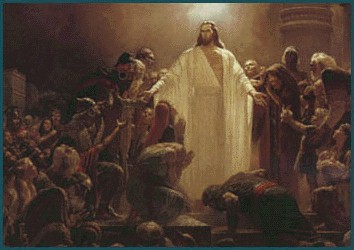
 Keep
your eyes open!...
Keep
your eyes open!...

May 29, 2025
(Joh 16:33) These
things I have spoken to you, that in me you may have peace. In the
world you shall have distress. But have confidence. I have overcome the
world.
NEWS REPORT: Pope Leo XIV calls for peace in Ukraine and ceasefire in Gaza
Pope Leo XIV forcefully appealed for a “ceasefire now!” in Gaza,
along with the liberation of all hostages, and that humanitarian law be
fully respected.
“From the Gaza Strip,” the Pope said, we hear “rising ever more
insistently to the heavens, the cries of mothers and fathers who clutch
the lifeless bodies of their children, and who are continually forced
to move about in search of a little food and water and safer shelter
from bombardments."
VATICAN NEWS: Fr. Romanelli: Pope Leo XIV gives us new encouragement to persevere
In an interview with Vatican News, the parish priest of the Holy Family
Church in Gaza, Fr. Gabriel Romanelli, described the atmosphere in the
enclave at the moment.
“More than the lack of food, clean water, and medicine, more than the
threat to our safety, what worries me most is that hope might be lost,”
Fr. Romanelli explained.
Since people in the Gaza Strip are not being “treated as human beings
with rights but as objects,” he said, “hope is fading.” The hope that
this war will end, that peace will return, that homes will be rebuilt,
and that the “small and resilient Christian community” will continue is
hard to maintain in the midst of the conflict.
The parish priest stressed that the majority of the people living in
Gaza are civilians and are in no way part of the armed conflict.
“Our community must resist,” Fr. Romanelli said, “because Gaza must continue to have a visible Christian presence.”
RELATED: Four Palestinians die in storming of UN food warehouse a day after gunfire at new Gaza aid site
THE CATHOLIC THING: Martyrs of the New Millennium: Persecution at Our Doorstep
Summary:
The video features an interview between Brad Miner and Robert Royal,
focusing on Royal's new book, "Martyrs of the New Millennium," which
discusses the ongoing persecution of Christians worldwide. They explore
the evolving definitions of martyrdom, historical and contemporary
examples of persecution, and the challenges faced by Christians in
various regions, including the Middle East, Africa, China, India, and
Latin America. Royal emphasizes the vigilance needed against growing
anti-Christian sentiments, especially in the West, and the complexity
of navigating both religious and political tensions.
Key Points
Definition of Martyrdom
Royal outlines that martyrdom has evolved in its definition over time,
distinguishing between historical martyrs, contemporary cases, and
varying contexts of sacrifice and persecution. He identifies several
categories, such as 'new martyrs' defined by John Paul II and
spontaneous acts of sacrifice emphasized by Pope Francis.
Current Global Persecution
They discuss the resurgence of martyrdom, particularly in countries
like Mexico, where cartels pose significant threats to priests and
believers, and in nations experiencing radical Islamism such as in the
Middle East. The dangers are not confined to historical contexts but
are very much a modern reality.
The Role of Nationalism
Royal examines how nationalism in countries like India leads to
Christian persecution, as the ruling Hindu party promotes
anti-Christian sentiment. He warns about the effects of this hardline
nationalism on the Christian population and raises concerns about the
risks of similar ideologies spreading.
Latin America and Anti-Christian Sentiments
Miner highlights the Ortega regime in Nicaragua as an example of
political repression against the church, where the government targets
Catholic clerics without provoking martyrdom that could generate
martyrdom cases that give the church sympathy.
Persecution in the West
Royal warns that anti-Christian trends are emerging in Western nations
where societal norms increasingly alienate Christians. He cites
examples of hate crimes and legal challenges faced by Christians in the
U.S. and Europe, urging vigilance against complacency.
The Future of Christianity
The discussion concludes with Royal urging Christians to remain
vigilant and proactive in preserving their rights, emphasizing the need
for a renewed commitment to faith in a society that may increasingly
oppose Christian values.
The
Desert Fathers: sayings of the Early Christian Monks: Visions
10. Macarius wanted to encourage the brothers so he said, 'A little
while ago a mother came here with her son who was vexed by a devil, and
he said to his mother, "Get up, let us go away from here." But she
said, "my feet are so bad that I can't walk away." So her son said to
her, "I will carry you." I am amazed at the cleverness of the devil,
how much he wanted them to flee from this place.'

May 28, 2025
(Php 1:9-11) And
this I pray: That your charity may more and more abound in knowledge
and in all understanding: That you may approve the better things: that
you may be sincere and without offence unto the day of Christ: Filled
with the fruit of justice, through Jesus Christ, unto the glory and
praise of God.
DENVER CATHOLIC: Old and New: The American Pope Takes on AI
US DEPARTMENT OF HOMELAND SECURITY: Exploring Gen AI Across the New Tech Frontier
ICN: Artificial Intelligence, Faith and Ethics at a Crossroads
From the outset of his pontificate, Pope Leo XIV has explained how the
development of Artificial Intelligence (AI) inspired the choice of his
papal name.
Speaking to the College of Cardinals after his election, he said: "I
chose to take the name Leo XIV. There are different reasons for this,
but mainly because Pope Leo XIII in his historic encyclical Rerum
Novarum addressed the social question in the context of the first great
industrial revolution."
"In our own day, the Church offers to everyone the treasury of her
social teaching in response to another industrial revolution and to
developments in the field of artificial intelligence that pose new
challenges for the defence of human dignity, justice, and labour."
With serendipitous timing, the Catholic Union, in collaboration with
Farm Street Church, Mayfair, hosted a panel discussion last Sunday 18th
May entitled 'AI, Faith and Ethics at a Crossroads: Discerning the Way
Forward' which explored the moral and spiritual challenges in this time
of technological transformation. The event was convened and chaired by
Farm Street Parish Priest, Fr Dominic Robinson SJ.
In her opening remarks, Dr Karen Singarayer, Vice-Chair of the Catholic
Union of Great Britain, highlighted the opportunities and risks of the
development of AI. She said: "The artificial intelligence revolution
holds both promise and peril. The AI revolution seems to be impacting
not only manual labourers but also professionals. The written word,
once the exclusive realm of the human mind, is now increasingly the
domain of machines. Video and audio too are more and more frequently
AI-generated. Professions that long commanded social respect as learned
or creative vocations now seem vulnerable in the face of the machine."
She added: "These developments prompt us to ask difficult questions -
what does it mean to be truly present to another human being? How are
relationships, education, healthcare, and even evangelisation being
reshaped by the advent of AI?"
Fr Michael Baggot, Professor of Theology at Pontifical University of St
Thomas Aquinas, Rome, spoke about how the Church is founded upon
relationship, with God and each other. He said: "We are masters of
communion. We are masters of relationship. We follow a God of
relationship, not a solitary God, but a God who is eternal exchange of
interpersonal love. If we're made in the image of that God, we are
called into being by a God of communion for communion-with that God and
with the other persons made in the image of that God. We were made for
interpersonal communion."
The Church, he said, is "expert in humanity'" adding "I hope we know how to accompany people and their most profound needs."
He warned against the abuses of AI's virtual world, seductive and
damaging as it moved from an attention economy to an affection economy
but was lacking in compassion and an interior life.
Fr Baggot warned, too, against the possibility of "outsourcing" moral
agency. While AI worked with data and statistical patterns it should
never replace human responsibility. The Church insisted on equity,
sexual and racial, he said.
NEWS REPORT: Amazon-Backed AI Model Would Try To Blackmail Engineers Who Threatened To Take It Offline
The
Desert Fathers: sayings of the Early Christian Monks: Visions
1. A brother went to the cell of
Arsenius in Scetis, and looked in through the window, and saw him like
fire from head to foot. (He was a brother worthy to see such sights.)
When he knocked, Arsenius came out, and saw the brother standing there
amazed, and said to him, 'Have you been knocking long? Did you see
anything?' He answered, 'No.' After talking with him, Arsenius sent him
on his way.
May 22, 2025
(Mat 10:38-39) And
he that taketh not up his cross, and followeth me, is not worthy of me.
He that findeth his life, shall lose it: and he that shall lose his
life for me, shall find it.
POPE LEO XIV: "There is no aspect of life that remains untouched by the Gospel".
FATHER JEFFREY F. KIRBY: Human beings are not zombies or robots, and need prayer
VIA: The Discalced Hermits of Our Lady of Mount Carmel
Three Steps to Conforming Your Will to God's Will
- Memorize God’s commandments (especially the two greatest
commandments: “You shall love the Lord your God with your whole heart,
soul, mind, and strength” and “You shall love your neighbor as
yourself,” and the 10 commandments).
- Pray each day for the grace to live according to God’s commandments as you carry out your daily duties.
- Before retiring at night, reflect on the ways you lived according
to God’s commandments and the ways you failed to do so. Then make a
devout act of contrition begging God’s forgiveness and the grace to
amend your life.
Two Practical Recommendations to Help You Pray Well
- Before beginning your prayer, spend a few moments reflecting on
the fact that: God right now is keeping you and everything around you
in existence, and He knows everything that can be known about you and
everything around you, and He lovingly governs you and all things
around you.
- Adore the three divine Persons dwelling within you by slowly
praying: “Glory be to the Father, and to the Son, and to the Holy
Spirit; as it was in the beginning, is now, and ever shall be, world
without end. Amen.”
Three recommendations for developing the virtues of humility and charity
- Prayerfully read and reflect on the parable of the Pharisee and the tax collector in Luke 18:9-14.
- Pray the litany of humility or the simple prayer: “Jesus, meek
and humble of heart, make my heart like unto Thine.” Regularly make
acts of charity such as the following: “O my God, I love Thee above all
things with my whole heart, soul, mind, and strength, and I love my
neighbor as myself for Thy sake.”
CARDINAL SARAH VIA X:
- “We must return to the essentials: to God, to prayer, to the
Eucharist, to confession, to the truth of the Gospel. The Church is not
a humanitarian organization. She is the door to eternal life.”
- “The Church is not made to please the world. She is made to
convert it—to open the gates of eternity. Without Heaven, all our work
is in vain.” “The greatest poverty is the loss of God. The worst
violence is the refusal to speak about eternity. If we do not live for
Heaven, we live in despair.”
- “Let us not be afraid of being few. Let us be afraid of being
lukewarm. Christ saved the world with twelve apostles, not with crowds.”
- Jesus Christ is the Living God. The Church is not a club of
activists—she is the Ark of Salvation. And eternal life is not a
fantasy—it is the goal for which we were created.
The
Desert Fathers: sayings of the Early Christian Monks: Charity
24. A hermit said, 'I never wanted work to be useful to me while
causing loss to my brother, for I have this hope that what helps my
brother will bring fruit to me.'
May 20, 2025
(2Co 13:11) For
the rest, brethren, rejoice, be perfect, take exhortation, be of one
mind, have peace. And the God of grace and of love shall be with you.
BREAKING VIA LIFESITE: Trump says Vatican ‘very interested’ in hosting peace talks between Russia, Ukraine
EURONEWS: Pope Leo XIV offers to host Ukraine-Russia peace talks at the Vatican
The newly
elected Pope Leo XIV has suggested that the Vatican could host
high-level negotiations between Ukraine and Russia, as Istanbul talks
were watered down following Russian President Vladimir Putin's refusal
to come face to face with his Ukrainian counterpart, Volodymyr
Zelenskyy.
According to Vatican Secretary of
State Cardinal Pietro Parolin's statement on Friday, the supreme
pontiff plans to "if necessary, provide the Vatican, the Holy See, as a
direct meeting (place) between the two sides."
Parolin has also expressed his disappointment with the talks in Turkey, which took place on Friday.
"It's all tragic because we hoped
that a process would begin, perhaps slowly, but with a peaceful
resolution of the conflict. Instead, we are back to square one."
"Now we will see what to do, but the situation is very difficult, dramatic," Parolin added.
Since his appointment, Pope Leo XIV has repeatedly voiced his
solidarity with Ukraine. During his first Sunday Angelus blessing and
again this week while addressing pilgrims from Eastern Rite churches,
he renewed his appeal for an end to the conflict.
“I carry in my heart the sufferings of the beloved Ukrainian people,”
the pontiff said on Sunday. “Let everything possible be done to achieve
genuine, just and lasting peace as soon as possible. May all the
prisoners be freed, and may the children return to their families.”
Parolin said on Thursday that it remained “premature” to consider a
papal visit to Kyiv, despite Ukrainian President Volodymyr Zelenskyy
raising the possibility in his first phone call with the pope earlier
this week.
While the Vatican traditionally maintains diplomatic neutrality, Pope
Leo XIV has pledged to make “every effort” to foster dialogue to end
wars. “The Holy See is always ready to help bring enemies together,
face to face, to talk to one another, so that peoples everywhere may
once more find hope and recover the dignity they deserve, the dignity
of peace,” he said on Wednesday.
UPDATE VIA X: Pope Offers Vatican for Russia-Ukraine Peace Talks — World Leaders Listen
Pope Leo XIV has offered the Vatican as neutral ground for Russia-Ukraine peace talks—and for once, world leaders seem to agree.
Italian Prime Minister Giorgia Meloni said the proposal was welcomed by
Zelensky, Macron, Merz, and Trump, following a call between the U.S.
and Russian presidents.
Meloni: “Work is underway to immediately start negotiations between the
parties that can lead to a ceasefire as soon as possible and build the
conditions for a just and lasting peace in Ukraine.
In this regard, the Holy Father’s willingness to host the talks at the
Vatican was considered positive. Italy is ready to do its part to
facilitate contacts and work for peace.”
The Vatican, better known for diplomacy than diplomacy-by-drone, may
now host one of the most consequential conversations of the 21st
century.
A ceasefire isn’t a sure thing—but if anything can break the deadlock, it might just be white smoke from St. Peter’s.
The
Desert Fathers: sayings of the Early Christian Monks: Charity
23. A brother said to a hermit, 'If I see a monk about whom I have
heard that he is guilty of a sin, I cannot make myself invite him into
my cell. But if I see a good monk, I bring him in gladly.' The
hermit said, 'If you do good to a good brother it is nothing to him,
but to the other give double charity, for he is sick.'
May 18, 2025
(Mat 4:18-19) And
Jesus walking by the sea of Galilee, saw two brethren, Simon who is
called Peter, and Andrew his brother, casting a net into the sea (for
they were fishers). And he saith to them: Come ye after me, and I will
make you to be fishers of men.
VIDEO: 5th Sunday in the Time of Easter - Holy Mass for the Beginning of the Pontificate of Pope Leo XIV
VATICAN NEWS EDITORIAL: Pope Leo XIV’s call for Church to be ‘a little leaven’ of unity and love
EXCERPT HOMILY INSTALLATION MASS POPE LEO XIV:
"The Apostle Peter himself tells us that Jesus “is the stone that was
rejected by you, the builders, and has become the cornerstone” (Acts
4:11). Moreover, if the rock is Christ, Peter must shepherd the flock
without ever yielding to the temptation to be an autocrat, lording it
over those entrusted to him (cf. 1 Pet 5:3). On the contrary, he is
called to serve the faith of his brothers and sisters, and to walk
alongside them, for all of us are “living stones” (1 Pet 2:5), called
through our baptism to build God’s house in fraternal communion, in the
harmony of the Spirit, in the coexistence of diversity. In the words of
St. Augustine: “The Church consists of all those who are in harmony
with their brothers and sisters and who love their neighbor” (Serm.
359,9).
Brothers and sisters, I would like that our first great desire be for a
united Church, a sign of unity and communion, which becomes a leaven
for a reconciled world. In this our time, we still see too much
discord, too many wounds caused by hatred, violence, prejudice, the
fear of difference, and an economic paradigm that exploits the Earth’s
resources and marginalises the poorest. For our part, we want to be a
small leaven of unity, communion and fraternity within the world. We
want to say to the world, with humility and joy: Look to Christ! Come
closer to him! Welcome his word that enlightens and consoles! Listen to
his offer of love and become his one family: in the one Christ, we are
one. This is the path to follow together, among ourselves but also with
our sister Christian churches, with those who follow other religious
paths, with those who are searching for God, with all women and men of
good will, in order to build a new world where peace reigns!
This is the missionary spirit that
must animate us; not closing ourselves off in our small groups, nor
feeling superior to the world. We are called to offer God’s love to
everyone, in order to achieve that unity which does not cancel out
differences but values the personal history of each person and the
social and religious culture of every people.
Brothers and sisters, this is the
hour for love! The heart of the Gospel is the love of God that makes us
brothers and sisters. With my predecessor Leo XIII, we can ask
ourselves today: If this criterion “were to prevail in the world, would
not every conflict cease and peace return?” (Rerum Novarum, 21).
With the light and the strength of
the Holy Spirit, let us build a Church founded on God’s love, a sign of
unity, a missionary Church that opens its arms to the world, proclaims
the word, allows itself to be made “restless” by history, and becomes a
leaven of harmony for humanity.
Together, as one people, as brothers and sisters, let us walk towards God and love one another.
VATICAN NEWS: The rite for the Inauguration of the Petrine Ministry of Leo XIV
GEORGE WEIGEL COMMENTARY: Hopes for a new pontificate
CRISIS MAGAZINE OPINION: Pope Leo XIV and the Battle Against Modernity
RELATED
John Paul II’s Birthday, Leo XIV’s Inauguration: A Papal Coincidence
Pope Leo XIV Was Providentially Elected on the Same Day as These 4 Liturgical Celebrations
Patriarch of Moscow launched friendly overture to new Pope
The
Desert Fathers: sayings of the Early Christian Monks: Charity
18. A brother asked a hermit, 'Suppose there are two monks: one stays
quietly in his cell, fasting for six days at a time, laying many
hardships on himself: and the other ministers to the sick. Which
of them is more pleasing to God?' He replied, 'Even if the
brother who fasts six days hung himself up by his nose, he wouldn't be the equal of him who ministers to the sick.'
May 15, 2025
(Joh 20:19-20) Now
when it was late the same day, the first of the week, and the doors
were shut, where the disciples were gathered together, for fear of the
Jews, Jesus came and stood in the midst and said to them: Peace be to
you. And when he had said this, he shewed them his hands and his side.
The disciples therefore were glad, when they saw the Lord.
Pope Leo XIV @Pontifex:
Peace be with you all! This is the first greeting spoken by the Risen
Christ, the Good Shepherd. I would like this greeting of peace to
resound in your hearts, in your families, and among all people,
wherever they may be, in every nation and throughout the world.
THE CATHOLIC THING: Leo XIV: Liturgy, the Heart, and the Postmodern City
VATICAN NEWS: Leo XIII’s times and our own
EXCERPT FATHER ROBERTO M. CID: He
chose the name Leo to show continuity with the social magisterium of
Leo XIII (1878-1903), especially his encyclical Rerum Novarum,
published in times of rapid changes in the world. The industrial
revolution was transforming life in society. Urbanization, together
with technological change and internal migrations led to the emergence
of the “working class.” In the face of these changes in political,
social and economic organization, the “utopian” socialism of Owen,
Saint Simon, Fourier and others proposed a humanism without God,
whereas the “scientific” socialism of Marx and Engels, whose Communist
Manifesto had been published in 1848 promoted “class struggle” as a
means to lead humanity to a worldly paradise.
The transformations under way and the ideologies that emerged during
the 19th century fueled armed conflicts between nation states, such as
the Franco Prussian war or the Ruso Japanese war, anticipating the
great conflagrations of the 20th century.
The Church also found itself in a difficult situation. Italian
unification had brought about the end of the Papal States, dismantling
the temporal power of the pontiffs. Although this helped purify the
Church, it also created new challenges, since the Pope was now in a
very precarious situation. The Italian state offered a “Law of
Guarantees” to protect his freedom, but it was only several decades
later, well into the 20th century that the Lateran Treaty ended the
“Roman question” establishing Vatican City as a state.
It was in that context that the pontificate of Leo XIII unfolded. In
addition to Rerum Novarum, he is remembered for his promotion of the
study of the philosophical and theological works of St. Thomas Aquinas,
especially as a means to improve the formation of clergy. He also
fought against Masonic groups and did not spare any effort to combat
Americanism, which threatened the unity of the Church. Additionally, he
promoted the Holy Rosary and wrote the prayer to St. Michael the
Archangel that pope Francis has asked us to pray regularly.
The encyclical of Leo XIII on the “new things,” published on May 15,
1891, became the cornerstone in a series of luminous documents and
papal pronouncements known collectively as “Catholic Social Teaching.”
Pope Leo XIV begins his Petrine ministry in a context marked by rapid
transformations in social relations and violent international
conflicts. In our times there are also many threats to the unity of the
Church. Technological change and the emergence of artificial
intelligence present new challenges to the world and the Church. In
times when algorithms rule, it seems providential that someone who has
studied mathematics occupies the see of Peter.
There are undoubtedly many similarities between the context in the
pontificate of both Leos. However, there is one characteristic that is
common to both. It is fundamental and transcends any other
consideration. Leo XIV highlighted it in his first public appearance
when he singled out this old yet ever new constant in universal
history: “God loves us, all of us, evil will not prevail. We are all in
the hands of God. Without fear, united, hand in hand with God and among
ourselves, we will go forward. We are disciples of Christ, Christ goes
before us, and the world needs His light. Humanity needs Him like a
bridge to reach God and His love.”
C&C SUBSTACK EXCERPT: The Times did not escape a scolding of its own. Yesterday, the Times choked out an uncomfortable story below the headline, “Pope Leo XIV Calls for News Media to Shun Divisive Language.”
It was another mild-mannered moment, but one that gave conservative
Catholics something they haven’t felt in a long time: hope.
New Pope Leo has been quickly,
quietly, and reverently unstitching some of his progressive
predecessor’s more liberal embroidery. And in his first major
address—to journalists, no less—he gently called out the media for its
role in fomenting division.
If there was one Francis-era policy
that stung the faithful the most, it was the 2021 decree all but
banning the Traditional Latin Mass. The ancient rite sounds like arcane
gibberish to outsiders, but for many conservative Catholics, it’s a
sacred treasure— an unbroken link to centuries of historical worship.
But Francis buried the Latin Mass
beneath layers of bureaucracy, all but outlaweding it— signaling a
pointed rejection of Catholic traditionalism. Headlines like this 2023
example from the New Yorker captured the moment: What’s Behind the Fight Between Pope Francis and the Latin Mass Movement?
Pope Leo hasn’t formally reversed
his predecessor’s restrictions, but he’s dropping liturgical
breadcrumbs. In his first public Mass, he slipped in some Latin —a
pleasing linguistic aroma like incense wafting back into the sanctuary—
and donned traditional papal vestments that Francis had dismissed as
too showy.
Even more telling: reports surfaced
this week that Leo has privately celebrated Latin Mass under a special
personal exemption allowed by Francis. That news wasn’t as welcome as a
policy change —not yet— but to traditionalists, it was as clear a
miracle as a weeping statue.
So conservative Catholics are cautiously becoming more optimistic.
In yesterday’s address to over
1,000 journalists, Leo first hit the usual applause lines about the
free press, jailed reporters, and a “just and lasting peace” in
Ukraine. But then he pivoted —softly but unmistakably— toward a
full-throated defense of free speech.
Leo spoke of the people’s need to
be well-informed— not indoctrinated. He praised the “precious gift of
free speech and of the press.” And he gently urged the media to “disarm
communication of all prejudice and resentment, fanaticism and even
hatred.” Read that again. Prejudice sounds a lot like bias. Hatred had
“Trump Derangement Syndrome” written all over it. And his emphasis on
listening over “loud, forceful communication” wasn’t just a pastoral
note— it was a rebuke of modern media’s apoplectic performance art.
Notably, he never mentioned social media “misinformation” or “disinformation.” Not a single time.
Which brings us to what may be the
most significant sign: the press is already misquoting him. His very
first words as Pope were, “The Peace of Christ be with you all.” But
the BBC —bless their agenda— clipped it to: “Peace be with you all.”
Subtle, but telling. They edited Christ right out of the opening line
of a papacy.
In other words, they are trying to
make Pope Leo into the secularized, politicized Pope they were hoping
for, rather than showing the world who he really might be. It smacks of
fear.
And, having been misquoted right out of the Vatican’s gate, it’s no wonder Pope Leo had a few choice words for journalists.
It’s still too early to call him a
conservative pope. But let’s just say, if this is the direction he’s
headed, the incense might finally be blowing in the right direction.
The
Desert Fathers: sayings of the Early Christian Monks: Charity
15. One of the fathers said, 'If anyone asks you for something, and you
give it to him, even if you are forced to give it, let your heart go
with the gift, as it is written, "If a man forces you to go with him
one mile, go with him two" (Matt. 5:41). This means that if you are
asked for anything, give it with a willing heart.'
May 13, 2025
(Mat 5:9) Blessed are the peacemakers: for they shall be called the children of God.
“The Church must face the
challenges posed by the times. In the same way, communication and
journalism do not exist outside of time and history. Saint Augustine
reminds of this when he said, ‘Let us live well, and the times will be
good. We are the times’. Communication is not only the
transmission of information, but it is also the creation of a culture,
of human and digital environments that become spaces for dialogue and
discussion.”
- Pope Leo XIV
FIRST THINGS: Pope Leo XIV, Builder of Bridges
VATICAN NEWS: Pope Leo XIV speaks by phone with Ukraine's President Zelensky
ORTHODOX TIMES: Ecumenical Patriarch on Pope Leo: I will attend his enthronement to advance dialogue between East and West
Abp. George G�nswein, Apostolic Nuncio to Lithuania and former secretary to Pope Benedict XVI:
"Leo XIV will create bridges like his predecessor. But in a different
context and a different style than Francis. In the Church today there
are great tensions, and outside there are frightening conflicts. I
think doctrinal clarity is needed now. The confusion of these years
must be overcome. And one of the tools to be used are the structures
that are already present there. The institutions of the Church are
neither a plague, nor a threat against the Pope. They are there to
provide help to the pontiffs, who must get help. You cannot govern
yourself by distrusting your own institutions." ...
“Papa Prevost gives me great hope. I am convinced that he will make a
positive impact within the Church and in the world. He is a peacemaker.
Already the choice of name, in the tradition of St. Leo the Great and
Leo III who crowned Charlemagne in the 800s, is very indicative. Name
and dress made it clear that there will be continuity, not a totally
new phase. His experience, ability to speak many languages, the fact
that he was a missionary, but also worked in the Curia for two years,
make him both a pastor and a governing pope. He does not come from one
background but from many things together. And this will allow him to
speak to everyone.” ...
"Now a new phase is opening. I sense some widespread relief. The age of
arbitrariness is over. We can start counting on a papacy that can
guarantee stability and rely on existing structures, without
overturning and upsetting them."
BLOG: On Leo XIV
‘I am’, said our Holy Father this evening, addressing us for the first
time as pope, ‘a son of St Augustine’ — of Augustine, that supremely
intelligent, compassionate, yet uncompromising prober of the human
condition, who knew how to orient hearts and minds towards God in such
a way that his words resound still with undiminished power. Prosper of
Aquitaine held Augustine forth, too, as an example of those ‘strong
figures who could tame the unjust powers of the world and protect
otherwise helpless communities from the ravages of war’. As another
such instance he cited Leo the Great, who turned Attila away from
northern Italy in 452 relying ‘on the help of God, who one should know
is never missing from the labours of the pious.’ Augustine and Leo,
consummate theologians, men of prayer and courage, orderers of chaos,
keen readers of the signs of the times: these are the patrons of a new
papacy. Long life to Pope Leo XIV!
The
Desert Fathers: sayings of the Early Christian Monks: Charity
9. Poemen said, 'Try, so far as you can, to wrong no man, and keep your heart pure towards everyone.'
May 11, 2025
(Joh 17:20-21) And
not for them only do I pray, but for them also who through their word
shall believe in me. That they all may be one, as thou, Father, in me,
and I in thee; that they also may be one in us: that the world may
believe that thou hast sent me.
VATICAN NEWS: Regina Caeli prayer- Pope Leo XIV - 11 May 2025
ORTHODOX TIMES: Pope Leo XIV: A call for global peace in his first Sunday message
CNS VIDEO: Pope Leo on media and evangelization. Full 2012 interview.
X: Pope Leo XIV Coat of Arms (Image link here)
Pope Leo XIV's coat of arms consists of a shield divided into two sectors, each carrying a profound message.
On the left side, against a blue background, there is a stylized white lily, a traditional symbol of purity and innocence.
This flower, often associated with the Virgin Mary, immediately evokes the Marian dimension of the Pope’s spirituality.
This is not a purely devotional
call, but a precise indication of the centrality that the Blessed
Virgin Mary occupies in the way of the Church: a model of listening,
humility, and total surrender to God.
On the right side of the shield, on
a white background, is represented the Sacred Heart of Jesus, pierced
by an arrow and lying on a closed book.
This image, intense and full of
meaning, refers to the mystery of Christ's redeeming sacrifice, a heart
bruised by love for humanity, but also to the Word of God, represented
by the closed book.
This closed book suggests that divine truth is sometimes veiled and must be received and pursued with the light of faith.
It's an invitation to trust and
abandonment, to persevere in the pursuit of the Gospel’s deep meaning,
even in moments of darkness.
The motto chosen by Pope Leo XIV,
"In Illo uno unum" is taken from a commentary by Saint Augustine on
Psalm 127, summarizes the core of his message: “In Him who is One, we
are one. ”
These words reflect a Church, united in mind and heart by profession of
the same one true Faith, despite the differences and tensions that
inevitably permeate it in its human dimension. It is an expression of
communion founded and encountered in Christ's love, which makes
brotherhood and reconciliation possible even in the most complex
contexts.
It is not by accident that, in his
greeting to the Church and the world, Pope Leo XIV spoke of precisely
this: of a Church as a bridge, called to overcome divisions, to make
space for meeting, listening and mercy.
Ultimately, through his coat of
arms and motto, the new Pontiff proposes a vision of a missionary and
Marian Church, deeply rooted in the love of Jesus Christ and faithful
to the Gospel. A Church willing to suffer and commit itself entirely to
the service of God's people, aware that only in unity with the Lord can
all diversity find harmony.
FIRST THINGS: This Pope Will Roar
The
Desert Fathers: sayings of the Early Christian Monks: Charity
6. Agatho said, "I tried never to go
to sleep while I kept a grievance against anyone. Nor did I let anyone
go to sleep while he had a grievance against me.'
May 9, 2025
(Mat 16:18-19) And
I say to thee: That thou art Peter; and upon this rock I will build my
church, and the gates of hell shall not prevail against it. And I will
give to thee the keys of the kingdom of heaven. And whatsoever thou
shalt bind upon earth, it shall be bound also in heaven: and whatsoever
thou shalt loose on earth, it shall be loosed also in heaven.
THE CATHOLIC THING EDITORIAL: Preparing Ourselves for Life Under the New Pope
CHICAGO SUN TIMES PREVIEW: Cardinal Robert Prevost, born in Chicago, is the first pope from the United States
EXCERPT CULTURA COLECTIVA: Why Pope Leo XIV Chose His Name — And What It Means for the Church
If Leo XIV is aiming to model his papacy after anyone, it’s Pope Leo
XIII — arguably one of the most intellectually formidable and socially
conscious popes of modern history. Reigning from 1878 to 1903, Leo XIII
is best known for his groundbreaking 1891 encyclical Rerum Novarum,
which tackled labor rights, capitalism, socialism, and the Church’s
role in modern economic life. In doing so, he laid the foundations of
what we now call Catholic Social Teaching.
He also revived the study of St. Thomas Aquinas, emphasizing the
compatibility of faith and reason at a time when the Church felt
besieged by modernity. He didn’t retreat — he engaged. Leo XIII didn’t
try to drag the world backward; he tried to bring the Church forward,
without letting it fracture.
By invoking Leo, Pope Leo XIV appears to be drawing from that same
energy: reformist, engaged, not afraid to confront contemporary
realities head-on.
Prevost’s background already set him apart. He’s a moderate,
Chicago-born Augustinian with deep ties to Latin America, having served
as a bishop in Peru for nearly a decade. He’s fluent in Spanish, was
elevated to the powerful Dicastery for Bishops under Pope Francis, and
is known more for listening than lecturing.
By choosing a name associated with diplomacy, social engagement, and
intellectual depth, Leo XIV is sending a message: this will not be a
culture-war papacy. It will be a papacy of continuity — not just with
Francis, but with the long arc of the Church’s social conscience.
In his first public address, Pope Leo XIV emphasized peace, dialogue,
and missionary outreach — key priorities of both Francis and Leo XIII.
But the name alone suggests more: a willingness to tackle modern
challenges not with condemnation, but conversation.
The Church today faces a crossroads — rising secularism, deep internal
divisions, the legacy of abuse scandals, and geopolitical instability.
A name like Leo isn’t a nostalgic callback. It’s a statement of purpose.
By calling himself Leo XIV, Cardinal Robert Francis Prevost is telling
the world that this is not about where he comes from — it’s about where
he wants the Church to go.
X POST:
Pope Leo XIII. Born in 1810, he was head of the Catholic Church from
20th February 1878 until his death on 20th July 1903. Filmed here in 1896, he is likely the earliest born person ever filmed.
X VIA SANOJ THOMAS:
“I am a son of Saint Augustine, an Augustinian.
With you I am a Christian, for you I am a Bishop.” — Pope Leo XIV
What a profound and humble introduction from the new Successor of
Peter. With these words, Pope Leo XIV identifies not only his
theological heritage, but also the heart of his mission—rooted in the
wisdom of St. Augustine, one of the greatest doctors of the Church.
To be a son of Augustine is to
embrace a spirituality of interior conversion, love for truth, and
unwavering fidelity to Christ and His Church. It is to walk the path of
humility, prayer, and repentance, all while upholding the deepest
doctrines of the Faith—not as burdens, but as treasures.
In an age of confusion, his voice
echoes Augustine’s plea: “Let us cling to the Church, which alone
possesses the true doctrine.” May the Church under Pope Leo XIV
rediscover the strength of her foundations, the beauty of her moral
clarity, and the radiance of her unchanging truth.
We pray that the flame of
Augustinian wisdom will burn brightly in this new pontificate—and lead
us closer to the Heart of Christ, through the love of His Bride, the
Holy Catholic Church.
The
Desert Fathers: sayings of the Early Christian Monks: Charity
5. Mark said to Arsenius, 'Why do you go away from us?' He replied,
'God knows I love you. But I cannot be with God and with men. The
countless hosts of angels have only a single will, while men have many
wills. So I cannot leave God, and be with men.'
May 8, 2025
(Rom 8:24-25) For
we are saved by hope. But hope that is seen is not hope. For what a man
seeth, why doth he hope for? But if we hope for that which we see not,
we wait for it with patience.
LIFESITE: Black smoke rises from Sistine Chapel as Thursday morning voting concludes without a pope
CONCLAVOSCOPE (AI): Analysis of Catholic Church Cardinals
CNA: Meet the 5 cardinal electors with the most conclave experience
Four electors — Cardinals Peter Turkson, Philippe Barbarin,
P�ter Erdo, and Josip Bozanic — became members of the College of
Cardinals in 2003 and have participated in two conclaves before this
one.
Cardinal Vinko Puljic, the archbishop emeritus of Sarajevo, received
the red hat in 1994, making him the elector with the most years —
nearly 31 — as cardinal. He has also participated in two conclaves: the
2005 conclave that elected Benedict XVI and the 2013 conclave that
elected Francis.
VIA KENYA: Papabili: 3 African cardinals qualify for papacy, why their chances are slim
CONCLAVE VOTING TIMES
Wednesday, May 7 1:00 pm ET (7:00 pm Rome time)
Thursday, May 8 and Friday, May 9
4:30 am ET (10:30 am Rome time)
6:00 am ET (Noon Rome time)
11:30 am ET (5:30 pm Rome time)
1:00 pm ET (7:00 pm Rome time)
Saturday, May 10
*Similar to previous days
*Note: These are approximate times. Times may vary.
THE CATHOLIC THING VIDEO: What Kind of Pope Does the World Need? | The Conclave Crew: Ep. 4
AI VIDEO SUMMARY:
In this episode of 'The Conclave Crew', host Raymond Arroyo and his
guests discuss the needs and expectations surrounding the election of
the next Pope. They reflect on the significance of the papacy, the
qualities the new Pope should possess, and the implications of recent
teachings by Pope Francis. Topics include the importance of doctrinal
clarity, the financial crisis within the Vatican, and perspectives on
church teachings concerning morality and liturgy.
- Nature of the Papacy
The discussion opens with the acknowledgment that the conclave is about
electing St. Peter's successor, emphasizing the significant spiritual
responsibility upon the cardinals to choose a pope who can uphold and
further Christ's teachings.
- Challenges Faced by Next Pope
The crew outlines various challenges that the next pope will need to
address, namely the current confusion in church doctrines resulting
from statements made during Pope Francis's leadership. They stress that
the next pope must reaffirm doctrinal orthodoxy.
- Cardinal Poll Insights
A recent CBS poll highlighted diverging opinions among self-identified
Catholics regarding the direction of the papacy. The crew discusses the
implications of these views and argues that attendance at mass should
be considered when assessing these opinions.
- Expectation of Doctrinal Restoration
The conversation turns to the expectation that the next pope will
restore canonical norms and operate within the established laws of the
church, correcting perceived lapses during the Francis pontificate.
- Financial Management of the Vatican
Significant financial challenges face the next pope, including a rising
budget deficit and a historical mishandling of Vatican finances. There
is a pressing need for a pope who can provide sound financial
stewardship.
- Expected Qualities in New Pope
The speakers finalize by sketching the qualities the next pope should
have: a strong commitment to the core values of the church, a clear
doctrinal stance, and an ability to reconcile different views among the
church members.
The
Desert Fathers: sayings of the Early Christian Monks: Charity
3. Amoun of Nitria came to Antony, and said to him, 'I see that I have
more to suffer than you; how is it that your reputation among men is
greater than mine?' Antony said, 'It is because I love God more than
you do.'
May 7, 2025
(Heb 12:1-2) And
therefore we also having so great a cloud of witnesses over our head,
laying aside every weight and sin which surrounds us, let us run by
patience to the fight proposed to us: Looking on Jesus, the author and
finisher of faith, who, having joy set before him, endured the cross,
despising the shame, and now sitteth on the right hand of the throne of
God.
CNA: Live updates cardinals gather as conclave to elect successor to Pope Francis
VATICAN NEWS: Vatican Smoke Watch: LIVE from St. Peter’s Square
x: Veni, Creator Spiritus, Mentes tuorum visita, Imple superna gratia Quae tu creasti pectora.
VATICAN NEWS: Holy Mass “pro eligendo Romano Pontifice”
At 10.00 this morning, in the Vatican Basilica, the Holy Mass “pro eligendo Romano Pontifice” took place.
The Mass was concelebrated by the
Cardinal Electors and presided over by the Dean of the College of
Cardinals, His Eminence Cardinal Giovanni Battista Re.
The following is the homily delivered by His Eminence Cardinal Giovanni Battista Re.: https://press.vatican.va/content/salastampa/en/bollettino/pubblico/2025/05/07/250507a.html
ALETEIA: The beginning of the conclave, in 7 detailed steps
LIFESITE: Diagram of the election process as the conclave commences
NEW ZEALAND CATHOLIC CONFERENCE: Litany of the Saints for Conclave 2025
Reminder:
It is good to request prayers from the Church Militant for the conclave
but we have BILLIONS of saints in the Church Triumphant interceding for
this conclave.
CWR: As the Cardinal-electors processed into the conclave on May 7th, the Litany of the Saints
was chanted. In it the Church Militant begs the Church Triumphant, the
Saints in heaven, to pray and intercede for her needs on earth.
Moreover, the fact that the Litany of the Saints is prescribed for
solemn occasions such as a papal election or the conferral of Holy
Orders is a reminder that the Church’s ordained priests are images of
the One High Priest in heaven, and that the Church’s liturgy is for the
faithful on earth a participation in the eternal heavenly liturgy.
These truths are encapsulated in the article of faith that we profess
every time we recite the Creed: “I believe in … the communion of
saints.”
Prayer for the Conclave’s Crucial Election of the New Pope
We kneel and plead with you, O Lord, as we humbly pray and fastfor
the Cardinals who are electing the new Pope.
We entrust the Divine Appointment
of our new Pope for the Glory of God,
for the Good of the Holy Church,
and for the New Springtime of humanity.
The Holy Father holds the key to open the Doors
to the Kingdom of God on earth, as it is in Heaven.
May Jesus and Mary purify the Bride of Christ
with a New and Holy Pope;
And through the Power of the Holy Spirit
Begin This New Era of Sanctification.
May this Conclave in the Jubilee Year of Hope
bring the Holy Father whom you, O Lord, desire.
We Appeal to you, O Lord, for the New Pope,
the Highest Hierarch, for the Roman Pontiff,
for His Holiness, for the Head of the Holy Catholic Church.
We pray that His Paternal & Authoritative voice
calls His priest sons and all humanity
to begin to live in the Kingdom of God
on earth as it is in Heaven,
eclipsing all humanity with God’s Light
to form one Church,
one Flock,
one Shepherd as you, O Lord, desire!
The
Desert Fathers: sayings of the Early Christian Monks: Charity
2. He also said, 'Our life and our death are with our neighbour. If we
do good to our neighbour, we do good to God; if we cause our neighbour
to stumble, we sin against Christ.'
May 6, 2025
(Psa 31:14-15) But I have put my trust in thee, O Lord: I said: Thou art my God. My lots are in thy hands.
CRISIS MAGAZINE: On Our Knees in Hope: The Conclave, the Papacy, and the Call to Prayerful Reverence
FIRST THINGS: On the Eve of a Conclave of Great Consequence: Some Reflections by George Weigel
DENVER CATHOLIC: Archbishop Chaput: What the Church Needs in the Next Pope
- Clarity
and Conviction: The next pope must clearly articulate Catholic
doctrine, avoiding ambiguity. Chaput argues that the Church’s teachings
on contentious issues like marriage, family, and sexuality should be
presented with confidence, as they are rooted in reason and scripture,
not merely tradition.
- Evangelical Zeal: The pope should inspire a renewed sense of
mission, encouraging Catholics to live out their faith boldly in a
world increasingly hostile to Christianity. This includes fostering a
culture of evangelization to counter secularism and moral relativism.
- Moral Authority: The pontiff must embody personal holiness and
integrity to restore trust in the Church, especially after scandals and
internal divisions. A pope who lives simply and authentically can model
the Gospel’s call to humility and service.
- Global Perspective: With Catholicism’s center of gravity shifting
to the Global South, the next pope should continue to engage with
diverse cultures while unifying the Church around universal truths.
Chaput notes the importance of a leader who can navigate the tensions
between progressives and conservatives.
- Courage to Confront Challenges: The pope must address internal
issues like clericalism and external pressures like cultural decline.
This requires courage to uphold the Church’s countercultural stance on
issues like abortion, gender ideology, and consumerism without
compromising for societal approval.
Archbishop Chaput concludes that
the Church needs a pope who combines intellectual rigor, spiritual
depth, and pastoral warmth to lead Catholics through a turbulent era.
The next pontiff should be a unifying figure who strengthens the
Church’s witness in a world that desperately needs its moral and
spiritual guidance.
YOUTUBE: The Real Factors Shaping the Next Pope | The Conclave Crew: Ep. 1 Arroyo Grande with Raymond Arroyo
FR. ROBERTO M. CID: Papal Sweepstakes
During these days before the
beginning of the conclave that will elect the new pope, media outlets
offer us a sort of papal sweepstakes, with candidates, celebrities,
favorites and the like. Setting aside the ever present, repetitious and
nauseating sociological reduction of the Church that leaves no room for
mystery or the action of the Spirit, it is truly striking to see the
superficiality, ignorance of history and sheer lack of professionalism
shown by so many communicators and commentators.
We must never forget that first and
foremost the Church is a supernatural reality whose head is Christ.
Animated by the Holy Spirit, she journeys through time towards the
consummation of history in God. What is essential in her life is
communion with Christ together with Peter, not uniformity.
Needless to say, in the Church
there are nuances, controversies, differing criteria and cultural
diversity. There may also be power struggles, cabals, cliques, ambition
and vanity because in her there is grace and sin: the grace of God and
the sin of men. Grace, however, always carries the day, as St. Paul
explains in Romans 5:20.
Through the history of the Church
there have been holy popes and those that were not so holy, as well as
some that left a lot to be desired. Whoever may be that ends up being
elected in the conclave that is about to begin on May 7, he will be
Peter. We may or may not find him friendly. He may or may not be
charismatic. He may or may not have many academic degrees. He may be
affable and extroverted or circumspect and introverted. He may hail
from the same place that we do or not. Beyond all these issues, he will
be our universal shepherd and the Vicar of Christ on earth. This last
consideration is the only one that matters.
The papal sweepstakes played by the
media may be the subject of a conversation over a cup of coffee,
material for a moment of leisure or an inconsequential chat but does
not affect in the least the life of the Church. It may be useful to
them who wish to sell newspapers or attract an audience. Let us not
fall in the fatuous mediocrity of the media. What is much more
interesting than participating in the papal sweepstakes offered to us
is to actively participate in the conclave. Undoubtedly, we can
influence the election in a decisive way through our fervent prayers
for the cardinals and for the next pope.
The
Desert Fathers: sayings of the Early Christian Monks: Charity
1. Antony said, 'Now I no longer fear God, I love him, for love casts out fear (1 John 4:18).'
May 4, 2025
(Luk 24:4-6) And
it came to pass, as they were astonished in their mind at this, behold,
two men stood by them, in shining apparel. And as they were afraid and
bowed down their countenance towards the ground, they said unto them:
Why seek you the living with the dead? He is not here, but is risen....
EXCERPT THE MOYNIHAN LETTERS: The Central Message
The central message of the Church is the "Good News" of the
resurrection. Of Christ's victory over sin and death on the first
Easter morning.
It is the proclamation of an eternal dimension, an eternal meaning, to
our lives, to our reality. This proclamation means that the
events of this life are not meaningless, but occur against an eternal
backdrop, a backdrop invisible to these human eyes that we have, of
flesh and blood, but visible to the eyes of the soul.
And this is why St. Irenaeus of Lyons in about the year 180 A.D. said
that "The glory of God is man alive... but the life of man is the
vision of God."
In other words, the fully alive human being is God's glory. But
we are fully alive only when our vision — physical, intellectual and
spiritual — catches a glimpse of the eternal, holy God, and draws
eternal life from that.
If in this life we are able to catch a glimpse of the Holy One, we are
on the threshold of a kingdom which is "not of this world" — a kingdom,
therefore, that is inaccessible to our flesh and blood, as long as we
in this world, yet a kingdom that we ma encounter, glimpse, come to
know, through this grace of seeing what is "above," that is, through
seeing God.
This is why our mission here, our preaching here, is essentially to try
to assist others to catch a glimpse of the Lord. This is what
brings life to men, and God's glory into the world.
And this, essentially, is the mission of the Pope: to confirm his
brothers in their common task of communicating Christ to the world, to
encounter Christ, to see Christ, who lives in an eternal kingdom which
has an intimate connection with our world of space and time, through
the Incarnation, and Passion, of our Lord.
MELKITE CATHOLIC CHURCH: Trampling Upon Death By Death
Christ is risen from the dead and by His death He has trampled upon Death and has given live to those who are in the tombs.
This hymn, the troparion of Pascha,
is chanted repeatedly on Pascha and throughout the forty days until the
feast of Christ’s ascension. Many of us know it by heart. Often,
however, we have not plumbed the depth of its meaning, particularly as
it applies to our lives.
Why Did Christ Die?
On the most basic level we can say that Christ died because humans die
and He was fully human. By truly assuming all that is human apart from
sin, the Word of God accepted all the weaknesses inherent in our human
nature, from the indignities of birth and infancy to the final
humiliation of death. Christ died because He was fully and completely
human as well as divine.
But Christ did not simply die; by
His death He defeated Death. The first and most obvious aspect of this
victory is that He rose from the dead: Death could take Him because He
was human; it could not hold Him because He was the Son of God. Christ
rose from the dead because He was fully and completely divine as well
as human.
Christ’s Death Takes Away Sin
The Scriptures specify a particular result of Christ’s victory over
Death. Dying, they teach, He destroyed the power of sin over us. When
St Paul summarized the Church’s belief about the Lord Jesus for the
Corinthians the first thing he mentioned was that Christ died for our
sins: “I delivered to you first of all that which I also received: that
Christ died for our sins according to the Scriptures, and that He was
buried, and that He rose again the third day according to the
Scriptures…” (1 Corinthians 15:3-4).
St Paul’s summary has been
described as an early creed, putting together various aspects of the
Christian message in a systematic way. To say that Christ died “for our
sins” means that His death on the cross, where His blood would be
poured out, would somehow achieve the overthrow of sin; not that people
would cease sinning but that sin would no longer have the ultimate
power over mankind.
Trampling Upon Death
We who are united to Christ in His
death and resurrection through baptism are called to continue His
defeat of sin and death in our own person, as the Scriptures make
clear. “For to this you were called, because Christ also suffered for
us, leaving us an example, that you should follow His steps: ‘Who
committed no sin, nor was deceit found in His mouth’; who, when He was
reviled, did not revile in return; when He suffered, He did not
threaten, but committed Himself to Him who judges righteously; who
Himself bore our sins in His own body on the tree, that we, having died
to sins, might live for righteousness—by whose stripes you were
healed.” (1 Peter 2:19-24)
Death is defeated when we allow
Christ to take us by the hand and lead us along His way of not reacting
to evil by copying it; rather to follow Christ’s way of forgiveness and
trust in God even to death. Then our deeds as well as our words will
proclaim that Christ is risen and that we are as well.
“For your sake I, your God,
became your son; I, the Lord, took the form of a slave; I, whose home
is above the heavens, descended to the earth and beneath the earth. For
your sake, for the sake of man, I became like a man without help, free
among the dead. For the sake of you who left a garden, I was betrayed
in a garden, and I was crucified in a garden.
“See on my face the spit I received in
order to restore to you the life I once breathed into you. See there
the marks of the blows I received in order to refashion your warped
nature in my image. On my back see the marks of the scourging I endured
to remove the burden of sin that weighs upon your back. See my hands,
nailed firmly to a tree, for you who once stretched out your hand to a
tree.
“I slept on the cross and a sword
pierced my side for you who slept in paradise and brought forth Eve
from your side. My side has healed the pain in yours. My sleep will
rouse you from your sleep in hell. The sword that pierced me has
sheathed the sword that was turned against you.
“Rise. Let us leave this place. The
enemy led you out of the earthly paradise. I will not restore you to
that paradise, but I will enthrone you in heaven. I forbade you the
tree that was only a symbol of life, but see! I who am life itself am
now one with you. I appointed cherubim to guard you as slaves are
guarded, but now I make them worship you as God. The throne formed by
cherubim awaits you, its bearers swift and eager. The bridal chamber is
adorned, the banquet is ready, the eternal dwelling places are
prepared, the treasure houses of all good things lie open. The kingdom
of heaven has been prepared for you from all eternity.”
-St. Epiphanios of Cyprus (+403)
The
Desert Fathers: sayings of the Early Christian Monks: Patience
11. Someone who saw a religious person carrying a corpse on a bed, said, 'Are you carrying dead men? Go and carry the living.'
May 1, 2025
(Mar
6:3) Is not this the carpenter, the son of Mary, the brother of James,
and Joseph, and Jude, and Simon? are not also his sisters here with us?
And they were scandalized in regard of him.
BISHOP BARRON SERMON: Go to Joseph
UNIVERSALIS: St Joseph the Worker
CNA: The story behind the feast of St. Joseph the Worker
EXCERPT POPE SAINT JOHN PAUL II: Apostolic Exhortation Redemptoris Custos
22. Work was the daily expression of love in the life of the Family of
Nazareth. The Gospel specifies the kind of work Joseph did in order to
support his family: he was a carpenter. This simple word sums up
Joseph's entire life. For Jesus, these were hidden years, the years to
which Luke refers after recounting the episode that occurred in the
Temple: "And he went down with them and came to Nazareth, and was
obedient to them" (Lk 2:51). This "submission" or obedience of Jesus in
the house of Nazareth should be understood as a sharing in the work of
Joseph. Having learned the work of his presumed father, he was known as
"the carpenter's son." If the Family of Nazareth is an example and
model for human families, in the order of salvation and holiness, so
too, by analogy, is Jesus' work at the side of Joseph the carpenter. In
our own day, the Church has emphasized this by instituting the
liturgical memorial of St. Joseph the Worker on May 1. Human work, and
especially manual labor, receive special prominence in the Gospel.
Along with the humanity of the Son of God, work too has been taken up
in the mystery of the Incarnation, and has also been redeemed in a
special way. At the workbench where he plied his trade together with
Jesus, Joseph brought human work closer to the mystery of the
Redemption.
23. In the human growth of Jesus "in wisdom, age and grace," the virtue
of industriousness played a notable role, since "work is a human good"
which "transforms nature" and makes man "in a sense, more human."
The importance of work in human life demands that its meaning be known
and assimilated in order to "help all people to come closer to God, the
Creator and Redeemer, to participate in his salvific plan for man and
the world, and to deepen...friendship with Christ in their lives, by
accepting, through faith, a living participation in his threefold
mission as Priest, Prophet and King."
24. What is crucially important here is the sanctification of daily
life, a sanctification which each person must acquire according to his
or her own state, and one which can be promoted according to a model
accessible to all people: "St. Joseph is the model of those humble ones
that Christianity raises up to great destinies;...he is the proof that
in order to be a good and genuine follower of Christ, there is no need
of great things-it is enough to have the common, simple and human
virtues, but they need to be true and authentic."
A MOMENT WITH MARY: Joseph, of royal blood, united by marriage to the greatest and holiest of women, and reputed the father of the Son of God
Men of every rank and country
should fly to the trust and guard of the blessed Joseph. Fathers of
families find in Joseph the best personification of paternal solicitude
and vigilance; spouses a perfect example of love, of peace, and of
conjugal fidelity; virgins at the same time find in him the model and
protector of virginal integrity. The noble of birth will learn of
Joseph how to guard their dignity even in misfortune; the rich will
understand, by his lessons, what are the goods most to be desired and
won at the price of their labour. As to workmen, artisans, and persons
of lesser degree, their recourse to Joseph is a special right, and his
example is for their particular imitation.
For Joseph, of royal blood, united by marriage to the greatest and
holiest of women, reputed the father of the Son of God, passed his life
in labour, and won by the toil of the artisan the needful support of
his family. It is, then, true that the condition of the lowly has
nothing shameful in it, and the work of the labourer is not only not
dishonouring, but can, if virtue be joined to it, be singularly
ennobled. Joseph, content with his slight possessions, bore the trials
consequent on a fortune so slender, with greatness of soul, in
imitation of his Son, who having put on the form of a slave, being the
Lord of life, subjected himself of his own free-will to the spoliation
and loss of everything.
-Pope Leo XIII, Encyclical letter Quamquam pluries, on devotion to Saint Joseph, �4 - 1889
The
Desert Fathers: sayings of the Early Christian Monks: Patience
9. Poemen said, 'Whatever hardship comes upon you, it can be overcome by silence.'

 Links
Links  E-mail
Dr. Zambrano
E-mail
Dr. Zambrano  Home
Home
 Jubilee
2000: Bringing the World to Jesus
Jubilee
2000: Bringing the World to Jesus
 The
Tribulation Times Archives:
The
Tribulation Times Archives:
FAIR
USE NOTICE: This site contains copyrighted material the
use of which
has not always been specifically authorized by the copyright owner. We
are making such material available in our efforts to advance
understanding of environmental, political, human rights, economic,
democracy, scientific, and social justice issues, etc. We believe this
constitutes a ‘fair use’ of any such copyrighted
material
as provided for in section 107 of the US Copyright Law. In accordance
with Title 17 U.S.C. Section 107, the material on this site is
distributed without profit to those who have expressed a prior interest
in receiving the included information for research and educational
purposes. For more detailed information go to: http://www.law.cornell.edu/uscode/17/107.shtml.
If you wish to use copyrighted material from this site for purposes of
your own that go beyond ‘fair use’, you must obtain
permission from the copyright owner.