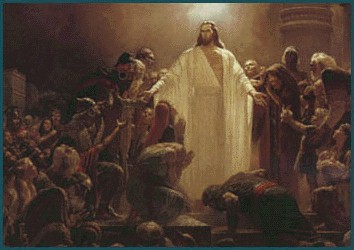
 Keep
your eyes open!...
Keep
your eyes open!...

July 30, 2025
(1Co
9:24-25) Know you not that they that run in the race, all run indeed,
but one receiveth the prize. So run that you may obtain. And every one
that striveth for the mastery refraineth himself from all things. And
they indeed that they may receive a corruptible crown: but we an
incorruptible one.
CRISIS MAGAZINE: Martyrs of Today
MARK MALLET BLOG: Out of My Control
ACN: Dozens killed in another church massacre in DR Congo
At least 40 people, including many children, were killed in a massacre
in the Democratic Republic of the Congo, in the early hours of Sunday,
July 27.
The attack took place in the east of the country, in the location of Komanda, Ituri.
According to information gathered by pontifical foundation Aid to the
Church in Need (ACN), the victims were killed by militants from the
Allied Democratic Forces (ADF), a terrorist group that has pledged
loyalty to the Islamic State and has committed many such atrocities in
the DRC.
Fr. Marcelo Oliveira, a Comboni missionary who has been in the DRC for
many years, told ACN that the victims were part of a movement called
Eucharistic Crusade and were participating in a prayer vigil, as part
of a summer holiday formation session.
“The attack occurred at around 1 o’clock in the morning. The rebels
entered the church and murdered a large number of children, both inside
the church building and in the compound,” he said in a message sent to
the Portuguese office of ACN.
The priest added: “We continue to pray for peace in this immense
country and to ask for the grace of peace.” An inspection of the scene
showed that the victims were shot and hacked to death with machetes.
The total death toll has not been confirmed but is around 40 people,
possibly more.
According to a local UN-backed radio station, the rebels came from an
area located around 7.5 miles away. The terrorists also set fire to
several homes and shops in Komanda, returning into the darkness of the
bush before the security forces arrived at the scene.
The DRC continues to be steeped in terrible violence, preventing
development and hindering the ordinary lives of civilians. Among the
many groups that fight each other throughout the country, the ADF has
become known for its particular cruelty. In February of 2025, the
Islamists murdered around 70 people in a Protestant church in Lubero,
and in 2024, several Christians were killed in North Kivu. Several
international organizations and figures, including the foreign ministry
of Italy and the Bishops’ Conference of France, have already publicly
condemned this latest massacre.
ACN urges all parties to strive to protect civilians and places of
worship in the Democratic Republic of Congo and calls on its friends
and benefactors to pray for the victims of this horrific attack, and
for peace to finally arrive in this African country.
MORE: Catholic News World Report
POPE LEO XIV: ”May the blood of these martyrs become a seed of peace, reconciliation, fraternity, and love for the Congolese people”.
Ladder
of Divine Ascent excerpt: Step 1- "On Renunciation of the World"
10. Those who enter this contest must renounce
all things, despise all things, deride all things, and shake off all things,
that they may lay a firm foundation. A good foundation of three layers
and three pillars is innocence, fasting, and temperance. Let all babes
in Christ begin with these virtues, taking as their model the natural babes.
For you never find them in anything sly or deceitful. They have no insatiate
appetite, no insatiable stomach, no body on fire, or raging like a beast;
but perhaps as they grow, in proportion as they take more food, their natural
passions also increase.

July 28, 2025
(Joh
8:31-32) Then Jesus said to those Jews who believed him: If you
continue in my word, you shall be my disciples indeed. And you shall
know the truth: and the truth shall make you free.
CERC: John Paul II and the Truth about Freedom
FR.ROBERTO M. CID: True Freedom
PATHEOS: A Church of Sentiment Over Substance
FATHER CLODOVIS BOFF: Letter
written for the conclusion of the 40th General Assembly of CELAM (the
Council of Bishops of Latin America and the Caribbean)
Boff's central observation is that the document does not speak of God
or Christ, who are mentioned only in passing. As has been the case
since at least the Medell�n Assembly in 1969, the document limits
itself to addressing social and economic challenges and envisioning a
church that is "merciful, synodal, and outgoing . . . a church that
listens and learns from the light that the Spirit offers to all God's
people, allows itself to be challenged by the cries of the people, and
has the courage to commit itself to them." "Dear elder brothers,"
observes Father Clodovis, "don't you see that this music is becoming
boring? When will you give us the good news about God the Father,
Christ, and his Spirit? About grace and salvation? About conversion of
heart and meditation on the Word? About prayer and adoration, devotion
to the Mother of the Lord, and other similar topics? When will you
finally announce a truly religious and spiritual message to us?" I read
your list of today's "cries" and "challenges," and I see that it is
nothing more than what journalists and sociologists commonly say. It is
useful to recall that the Church is, above all, a 'sacrament of
salvation' and not merely a social institution, progressive or not.
According to Boff, the consequences are: "Our Church is losing its
sheep. We see empty churches, seminaries, and convents around us. In
Latin America, seven or eight countries no longer have a Catholic
majority. Brazil itself is well on its way to becoming 'the largest
ex-Catholic country in the world.'
EXCERPT CARDINAL ROBERT SARAH HOMILY: “Do Not Profane France with Barbaric and Inhuman Laws”
The False Western Vision of Religion
Too often in the West, religion is presented as an activity in the
service of human well-being. Religion is equated with humanitarian
efforts, acts of charity, the welcoming of migrants and the homeless,
the promotion of universal fraternity and peace in the world.
Spirituality is viewed as a form of personal development, meant to
offer some comfort to modern man absorbed in his usual political and
economic pursuits.
Even if these matters are important, this vision of religion is false.
Religion is not a matter of food or humanitarian action. In the desert,
this was the first temptation that Jesus rejected. To redeem humanity,
one must overcome the misery of hunger and poverty—this is what the
devil proposed to the Lord. But Jesus replied that this is not the path
of redemption. He shows us that even if all people had enough to eat,
even if prosperity extended to all, humanity would not be redeemed.
We see clearly how, in lands of comfort, wealth, and abundance, man
destroys himself, self-destructs, because he forgets God and thinks
only of his riches and earthly well-being. What saves the world is the
bread of God. Man must be nourished with the bread of God—and the bread
of God is Christ Himself. What will save the world is man kneeling
before God, to adore and to serve Him. God is not at our service. It is
we who are at His service.
Silent Adoration as the Only Remedy
We were created to praise and adore God. It is in the adoration of God
that we discover our true dignity, the ultimate reason for our
existence. It is on his knees before God that man discovers his true
greatness and nobility. And if we do not adore God, we will end by
adoring ourselves.
God has chosen this place to be adored. God has chosen France to be as
it were a holy land, a land set apart for Him. Do not profane France
with your barbaric and inhuman laws that promote death, when God wills
life. Do not profane France, for it is holy ground, a land reserved for
God. Brittany is sacred ground and must remain sacred ground—a land set
apart for God. God must have the first place there.
And our first task is to adore and glorify God. It is the highest
expression of our gratitude to Him and the most beautiful response our
life can offer to the extraordinary love He bears us. To adore God, one
must set oneself apart—in silence. Come here in the silence of the
heart, to listen to God. This is what it means to enter into a sacred
disposition.
There are sacred places, places set apart for God, chosen by God—these
places must not be profaned by any activity other than prayer, silence,
and the liturgy.
Our churches are not theatres, nor concert halls, nor venues for
cultural or recreational events. The church is the house of God. It is
reserved for Him alone. We enter it with reverence and veneration,
properly clothed, because we tremble before the greatness of God. We do
not tremble out of fear, but out of reverence, awe, and wonder.
Ladder
of Divine Ascent excerpt: Step 1- "On Renunciation of the World"
9. All who enter upon the good fight, which is
hard and close, but also easy, must realize that they must leap into the
fire, if they really expect the celestial fire to dwell in them. But let
everyone examine himself, and so let him eat the bread of it with its bitter
herbs, and let him drink the cup of it with its tears, lest his service
lead to his own judgment.
July 25, 2025
(Joh 20:23) Whose sins you shall forgive, they are forgiven them: and whose sins you shall retain, they are retained.
CATHOLIC STAND:
Once, in Italy, there was man who was worried about going to
confession. He felt embarrassed. He thought the priest would remember
his sins. The man was on his way to the Basilica one day for Mass and
Jesus appeared to him. This happened every time he was on his way to
Mass. He was afraid to tell anyone because he feared they would think
he was crazy, or, worse, that he was making it up for attention.
Finally, after Mass one day, he
approached the bishop and told him that he has seen the Lord several
times. This bishop thought for a moment and then told the man, “Next
time you see Jesus, ask Him what the last sin I confessed was.” The
next day, on his way to Mass, the man saw Jesus again. This time, when
he fell to his knees, he said, “Lord, please don’t go. I told the
bishop that I see you and I don’t think he believes me.” The man said
to Jesus, “The bishop asked me to ask You what the last sin he
confessed was.” Jesus smiled at the man and said, “Tell the bishop, I
don’t remember.”
FATHER MARK VIDEO SHORT: They Dismiss What Their Soul Desperately Needs
FISHEATERS OVERVIEW: The Sacrament of Penance
CATHECHISM: The Sacrament of Penance and Reconciliation
CATHOLIC COURIER: Five things to know about the sacrament of reconciliation
Jesus himself instituted the sacrament of penance
1. Jesus instituted the sacrament of penance when he appeared to the
apostles on Easter Sunday night. In the Gospel of John, Jesus breathes
on the apostles and tells them, “Receive the Holy Spirit. Whose sins
you forgive are forgiven them, and whose sins you retain are retained”
(20:22-23).
The sacrament of penance has changed over the centuries
2. The sacrament of penance looked a lot different in the early church.
In St. Paul’s writings (for example, 1 Cor 5:3-5; 2 Cor 2:7-11), we see
the apostles’ role in placing sinners under bans of excommunication and
then reconciling them. It also seems there was an initial custom of
public confession of sins, but that seems to have ended early on. By
the fifth century, church leaders actively discouraged the practice.
In some regions, it was common for people guilty of serious sins (like
apostasy, adultery or murder) to be enrolled as “public penitents,”
meaning they dressed in sackcloth and ashes and performed prescribed
penances and almsgiving. They then would be reconciled publicly with
the church on the Thursday before Easter.
Innovations by Irish monks led to the practice of the sacrament of penance
3. We owe it to Irish monks for several innovations that led to the
practice of the sacrament of penance as we recognize it today. They
formalized the practice of confession of sins made privately to a
priest, and under a seal of secrecy, and absolution was granted before
penance, usually also private, was performed. This Celtic practice of
immediate absolution became very popular and was spread throughout
Europe through the Irish monks’ missionary endeavors.
The Council of Lyons formally defined penance as a sacrament
4. During the Middle Ages, theologians all recognized penance as a
sacrament of the church, but disagreed on fine points like whether
forgiveness came about through the grace of the person’s sorrow, or
through the grace of the priest’s absolution. St. Thomas Aquinas, using
scholastic terms, defined the “matter” of the sacrament as the
penitent’s sorrow, and the “form” as the priest’s absolution.
The second Council of Lyons, France, in 1274 formally defined penance as a sacrament.
But it was the Council of Trent, Italy, in the mid-16th century that
really made extensive clarifications to the sacrament. It devoted some
nine chapters and 15 canons on sin and penance. The Second Vatican
Council also dwelled on the sacrament, emphasizing its healing nature.
Why is this sacrament known by so many names?
5. Why do we use both “reconciliation” and “penance” to describe the
sacrament? Reconciliation and penance are two different aspects of the
sacrament. Reconciliation refers primarily to the process by which
someone who is in serious sin returns to the full communion of the
church through confession and absolution.
Penance refers to the process by which someone who is guilty of lesser
sins and who has not broken communion with the church through mortal
sin continues his or her life in the church by spiritual growth and
conversion via sacramental confession.
This distinction between reconciliation and penance also serves to
orient people as they prepare for the sacrament. (The Catechism also
refers to it as the “sacrament of forgiveness” and the “sacrament of
conversion.”)
Ladder
of Divine Ascent excerpt: Step 1- "On Renunciation of the World"
8 (cont.). But let us who are weak and passionate
have the courage to offer our infirmity and natural weakness to Christ
with unhesitating faith, and confess it to Him; and we shall be certain
to obtain His help, even beyond our worth, if only we continually plunge
to the depth of humility.
July 23, 2025
(Mat
5:14-16) You are the light of the world. A city seated on a mountain
cannot be hid. Neither do men light a candle and put it under a bushel,
but upon a candlestick, that it may shine to all that are in the house.
So let your light shine before men, that they may see your good works,
and glorify your Father who is in heaven.
Charles J. Chaput, O.F.M. Cap.:
But cheap faith—faith without a cost—is an act of self-delusion. It
makes no disciples. It changes nothing about the world. And that’s
because no one is persuaded by a faith that’s indistinguishable from a
comfortable form of therapy. So this time of testing that we face
today is not a moment of defeat. It’s a moment of privilege. What we
need now is to awake again to the measure of God’s love, the price he
paid for our redemption—and the happiness, the real happiness, his
sacrifice makes possible for those who truly believe.
CRISIS MAGAZINE REVIEW: The Plight of Christians in the Holy Land Worsens
NEWS HEADLINES
“We return from Gaza with broken hearts”: Cardinal Pizzaballa at press conference in Jerusalem
New Wave of Violence Against Syria's Christians
“What is happening to Christianity in Nigeria is incomprehensible.”
A Pakastani Catholic arrested on false blasphemy charges
BISHOP JOSEPH STRICKLAND SUBSTACK: A Shepherd's Reflection: Standing with the Martyrs
I recently received a heartfelt message from a faithful Catholic in the
United States, troubled and grieving over the ongoing persecution of
Christians in Nigeria, Syria, and parts of the Middle East. Her
simple question struck my heart: “Is there anything we can do?” Yes –
there is much we must do.
We must first refuse to look away. The pain of the persecuted
Church is not distant from us. These are our brothers and
sisters. Their wounds are Christ’s wounds. Their blood
cries out from the earth, and far too many in positions of power –
political and ecclesial – remain silent.
In Nigeria, priests are abducted and killed. Entire Catholic
communities are burned to the ground. In Syria and Iraq, ancient
Christian communities that once thrived in the early centuries of the
Church have been nearly wiped away. And yet – amid this horror –
we find radiant faith. The Church in Nigeria boasts some of the
highest Mass attendance in the world, and vocations are
flourishing. These Christians, surrounded by danger, refuse to
deny Christ. They live as martyrs in spirit – and often in flesh.
Meanwhile, much of the Western Church sleeps. We debate
comforts. We tolerate heresy. We remain quiet while the
Body of Christ is torn and bleeding.
Where are the voices of world leaders? Where are the urgent
statements from powerful nations? There is silence – because the
suffering of Christians does not fit the preferred narrative.
Martyrdom does not trend. And so it is left to the faithful – to
you and me – to raise the cry of truth and to carry the burden of love.
Our Lord said, “If the world hate you, know ye, that it hath hated me
before you” (John 15:18). He promised us not ease, but the
cross. And the faithful in Africa and the Middle East bear that
cross with courage that should bring us to our knees.
So what can we do?
• Pray – fervently and daily – for the persecuted Church.
• Fast – offer sacrifice in solidarity with those who have lost everything.
• Speak – raise your voice in defense of the voiceless.
• Live the faith – boldly and publicly, as they do, unashamed of the Gospel.
• Help directly - contact organizations like Aid to the Church in Need
(ACN), the Catholic Near East Welfare Association (CNEWA), or the
Knights of Columbus Christian Refugee Relief. These Catholic
groups are actively providing material aid, rebuilding churches, and
supporting the faithful in Nigeria, Syria, Iraq, and surrounding
regions. You can send letters of support, financial gifts, or
prayer intentions through their sites.
• Share public appeals – you can share their public appeals on social media to amplify awareness and rally others to the cause.
We may not be called to shed blood, but we are all called to be
witnesses. May the suffering Church ignite in us a renewed fire
of fidelity, and may their example remind us that the Church is not
dying. She is bleeding. She is being purified. And
the blood of the martyrs is still the seed of the Church.
Let us never forget them. Let us live worthy of their sacrifice.
Ladder
of Divine Ascent excerpt: Step 1- "On Renunciation of the World"
8. Those who aim at ascending with the body to
Heaven, indeed need violence and constant suffering, especially in the
early stages of their renunciation, until our pleasure-loving dispositions
and unfeeling hearts attain to love of God and chastity by manifest sorrow.
This is a great toil, very great indeed, with much unseen suffering, especially
for those who live carelessly, until by simplicity, deep angerlessness
and diligence, we make our mind, which is a greedy kitchen dog addicted
to barking, a lover of chastity and watchfulness.
July 21, 2025
(Mic
6:8): You have been told, O mortal, what is good, and what the LORD
requires of you: Only to do justice and to love goodness, and to walk
humbly with your God.
GREEK ORTHODOX DIOCESE OF BOSRA-HAURAN SYRIA STATEMENT
(07/19/2025): "Glory to God in all things! I direct this message
to the entire world and call upon them to urgently intervene to stop
the terrorist massacres in Suwayda. I direct this humanitarian
plea to those of sound minds who love peace. The ongoing war in
Suwayda Governorate is a war of annihilation killing both young and
old. Therefore, I raise my voice loudly to the international
community and to the United Nations to help us. I hope this cry
reaches the whole world.
NEWS REPORT: Israel Defends Syria Strikes as Necessary to Stop 'Massacre' of Druze
SUBSTACK: How Israel Defended the Druze Against Syria
EXCERPT: Our Blood Covenant with the Druze
The Jewish state cherishes its relationship with the Druze community
which, since 1956, has volunteered to be conscripted into the
IDF. Since then Druze soldiers, policemen and security personnel
have paid disproportionately for Israel’s defense. The covenant
between Israel and the Druze stands as proof of Israel’s steadfastness
as an ally and our unswerving respect for their traditions and family
ties. Of course, Israel can do much more to ensure equal
opportunities and services for our fellow Druze citizens, but the very
least we can do for their embattled brethren in Syria is what Israel
would do for endangered Jews anywhere.
Israel should remain open to the possibility of achieving a
non-belligerency agreement, if not full peace, with the al-Sharaa
government in Damascus. But the ability of that Sunni-backed
regime to reconcile with Israel remains questionable, as does its
ability to survive long term in a country known for violent
coups. Irrespective, Syria will remain home to a large community
of Druze to which Israel in keeping with our “blood covenant” must
continue to protect.
HEADLINE: Israel delivers medical aid to Syria’s Sweida as ceasefire appears to stick
Israel delivered humanitarian aid and medical equipment to Syria’s
Druze-majority Sweida on Sunday, as a monitor and reporters said that
calm had returned to the Syrian province after a week of sectarian
violence between Druze fighters and rival groups that killed more than
1,100 people.
According to the Kan public broadcaster, Israel coordinated the
delivery with the United States, which in turn coordinated with the
Syrian government.
On Monday, the Health Ministry confirmed that it had transferred
medical equipment, including trauma care equipment and life-saving
medications, to the hospital in Sweida, via the IDF. It said that
the transfer was made after reports of severe damage to the medical
center during the fighting.
crates set to be filled with medical supplies and sent to a hospital in Sweida, Syria, amid sectarian violence there.
Israel delivered humanitarian aid and medical equipment to Syria’s
Druze-majority Sweida on Sunday, as a monitor and reporters said that
calm had returned to the Syrian province after a week of sectarian
violence between Druze fighters and rival groups that killed more than
1,100 people.
According to the Kan public broadcaster, Israel coordinated the
delivery with the United States, which in turn coordinated with the
Syrian government.
On Monday, the Health Ministry confirmed that it had transferred
medical equipment, including trauma care equipment and life-saving
medications, to the hospital in Sweida, via the IDF. It said that
the transfer was made after reports of severe damage to the medical
center during the fighting.
“The decision to join the mission is another expression of the values
??in accordance with which the health system operates, and the
long-standing alliance with our Druze brothers,” the health ministry
said, adding that there were plans to transfer additional medical
equipment and medications to the hospital in further batches.
It was reported by Syrian media on Sunday that four Israeli Air Force
helicopters dropped off the aid at the main hospital in Sweida.
The Health Ministry had announced Saturday that Israel’s security
forces would deliver medical equipment and medicine to a hospital in
Sweida that had been heavily damaged in the recent clashes, as soon as
it had received clearance to do so from all relevant authorities.
“Our brotherhood with the Druze community is well known, but beyond
that, we are committed to a ‘covenant of life.’ We cannot stand idly by
when members of the community — inside or outside Israel — are in
danger,” Health Minister Uriel Buso said of the decision.
The delivery came as a ceasefire announced on Saturday appeared to be
holding after earlier agreements failed to end fighting between the
Druze and Bedouin that spiraled to draw in the Islamist-led government,
the Israeli military and armed tribes from other parts of Syria.
Ladder
of Divine Ascent excerpt: Step 1- "On Renunciation of the World"
7 (cont.). The former are like those who are healed
of the passions of the soul by the care of physicians; these are they who
come out of Egypt. The latter are like those who long to put off the uncleanness
of the wretched body. That is why they need a helper, an angel, so to speak,
or rather, one equal to an angel. For in accordance with the corruption
of our wounds, we need a director who is indeed an expert and a physician.
July 18, 2025
(Rev 6:9-11) And
when he had opened the fifth seal, I saw under the altar the souls of
them that were slain for the word of God, and for the testimony which
they held: And they cried with a loud voice, saying, How long, O Lord,
holy and true, dost thou not judge and avenge our blood on them that
dwell on the earth? And white robes were given unto every one of them;
and it was said unto them, that they should rest yet for a little
season, until their fellowservants also and their brethren, that should
be killed as they were, should be fulfilled.
POPE LEO XIV:
I am deeply saddened to learn of the loss of life and injury caused by
the military attack on the Holy Family Catholic Church in Gaza. I
assure the parish community of my spiritual closeness. I commend
the souls of the deceased to the loving mercy of Almighty God, and pray
for their families and the injured. I renew my call for an
immediate ceasefire. Only dialogue and reconciliation can ensure
enduring peace!
SUBSTACK REPORT: Catholic church in Gaza attacked by Israeli Army
OFFICIAL STATEMENT: Statement of the Latin Patriarchate of Jerusalem
After a complex day of difficult consultations, we are now able to communicate as follows:
This morning, at approximately 10:20 a.m., the Compund of the Holy
Family in Gaza, belonging to the Latin Patriarchate, was struck by the
Israeli army. As of this hour, three individuals lost their lives
as a result of the injuries sustained and ten others were wounded,
including one in critical condition and two in serious condition.
The community’s parish priest, Father Gabriel Romanelli, sustained
light injuries.
The people in the Holy Family Compund are people who found in the
Church a sanctuary—hoping that the horrors of war might at least spare
their lives, after their homes, possessions, and dignity had already
been stripped away. On behalf of the entire Church of the Holy
Land, we extend our deepest condolences to the bereaved families, and
from here, we offer our prayers for the swift and full recovery of the
wounded.
The Holy Father has conveyed his own heartfelt condolences, his solidarity with them, and his prayers on their behalf.
The Latin Patriarchate strongly condemns this tragedy and this
targeting of innocent civilians and of a sacred place. However,
this tragedy is not greater or more terrible than the many others that
have befallen Gaza. Many other innocent civilians have also been
harmed, displaced and killed. Death, suffering and destruction
are everywhere.
The time has come for leaders to raise their voices and to do all what
is necessary in order to stop this tragedy which is humanly and
morally, unjustified.
This horrific war must come to a complete end—so that we may commence the long work of restoring human dignity.
We embrace all those in the compound and stand with them in this
painful hour, as they bury members of the community. We express
our gratitude to all those who are sharing their condolences and
sympathy with the Patriarchate and the church.
We will continue to stand by the side of the community of Gaza and do all that what is within our power to support them.
May the souls of the victims rest in eternal peace and may the Lord grant you all His Peace.
VIA ACN: Children caught in the bombardment
For months, the Holy Family parish had been a refuge for around 500
Christians, including displaced families from across Gaza. Among
them were children who shared their dreams and fears with ACN only days
before the attack—dreams now overshadowed by uncertainty, as the
classrooms where they found shelter are heavily damaged.
Julia, 10 years old, said: “I have been at the church since the
beginning of the war. I live with my family in a classroom at the
Latin convent. I have two sisters: Leila, who is 13 years old,
and Natalie, who is 9. I miss school and my friends. I
dream of becoming a dermatologist. When I am afraid, my family
gives me a sense of safety. I hope the war ends well, everything
reopens, and everyone returns to their home.”
Tarek, 14 years old, echoed the same longing for normal life: “I have
been staying at the Latin Church for about eight months. I live
with my family in a classroom. I have two sisters. I miss
school and my classmates. Sometimes I wake up and things are
calm, there is no shelling, so I go and help at the Latin Church.
I dream of becoming a doctor. My parents give me a sense of
safety. I hope the war ends, that everyone returns to their
homes, and that the crossing reopens.”
The status of Julia, Tarek, and the other children who are sheltering
in the parish is currently uncertain. Due to the extensive damage
to the compound, no information about their condition is available at
this time. This situation highlights the critical need for peace
and humanitarian access.
Call for Prayer and Support
Aid to the Church in Need is urgently calling for prayers for peace and
for those impacted by this tragedy, including Fr. Romanelli and
the children.
Humanitarian aid is critically needed, as thousands remain without access to medical care and essential resources.
The Christian community in Gaza numbers around 500 people, including
refugees from other parishes and about 200 members of the Greek
Orthodox Church. The Latin parish has become a vital refuge,
offering shelter, medicine, and support not only to Christians but also
to thousands outside the compound who lack basic necessities.
Ladder
of Divine Ascent excerpt: Step 1- "On Renunciation of the World"
7. Those of us who wish to go out of Egypt, and
to fly from Pharaoh, certainly need some Moses as a mediator with God and
from God, who, standing between action and divine vision, will raise hands
of prayer for us to God, so that guided by him we may cross the sea of
sin and rout the Amalek of the passions. That is why those who have surrendered
themselves to God deceive themselves if they suppose that they have no
need of a director. Those who came out of Egypt had Moses as their guide,
and those who fled from Sodom had an angel.
July 16, 2025
(Luk 1:49) Because he that is mighty hath done great things to me: and holy is his name.
EWTN VIDEO: Our Lady of Mount Carmel with Fr. Dan Cambra, MIC
REVIEW: The Origins of Devotion to Our Lady of Mount Carmel
TESTIMONIES
MY CATHOLIC LIFE: Our Lady of Mount Carmel
At the base of Mount Carmel, on the northwest coast of Israel, lies a
Carmelite monastery named Stella Maris, Latin for “Star of the Sea.”
This monastery is built over a cave believed to have been where the
prophet Elijah, inspired by God, challenged 450 prophets of Baal in a
contest to the death. Elijah triumphed. Shortly after, Elijah
prophesied the end of a three-year drought when, in the passage above,
his servant reported to him that he saw a “cloud as small as a man’s
hand rising from the sea.” That small cloud quickly transformed into a
heavy rainfall over the parched earth. Later Carmelites interpreted
Elijah’s vision as a prefiguration of the Blessed Virgin Mary. She was
seen as the small cloud rising from the sea, a true “Star of the Sea,”
and the rain that would emerge from her to end the three-year drought
was perceived as the grace and mercy poured out by her Son, Jesus.
It is believed that following the time of Elijah, other hermits
emulated Elijah and his successor, Elisha, by becoming hermits in the
caves of Mount Carmel. Although some traditions hold that these holy
hermits embraced Christ and lived on this sacred mountain from the time
of Christ, written records only confirm their presence from the
thirteenth century onwards. It was then, in 1209, that a group of
hermits asked Bishop Albert, the Latin Patriarch of Jerusalem, to
provide them with a rule of life. Bishop Albert did so, and the Order
of Brothers of The Blessed Virgin Mary of Mount Carmel, later known as
the Carmelites, was formed. One of their first acts was to erect a
chapel dedicated to Mary, Star of the Sea, Stella Maris. In 1226, their
rule was approved by Pope Honorius.
Shortly after the order’s founding on Mount Carmel, Muslim invaders
conquered nearby territories, leading some of the hermits to flee from
the Holy Land to other parts of Europe, including Aylesford, England.
Though records are uncertain, it is believed that one of the first men
to join the Carmelite hermits in England was a man named Simon Stock.
The Carmelites were a new form of religious life, living as hermits
rather than as a more ordered community like the Benedictines,
Cistercians, and Augustinians. As a result, they found it challenging
to gain wide acceptance. In 1247, Simon Stock is believed to have been
elected Superior General of the Carmelites at the age of eighty-two. In
an attempt to help the new order gain wider acceptance within the
Church, Simon and his fellow hermits sought out the intercession of the
Blessed Virgin Mary. She responded and, in 1251, appeared to Simon
while holding the Christ Child in one arm and a brown scapular in the
other. She said to him, “Receive, my beloved son, this habit of thy
order: this shall be to thee and to all Carmelites a privilege, that
whosoever dies clothed in this shall never suffer eternal fire…It shall
be a sign of salvation, a protection in danger, and a pledge of peace.”
In the centuries that followed, the Carmelites continued to develop a
deep devotion to the Blessed Virgin Mary, especially clothing
themselves in the scapular habit and developing liturgies in her honor.
In the fifteenth century, the Carmelite order expanded to include women
in religious service and also developed into a lay third order. In
1726, Pope Benedict XIII placed this Carmelite devotion to our Blessed
Mother on the universal calendar of the Church under the title of Our
Lady of Mount Carmel.
Ladder
of Divine Ascent excerpt: Step 1- "On Renunciation of the World"
6. The man who has withdrawn from the world in
order to shake off his own burden of sins should imitate those who sit
outside the city among the tombs, and should not cease from his hot and
fiery streams of tears and voiceless heartfelt groanings until he, too,
sees that Jesus has come to him and rolled away the stone of hardness from
his heart, and loosed Lazarus, that is to say, our mind, from the bands
of sin, and ordered His attendant angels: Loose him from passions, and
let him go to blessed dispassion. Otherwise he will have gained nothing.
July 14, 2025
(Joh
11:54) Wherefore Jesus walked no more openly among the Jews: but he
went into a country near the desert, unto a city that is called Ephrem.
And there he abode with his disciples.
POPE LEO XIV:
"Brothers and sisters, let us not forget to pray for peace and for all
those who, because of violence or war, find themselves in a state of
suffering and need".
FIDES.ORG: Israeli settlers attacks threaten the Christian village of Taybeh
Today, Ephraim is the name of Taybeh, a Palestinian village in the West
Bank, a few kilometers northeast of Jerusalem. The Christian community
has been present here for two thousand years, and the village is still
entirely inhabited by Christian Arabs.
Yesterday, Tuesday, July 8, Israeli settlers set several fires near the
town cemetery and the ancient 5th-century Church of St. George,
threatening one of the oldest religious sites in Palestine. This was
reported by priests Daoud Khoury, Jacques-Noble Abed, and Bashar
Fawdeh, who oversee the three Christian communities of Taybeh (and thus
the Greek Orthodox, Latin Catholic, and Greek Melkite believers).
In a joint statement written "on behalf of the people of our city and
our parishioners," the three priests describe an emergency situation
characterized by "a series of serious and repeated attacks against our
city, threatening its security and stability and affecting the dignity
of its inhabitants and its holy sites."
"Had the residents not been vigilant and the intervention of the
firefighters," the text states, "a major catastrophe would have
occurred. In a scene marked by daily provocations, the settlers
continue to graze their cows on Taybeh's farmland, amidst fields
belonging to families in the city, and even near their homes, without
any intervention or deterrence from the relevant authorities." And
"these attacks," the priests say, "are not limited to provocations;
they also directly damage the olive trees, which are the main source of
income for citezens, and prevent farmers from accessing and cultivating
their land."
The eastern part of the village of Taybeh, which covers more than half
of the town's territory and where most agricultural activities take
place, "has become an open target for the illegal settlers, who are
quietly expanding under the protection of the army and serving as a
springboard for further attacks on the land and people."
In the message, the priests also appeal to local and international
bodies, "especially diplomats and church representatives from around
the world," calling for "an immediate and transparent investigation
into the arson attacks and the ongoing attacks on property, farmland,
and holy sites, as well as for pressure on the occupying authorities to
stop the settlers' practices and prevent them from entering the city's
farmland or grazing their livestock there."
NEWS REPORT: 'Footnote in history': Australian woman fears for the future of family's ancient village
SUBSTACK: An Open Letter to US Ambassador to Israel Mike Huckabee
SEETHEHOLYLAND.NET: Taybeh
Taybeh (pronounced Tie-bay) is 30 kilometres northeast of Jerusalem and
12 kilometres northeast of Ramallah. From its elevated site between
biblical Samaria and Judea, it overlooks the desert wilderness, the
Jordan Valley, Jericho and the Dead Sea.
Living amidst Muslim villages, Israeli settlements and military
roadblocks, Taybeh’s inhabitants (numbering 1300 in 2010) are intensely
proud of their Christian heritage.
The village’s Greek Orthodox, Roman Catholic (Latin) and Greek Catholic
(Melkite) communities maintain an ecumenical spirit — even celebrating
Christmas together on December 25 according to the Western calendar and
Easter according to the Eastern calendar.
The village of Taybeh was first settled by Canaanites about 2500 years
before Jesus came to visit. It is mentioned as Ophrah (or Ofrah), a
town of the tribe of Benjamin, in Joshua 18:23, and shown on the
6th-century Madaba mosaic map as “Ephron also Ephraia where went the
Lord”.
The Muslim sultan Saladin changed the biblical name to Taybeh (meaning
“good and kind” in Arabic) around 1187 after he found the inhabitants
hospitable and generous.
The villagers regard St George — whose traditional birthplace is Lod,
near Tel Aviv airport — as their patron. The Greek Orthodox and Melkite
churches are both named in his honour.
They also see the pomegranate as a symbol of the fullness of Jesus’
suffering and Resurrection. This fruit appears as a motif in religious
art in Taybeh.
A tradition says Jesus told the villagers a parable relating to this
fruit, whose sweet seeds are protected by a bitter membrane. Using this
image, Jesus explained that to reach the sweetness of his Resurrection
he had to go through the bitterness of death.
Ladder
of Divine Ascent excerpt: Step 1- "On Renunciation of the World"
5. All who have willingly left the things of the
world, have certainly done so for the sake of the future of the Kingdom,
or because of the multitude of their sins, or for love of God. If they
were not moved by any of these reasons, their withdrawal from the world
was unreasonable. But God who sets our contests waits to see what the end
of our course will be.
July 11, 2025
(Jer
1:17-19) Thou therefore gird up thy loins, and arise, and speak
unto them all that I command thee: be not dismayed at their faces, lest
I confound thee before them. For, behold, I have made thee this day a
defenced city, and an iron pillar, and brasen walls against the whole
land, against the kings of Judah, against the princes thereof, against
the priests thereof, and against the people of the land. And they shall
fight against thee; but they shall not prevail against thee; for I am
with thee, saith the LORD, to deliver thee.
FR. JOHN HARDON, S.J.: We
are living in the most critical age of human history. Too many
Catholics are passive, silent, indifferent while the enemies of Christ
are active, vocal, and militant. Where is our faith? Where
is our zeal?”
CRISIS MAGAZINE: Take Courage and Show Thyself a Man
CATHOLIC ANSWERS: The Real Story of Christ’s Warrior-Monks
TRADITION AND SANITY SUBSTACK: Preventing a Priestless Future; How the Church must reclaim the sacred masculinity it abandoned
The Catholic Church on earth has a priest problem. A big
one. Not the kind you read about in headlines. The kind you
see in empty seminaries. The kind that shows up in statistics and
makes Vatican officials sweat through their vestments.
Over the last five decades, America has lost 40% of its priests.
France ordains fewer men each year than most suburbs produce high
school graduates. German seminaries remain largely empty.
Ireland struggles to fill even a single seminary class. The same
institution that survived Roman persecution, barbarian invasions, and
two world wars can’t convince young men to become priests.
Something fundamental has broken.
The spiritual entropy isn’t just outside the Church—it’s inside the
rectory. Modern priests spend more time in committee meetings
than in prayer. They spend more time worrying about parish
budgets than souls. They trade the language of sin and salvation
for soft talk about “journeys” and “lived experiences.” The priesthood
was stripped of everything that made it attractive to brave men.
Early Church priests faced lions—literally. They were stoned,
beheaded, and burned alive. They knew the job might kill
them. They took it anyway. Today’s priests face parish
council meetings and liturgy planning committees. Far from being
warriors, they are middle managers. Administrators, not heroes.
No young man dreams of presiding over bingo night. He dreams of
slaying dragons. When that dream dies, so does the calling.
If that sounds harsh, good. It should. Because if the
Church were thriving, I wouldn’t need to write this.
One of the deepest, least acknowledged reasons young men are fleeing
the priesthood is this: it’s been feminized in all the wrong ways and
stayed masculine in all the wrong ways. Let me explain.
We’ve turned a calling that once demanded foresight and fortitude into
something soft, bureaucratic, and vaguely apologetic. Every
homily must now be a gentle conversation. Every statement, a
balancing act. Dialogue replaces declaration. Offense is
treated as heresy. The Gospel gets strained through the filter of
therapy-speak and HR lingo until it has the moral clarity of
twice-brewed lukewarm tea.
But while the message gets softer, the structure stays hard.
Celibacy? Still required. Marriage? Off the
table. You’ve got the bones of ancient sacrifice—but none of the
spirit that once made it noble. The worst of both worlds.
All the cost of traditional masculinity with none of the glory.
Young men see it. They feel the contradiction deep in their
gut. They’re told to renounce sex, fatherhood, and the comfort of
a partner — not for the thrill of spiritual warfare, not to offer the
mighty sacrifice of heaven and earth, not to baptize new nations or
stare down tyrants — but to attend diocesan diversity seminars and send
reminder emails about parish bake sales. They’re expected to
become celibate shepherds of a flock that would rather they just smiled
more and stayed quiet. It’s like training to be a Navy SEAL and
getting assigned to customer service. “Congratulations, you’ve
completed Hell Week. Here’s your headset — you’ll be taking
complaints about the communion wafers being too bland.” Meanwhile, the
Church keeps wondering where all the warriors went.
The masculine spirit hasn’t died. Not really. It’s just been insulted.
If you’re going to ask a man to sacrifice everything — his body, his
future, his legacy — then you had better provide him with a mission
that justifies that sacrifice. The early Church understood this,
indeed the Church of every age before our own. It didn’t just
tolerate masculine energy. It demanded it. The saints
didn’t avoid danger. They sprinted towards it. The
priesthood wasn’t a role. It was a war post.
Real men don’t mind rules and don’t fear sacrifice. What they
can’t stand is hypocrisy. What repels them is a structure that
demands heroic restraint while rewarding cowardly conformity.
They need clarity. They need ranks to climb, missions to
complete, a brotherhood to belong to. The tragedy is that the
Church already has all of this. It just forgot how to present it
(and some of its leaders stopped believing in it). And
men—especially the kind who once would’ve walked barefoot into
martyrdom—have taken the hint. They’re walking away.
.........
A real priest doesn’t look like someone you’d “follow” on your
screen. He looks like someone who’s seen something you
haven’t. He moves through the world marked. Set
apart. Other. He’s supposed to be strange — in a good
way. He’s supposed to unsettle the room just by entering
it. In my opinion, this is what we’ve lost completely. The
sense that priests are different. Not better than laypeople, but
different. Called to something that requires a fundamental
reordering of priorities, desires, and daily life.
Instead, we’ve made them accessible. Relatable. “Just like
us, but with a collar.” We’ve stripped away the mystery and wonder why
the mystique is gone. We’ve made them friendly and approachable
and then act shocked when young men don’t see anything worth
sacrificing for.
The problem runs deeper than recruitment strategies or seminary
reforms. It runs to the heart of what we think the priesthood is
for. If priests are just therapeutic facilitators with
sacramental authority, then frankly, we don’t need that many of
them. A few social workers with the power to consecrate bread
will suffice. But if priests are bridges between heaven and
earth, if they’re meant to be walking reminders that another world
exists, if they’re supposed to smell like eternity and move like men
who’ve touched the divine — then we need to start acting like it.
We need to stop apologizing for the strangeness of the calling and
start celebrating it. We need to stop making excuses for celibacy
and start presenting it as what it is: a radical witness to the primacy
of the eternal over the temporal. Most importantly, we need to
stop trying to make the priesthood appeal to everyone and start making
it appeal to the right men. The men who don’t want a job — they
want a mission. The men who don’t want comfort — they want
conquest. The men who don’t want to fit in — they want to stand
out for something that matters.
These men still exist. They’re not scrolling through seminary
websites looking for career counseling. They’re not impressed by
digital outreach campaigns or diversity initiatives. They’re
looking for something real. Something dangerous. Something
worth dying for. And when they find it — when they encounter a
Church that believes in its own message enough to demand sacrifice,
that values beauty enough to surround itself with it, that takes the
priesthood seriously enough to make it both terrifying and irresistible
— they won’t need to be recruited. They’ll come running.
So yes, let’s make priesthood great again. To achieve this,
however, we must make priests radiate with something the world doesn’t
fully understand. When that happens, you won’t need a digital
campaign. Because men won’t be scrolling. They’ll be going
unto the altar of God, the God who gives joy to their youth.
VIA: Sam Guzman’s book, The Catholic Gentleman: Living Authentic Manhood Today (2019):
“Holiness: The word is haloed by mystique. For some, it is an
appealing and enthralling word, inspiring struggle toward a goal.
For others, it is an intimidating word, signaling an impossibly remote
and unattainable ideal…The simple fact, though, is that holiness isn’t
for a select few; it is for every everyone. Holiness consists in
one thing only: obedience to the will of God at every moment.
That’s it. Seek God’s will and do it, and you will be holy; you
will be a saint. Being holy is not always easy. For Jesus,
it was “horrifically painful” but it saved us for our sins. Being
holy is not just a matter of showing up at church occasionally.
It starts there. We grow by showing up, day after day. We mature
by never quitting, despite frequent falls, discouragement, and
darkness”.
Ladder
of Divine Ascent excerpt: Step 1- "On Renunciation of the World"
4. The irreligious man is a mortal being with a
rational nature, who of his own free will turns his back on life and thinks
of his own Maker, the ever-existent, as non-existent. The transgressor
is one who holds the law of God after his own depraved fashion, and thinks
to combine faith in God with heresy that is directly opposed to Him. The
Christian is one who imitates Christ in thought, word and deed, as far
as is possible for human beings, believing rightly and blamelessly in the
Holy Trinity.
July 8, 2025
(Rev
21:4) And God shall wipe away all tears from their eyes: and death
shall be no more. Nor mourning, nor crying, nor sorrow shall be any
more, for the former things are passed away.
FROM THE MAILBAG VIA DAVID:
During this time of mourning, may I suggest that you have your parish
priest say a Mass for one of the victims of this terrible flood. If
they are already in Heaven, God will allow that Mass to be applied to a
soul that might be forgotten in this catastrophe. If you want to have
more than one Mass said, all the better.
Please keep their families in your prayers as well as the rescue workers.
THE CATHOLIC THING: Why Suffering?
X: Where Was God in the Texas Flood?
The sandals are still by the door. Her toothbrush is dry. There are
fingerprints on the car window that no one can bring themselves to wipe
away.
She was seven.
On the Fourth of July, she slipped beneath the water and did not come
back. She was not alone. Her sister was found close by, their fingers
still laced together. As if one last act of love might hold the river
back.
Sometimes, the sky just breaks open and nothing is ever the same. When
time becomes before and after. When pain is not a page in someone
else’s story, but the sound of your own heartbeat.
This is one of those moments.
And what can be said now? What words can rise in a flood of pain so
sudden, so wide, that entire families are washed into silence?
Still…we must speak. We must try.
Not to explain away the ache. Not to tidy up the tears. But to tell the
truth, because silence leaves a vacuum, and in that vacuum, where truth
stays quiet, shadows multiply: that this was meaningless, that God is
cruel, that death always wins.
Let me speak, then, not as one above the sorrow but as one who believes there is a God who entered it.
The Ache We Cannot Escape There is a question rising in the throat of every mother whose arms are empty tonight:
Where was God?
If God is love, where was He when the river rose? If God is powerful,
why didn’t He stop it? If God is wise, why did the storm come at all?
That question is not a sign of disbelief. It is a cry of faith that
feels betrayed. It is the heart’s protest that says: I know You’re
there, but I cannot understand You.
And that’s important.
Atheism has no right to ask why. It has no category for meaning. But
grief demands an answer because we know, in our bones, that things are
not as they should be. We rage at death because somewhere deep in our
soul we remember Eden. We remember a garden where death did not belong.
We rage against death because something in us remembers how it used to
be. It is evidence. The way your heart recoils at caskets and coffins
is not weakness…it is a whisper of the world we lost.
And the world we long for.
The Suffering That Shook the Heavens But here’s the question grief never expects: What if God grieved first?
What if He didn’t stand above suffering, but walked straight into it?
He did.
His name is Jesus.
He didn’t come as a king in gold. He came as a child in straw. Born to
peasants too poor to afford a proper sacrifice. Raised in a forgotten
town. Misunderstood, slandered, betrayed, beaten. And then He was
crucified.
You’ve heard the story so often, maybe it doesn’t shake you anymore. But let it.
The Eternal Son of God, hanging naked, bleeding before His mother. Not
just dying. Being judged. Treated as if He had committed every sin of
everyone who would ever believe. The One who knew no sin became sin.
And the Father turned His face away.
“My God, my God, why have You forsaken Me?” That was the cry that
echoed across the sky. That was the moment the earth trembled. That was
the night sorrow pierced heaven itself.
And that, dear reader, is the only reason we can speak hope into tragedy.
Because three days later, the tomb cracked open. And death blinked.
He is alive. Still scarred, but alive. And one day, every grave will
lose its grip. Every river will be rolled back. And every child in
Christ will rise.
The Suffering God Allows and Enters But what about now?
What about the parent who holds a balloon they meant to give their daughter but now releases into the sky with tears?
There is a kind of suffering God allows, so that we might wake up. When
tragedy comes, the wrong question is, “Why them?” The harder and holier
question is: “Why not me?” We live in a world we did not make, with a
breath we did not earn, in bodies we did not design. Every heartbeat is
borrowed. And every moment is mercy.
Jesus once spoke of a tower that fell and crushed eighteen people. His
words were sharp and strange: “Do you think they were worse sinners
than all others? No. But unless you repent, you will all likewise
perish.” He wasn’t being cruel. He was being clear. Suffering is a
trumpet blast: turn around. Come home.
There is another kind of suffering God gives. The suffering of conviction.
When the Spirit of God shows you that your greatest problem is not
what’s happened to you, but what lives inside you. When your eyes open
to the weight of your own sin, it hurts. It stings. But it is the pain
that leads to healing. The ache that leads to a Savior.
There is yet another kind of suffering…one reserved for God’s children. It is not punishment. It is preparation.
Job lost everything. Children. Wealth. Health. Dignity. His friends
blamed him. His wife told him to curse God. He sat in ashes scraping
his skin with pottery shards.
And then God spoke.
Not to answer every question, but to remind Job of who He is. To pull
Job out of his pain not with explanations, but with presence.
“Where were you when I laid the foundation of the earth?” Job never got the why. But he saw the Who. And it was enough.
The cross tells us this: God never wastes suffering. For the believer,
every sorrow chisels away what is not like Christ. Every wound makes
room for glory. Every trial becomes a testimony. Even if no one else
understands, He does.
What We Must Do Now…hear me clearly: We do not just sit with suffering. We move.
Jesus fed the hungry. He touched the leper. He wept at funerals. And He calls us to do the same.
Grief is not a reason to retreat. It is a reason to love harder.
We must hold the hand of the widow. Sit with the father who cannot
speak. Bring meals. Write cards. Show up. Keep showing up. And when the
words won’t come, we weep with those who weep. That, too, is holy work.
But we do more. We speak.
We tell the world what Texas still needs to hear: Death is not the end.
Loss is not meaningless. And there is one name under heaven by which we
must be saved.
His name is Jesus.
He welcomes sinners. He binds the broken. He walks into funeral homes
and whispers, “She is not gone. She is with Me.” To every family
grieving this week, I say with trembling: He is there. In the quiet. In
the storm. In the empty bedroom. He knows. He sees. He weeps.
And He will make all things new.
We grieve. But not as those without hope.
Because the hands that hold your sorrow are scarred.
Ladder
of Divine Ascent excerpt: Step 1- "On Renunciation of the World"
3. God belongs to all free beings. He is the life
of all, the salvation of all- faithful and unfaithful, just and unjust,
pious and impious, passionate and dispassionate.
July 6, 2025
(Joh 13:34-35) A
new commandment I give unto you: That you love one another, as I have
loved you, that you also love one another. By this shall all men know
that you are my disciples, if you have love one for another.
POPE LEO XIV:
I would like to express sincere condolences to all the families who
have lost loved ones, in particular their daughters, who were at the
summer camp, in the disaster caused by flooding of the Guadalupe River
in Texas in the United States. We pray for them.
SAN ANTONIO EXPRESS-NEWS: 'Last act of kindness': Camp Mystic owner died trying to save campers
SAN ANTONIO EXPRESS-NEWS: Live updates
NCR: Catholics Mobilize Aid After Historic Flash Floods Devastate Texas Hill Country
STATEMENT: Archdiocese of San Antonio regarding devastating flooding in Hill Country
The Archdiocese of San Antonio
requests prayers for all those affected by the historic flooding which
is occurring in the Hill Country this July 4. We pray especially for
those who have died as well as those who are still missing. As the
archdiocese mourns together, many are coming forward, including
archdiocesan entities and organizations, to assist in relief efforts,
as well as the first responders who continue to help the numerous
victims of this horrific event.
At this time it is unknown how many
have been affected by rising water levels along rivers and creeks. It
is our prayer that those impacted by the floods will find the strength
to rebuild. We pledge to be with the people in these challenging
circumstances. Let us answer Christ’s call to love one another.
Currently, Archbishop Gustavo
Garc�a-Siller and Bishop Michael Boulette are in Kerrville. Also, Notre
Dame Church there has opened its gym at 929 Main Street to any evacuees
seeking shelter from the flooding. In addition, the Catholic Charities
Mobile Relief Unit and CEO J. Antonio Fernandez have arrived at Notre
Dame to provide food, clothing, hygiene products and water to those in
need. More updates will be provided when there is additional
information.
To help local Church communities
unite in prayer and spiritual solidarity, Intercessions for the Prayers
of the Faithful and a Special Prayer for Flood Victims have also been
provided by the archdiocesan Department of Pastoral Ministries to all
parishes for use in their weekend liturgies.
May Our Lady of Guadalupe and St. Anthony of Padua intercede for all those affected.
DONATE: Catholic Charities,
Archdiocese of San Antonio’s President/CEO, J. Antonio Fernandez, and
staff delivered emergency supplies, including bottled water, blankets,
clothing, and hygiene kits to areas impacted by catastrophic flooding.
One thing is for sure. They need us NOW.
With our wraparound services, we
can support this community with the love and care of emergency
assistance, counseling, and other services to provide comfort in their
time of need.
Our prayers remain for all who are impacted by the flooding.
You can join us in supporting our neighbors as they journey through this crisis.
Ladder
of Divine Ascent excerpt: Step 1- "On Renunciation of the World"
2. Each of the classes mentioned above might well
have a special treatise devoted to it. But for simple folk like us it would
not be profitable at this point to enter into such lengthy investigations.
Come then, in unquestioning obedience let us stretch out our unworthy hand
to the true servants of God, who devoutly compel us and in their faith
constrain us by their commands. Let us write this treatise with a pen taken
from their knowledge and dipped in the ink of humility which is both dark
yet radiant. Then let us apply it to the smooth white paper of their hearts,
or rather rest it on the tablets of the spirit, and let us inscribe the
divine words (or rather sow the seeds). And let us begin like this.
July 4, 2025
(1Th 5:17) Pray without ceasing.
CRUX: Prayer is not easy: It can be a ‘battle’ by Father Jeffrey F. Kirby
While there are
three main types or categories of prayer – vocal, meditative, and
contemplative – there is a single battle for prayer. In every age, it’s
a challenging task for fallen humanity to humble itself, lift its head,
and seek divine wisdom and assistance.
In short, prayer is not easy.
After describing the different
types of prayer, the third chapter of part four of the Catechism of the
Catholic Church, moves to article two and begins to explain the battle
of prayer.
The use of the term “battle” might
surprise some people. It can sound like an exaggeration, but it
certainly is not. The task of dying to ourselves, surrendering to God,
and seeking to truly pray to him is an intense and constant battle. It
is a profound – and sometimes anguishing – act of humility. And so, the
“battle” language is as severe and uncomfortable as it is real and
honest.
Prayer is not always a walk in the
park. It oftentimes takes us to the mat of a spiritual wrestling match
between ourselves and God. At times, we don’t want to wrestle. We just
want to do whatever we prefer. Overcoming this impulse take great
effort. The Catechism explains: “Prayer is both a gift of grace and a
determined response on our part. It always presupposes effort.” A help
and motivation for prayer is the realization that it is ultimately a
response to God ‘s love for us. Our response, therefore, must also be
one of love, which involves the will. There are times when we will not
want to pray. There are moments when we just want to figure things out
on our own. There are situations in which we want to walk our own path.
As surprising as it can be, there
are times and scenarios in which we would rather talk to ourselves than
to God. We favor a self-monologue over a dialogue with God.
These inclinations show us our
fallenness and the rough part of our nature that wants to reject divine
assistance and do things our way. In our fallenness, however, we are
called to dig deep, love selflessly, and turn to God in spite of
ourselves.
In our efforts to pray, we are not
alone. There are many who have gone before us in faith who stand as
models and exemplars of prayer. We see we can be inspired by them. We
can also turn to them and ask their intercession. We can learn from
their holy example.
As we look to these masters of the spiritual life, their holy lives emphasize the raw truth: Prayer is a struggle.
The Catechism teaches: “The great
figures of prayer of the Old Covenant before Christ, as well as the
Mother of God, the saints, and he himself, all teach us this: prayer is
a battle.”
FATHER KIRBY: There is no wasted time when it comes to prayer
BLOG: Desert Fathers, Teach Us to Pray!
The Tradition of reciting The Jesus Prayer is referenced as early as
270 AD, in monastic communities, and was first introduced and practiced
by the Desert Fathers.
The Jesus Prayer: “Lord Jesus Christ, Son of God, have mercy upon me a
sinner”. This simple prayer combines adoration of the Glory of
God with humble recognition of our sin.
The Jesus Prayer is a form of meditation, without relying on mental
images or intellectual understanding but focusing on being attentive;
recognizing the continual Presence of God, listening intently for His
Response, and recognizing His Action in our lives. The intention of
this prayer is to pursue holiness (through humility and purification)
and union with God, rather than attaining insights into theological
Truths.
The Jesus Prayer “Lord Jesus Christ, Son of God, have mercy upon me” is
a statement of Faith, confession of sin, and a plea for God’s Mercy,
all at the same time. Through simple and constant repetition of this
prayer, we try to maintain awareness that we are in God’s Presence. We
are to prioritize attention with the heart over the mind. We are
encouraged to recite the prayer thoughtfully and intentionally, without
bringing to mind a visual image, and believing that the Lord sees us
and listens to us at all times.
MONASTERY OF CHRIST IN THE DESERT: On Unceasing Prayer
Abba Zeno said, ‘If a man wants God to hear his prayer quickly, then
before he prays for anything else, even his own soul, when he stands
and stretches out his hands towards God, he must pray with all his
heart for his enemies. Through this action God will hear everything
that he asks.’
Ladder
of Divine Ascent excerpt: Step 1- "On Renunciation of the World"
1 (cont.). By friends of God, dear and holy father,
we simple people mean, properly speaking, those noetic and incorporeal
beings which surround God. By true servants of God we mean all those who
tirelessly and unremittingly do and have done His will. By worthless servants
we mean those who think of themselves as having been granted baptism, but
have not faithfully kept the vows they made to God. By those estranged
from God and alienated from Him, we mean those who are unbelievers or heretics.
Finally, the enemies of God are those who have not only evaded and rejected
the Lord's commandment themselves, but who also wage bitter war on those
who are fulfilling it.
July 2, 2025
(2Th
2:13-15) But we are bound to give thanks alway to God for you,
brethren beloved of the Lord, because God hath from the beginning
chosen you to salvation through sanctification of the Spirit and belief
of the truth: Whereunto he called you by our gospel, to the
obtaining of the glory of our Lord Jesus Christ. Therefore, brethren,
stand fast, and hold the traditions which ye have been taught, whether
by word, or our epistle.
DAILY COMPASS: Cardinal Robert Sarah: 'A diabolical project against the Latin Mass'
SUBSTACK: Official Vatican Report Exposes Major Cracks in Foundation of Traditionis Custodes
New evidence has come to light that exposes major cracks in the
foundation of Traditionis Custodes, Pope Francis’ 2021 decree that
restricted the traditional Roman liturgy.
This journalist has obtained the Vatican’s overall assessment of the
consultation of bishops that was said to have “prompted” Pope Francis
to revoke Summorum Pontificum, Benedict XVI’s 2007 apostolic letter
liberalizing the vetus ordo, more commonly known as the “Traditional
Latin Mass” and sacraments.
The previously undisclosed text, which forms a crucial part of the
official report by the Congregation for the Doctrine of the Faith on
its 2020 consultation of bishops concerning Summorum Pontificum,
reveals that “the majority of bishops who responded to the
questionnaire stated that making legislative changes to Summorum
Pontificum would cause more harm than good.” The overall assessment
directly contradicts, therefore, the stated rationale for imposing
Traditionis Custodes and raises serious questions about its credibility.
When, on July 16, 2021, Pope Francis promulgated Traditionis Custodes,
he said the responses to the questionnaire “reveal a situation that
preoccupies and saddens me and persuades me of the need to intervene.”
“Regrettably,” he said in an accompanying letter to the world’s
bishops, “the pastoral objective of my Predecessors … has often been
seriously disregarded. An opportunity offered by St. John
Paul II and, with even greater magnanimity, by Benedict XVI … was
exploited to widen the gaps, reinforce the divergences, and encourage
disagreements that injure the Church, block her path, and expose her to
the peril of division.”
He told the bishops that he was “constrained” by their “requests” to
revoke not only Summorum Pontificum but “all the norms, instructions,
permissions and customs” that preceded his new decree.
However, what the Vatican’s overall assessment reveals is that the
“gaps”, “divergences”, and “disagreements” stem more from a level of
nescience, prejudice and resistance of a minority of bishops to
Summorum Pontificum than from any problems originating from adherents
to the traditional Roman liturgy.
Conversely, the official CDF report states that “the majority of
bishops who responded to the questionnaire, and who have generously and
intelligently implemented Summorum Pontificum, ultimately express
satisfaction with it.” It adds that “in places where the clergy have
closely cooperated with the bishop, the situation has become completely
pacified.”
X: The Catholic Mass is deeply Biblical
RELATED HEADLINES
LINK: Find a Latin Mass near you
Ladder
of Divine Ascent excerpt: Step 1- "On Renunciation of the World"
1. Our God and King is good, transcendently good
and all-good (it is best to begin with God in writing to the servants of
God). Of the rational beings created by Him and honoured with the dignity
of free-will, some are His friends, others are His true servants, some
are worthless, some are completely estranged from God, and others, though
feeble creatures, are His opponents.

 Links
Links  E-mail
Dr. Zambrano
E-mail
Dr. Zambrano  Home
Home
 Jubilee
2000: Bringing the World to Jesus
Jubilee
2000: Bringing the World to Jesus
 The
Tribulation Times Archives:
The
Tribulation Times Archives:
FAIR
USE NOTICE: This site contains copyrighted material the
use of which
has not always been specifically authorized by the copyright owner. We
are making such material available in our efforts to advance
understanding of environmental, political, human rights, economic,
democracy, scientific, and social justice issues, etc. We believe this
constitutes a ‘fair use’ of any such copyrighted
material
as provided for in section 107 of the US Copyright Law. In accordance
with Title 17 U.S.C. Section 107, the material on this site is
distributed without profit to those who have expressed a prior interest
in receiving the included information for research and educational
purposes. For more detailed information go to: http://www.law.cornell.edu/uscode/17/107.shtml.
If you wish to use copyrighted material from this site for purposes of
your own that go beyond ‘fair use’, you must obtain
permission from the copyright owner.