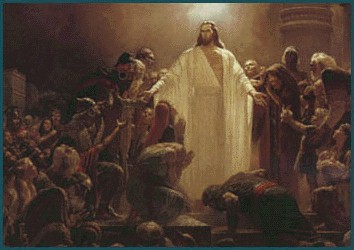
 Keep your eyes open!...
Keep your eyes open!...
Keep your eyes open!...

Pope Leo surprised those attending his noon papal Angelus in St. Peter's Square by announcing publicly, at the end of his prepared remarks, that he will "in the coming days" go to the hospital for an operation to remove "a small, localized nodule" that has been found in one of his lungs.
"Dear friends," Leo said, "during some recent medical examinations, the doctors found a small, localized nodule in my lung.
"It was detected at a very early stage and is well-localized.
"The doctors believe that it is best to intervene, so, following their advice, I have decided to undergo surgery to remove it.
"The operation is already scheduled to take place in the coming days.
"I thank you for your spiritual closeness and entrust myself to your prayers.
"Thank you, and happy Sunday!"
***
Here is a link to a video of the Pope speaking these words:
On Instagram (link)
On YouTube (link)
And here is an AI-vocalized video from "Catholic Snack" which discusses the announcement (the inauthentic voice is quite annoying, but some valid points are made, link).
***
It is quite unusual for such a medical announcement to be made publicly, for the first news regarding a medical condition, by the Pope himself personally. Usually, news about the Pope's health is issued in Vatican communiqués written by the Holy See Press Office or by the Pope's doctors.
So, the fact that Leo took the opportunity of a public Angelus message to announce that he will have this surgery has been noted as out of the ordinary by many.
It is being reported in Italy (but this is not confirmed) that the Pope will enter Rome's Policlinico Gemelli hospital on Tuesday, October 13, and be operated on Wednesday, October 14 — a day when he had been expected to greet and celebrate Mass with the presidents of all the bishops' conferences in the world gathered in Rome (so, a rather important appointment).
During today's Angelus, Leo spoke to pilgrims from Peru, saying he would be seeing them again next month in their home country, when he makes his long Apostolic Journey to Argentina, Uruguay and Peru from November 6 to 17. So, despite this imminent surgery, the November apostolic trip is still clearly "on."
Still, it is being reported in Rome (but, again, this is not confirmed) that Leo is expected to stay an entire week in the hospital to recuperate after the surgery. This suggests that the operation is, in fact, a rather serious surgery. And for older people, all such surgeries, where the patient goes under general anesthesia, may have some lingering temporary effects on those who undergo them.`
Leo has told the Church, and the world, that he is facing surgery, that it is a surgery for a nodule that has a relatively benign prognosis because the nodule is "circumscribed" and has been discovered at a "very early" stage, and he asked, in person, for our prayers.
One commenter on Instagram, iamnana5, said, for all of us: "My prayers will hold him in my heart & thoughts & God's loving arms during this time."
VIA X: Bishop Robert Barron @BishopBarronFriends, please join me in praying for our Holy Father, Pope Leo XIV, as he undergoes surgery this week.
I pray for his comfort, for those who will care for him, and for a swift and full recovery.
@Pontifex , know that we are praying for you, and that you are close to our hearts this week.
Ladder of Divine Ascent excerpt: Step 11- "On talkativeness and silence"
3. Intelligent silence is the mother of prayer, a recall from captivity, preservation of fire, an overseer of thoughts, a watch against enemies, a prison of mourning, a friend of tears, effective remembrance of death, a depicter of punishment, a delver into judgment, a minister of sorrow, an enemy of freedom of speech, a companion of stillness, an opponent of desire to teach, increase of knowledge, a creator of divine vision, unseen progress, secret ascent.
YOUTUBE: Mary, the Ark of the New Covenant | Dr. Brant Pitre
EXCERPT EDWARD PENTIN SUBSTACK: Cardinal Burke Defends Title ‘Co-Redemptrix’ for the Virgin Mary
The Blessed Virgin Mary, Mother of
God, participated in an altogether unique way in the Mystery of Faith,
the Mystery of the Redemptive Incarnation, and is rightly called
Co-Redemptrix. So, too, to the degree that we unite our hearts, one
with her Immaculate Heart, to the Most Sacred Heart of Jesus, we
participate in the saving mission of Christ. We can rightly be called
co-redeemers. In the words of Saint John Apostle and Evangelist, we are
called to be in Christ “fellow workers in the truth.” Our Lord Himself
makes clear the intimacy of our relationship with Him, when He
declares: “If any man would come after me, let him deny himself and
take up his cross daily and follow me.” In addressing this
International Conference on the Blessed Virgin Mary in Dogma and
Worship, I want to present the unique share in the mission of Christ
the King, the mission of the Redemptive Incarnation, which belongs to
the Virgin Mother of God as Co-Redemptrix and our share in the same
mission as co-redeemers.
The apparitions of the Virgin Mother of God at Tepeyac Hill in
present-day Mexico City help us, in a particular way, to understand her
mission and our corresponding mission. In fact, Our Lady’s children of
Mexico, guadalupanos and guadalupanas, have always understood their
mission in the world as service of Christ the King under the maternal
care of His Mother whom He gave to us as our Mother as He was dying on
the cross for our eternal salvation.[8] Blessed Miguel Pro wrote two
short prayers on the wall of the prison in which he was held before he
was martyred on November 23, 1927, by a firing squad during the bloody
persecution of the Church in Mexico: “¡Viva Cristo Rey! ¡Viva la Virgen
de Guadalupe!” (Long live Christ the King! Long live the Virgen of
Guadalupe!). So, too, Saint José Sanchez del Río, as he was cruelly
tortured and killed, also by firing squad on February 10, 1928,
repeatedly exclaimed: “¡Viva Cristo Rey! ¡Viva Santa Maria di
Guadalupe!” (Long live Christ the King! Long live Holy Mary of
Guadalupe!). Even as the Virgin Mother of God took the wine stewards at
the Wedding Feast of Cana to her Divine Son for the remedy of their
great woe, instructing them: “Do whatever he tells you,”, so she
accompanied these heroes of the faith to give their lives in doing
God’s will. So, too, she draws our hearts to her Immaculate Heart
leading us to give our hearts totally to the Sacred Heart of Jesus,
even to the shedding of our blood with Him for the glory of God and the
salvation of souls.
VIA X: Regarding the Vatican and Our Lady as Co-Redemptrix -- these are the popes who promoted it:
Pius IX:
Ineffabilis Deus, 1854
Pope Leo XIII:
Encyclical Supremi
apostolatus officio, 1883 Encyclical Jucunda semper, 1894 Apostolic
constitution Ubi primum, 1898 Encyclical Adjutricem populi, 1895
Leo XIII’s encyclicals (including
Jucunda semper / Iucunda semper of 1894, Supremi apostolatus officio,
Adjutricem populi, and related texts) repeatedly describe Mary as
associated with Christ in the work of salvation, offering her Son at
the cross, and sharing in the procurement of human redemption. Some
English renderings insert “co-Redemptress”; the underlying Latin
describes the role without always employing that precise compound. Pius
IX’s 1854 Ineffabilis Deus defines the Immaculate Conception in view of
the merits of Christ and presents Mary as uniquely prepared for her
place in the economy of salvation, but does not use the title
“Co-Redemptrix.” Pius XII’s Mystici Corporis (1943) and Ad caeli
Reginam (1954) describe her offering of her Son on Calvary and her
association with the new Adam in redemption, again without always
employing the exact title.
Pius X:
Encyclical Ad diem illum,
1904 During the pontificacy of this Pius X, a decree from the Holy
Office on June 26, 1913, praised “the custom of adding after the name
of Jesus that of His Mother, our Co-Redemptrix, the Blessed Virgin
Mary.” The same congregation granted an indulgence for the recitation
of the prayer in which Mary is called “co-redemptrix of the human race”
on January 22, 1914.
Benedict XV:
Apostolic Letter Inter
Sodalicia, March 22, 1918 states that Mary, suffering and nearly dying
with her Son and offering him to divine justice insofar as it depended
on her, can rightly be said to have “redeemed the human race together
with Christ” (Ipsam cum Christo humanum genus redemisse).
Pius XI
He is the first pope to
use the term co-redemptrix. In his message to the pilgrims of Lourdes
for the Jubilee of the Redemption, he made this prayer: “O Mother of
piety and mercy, who as Co-Redemptrix stood by your most sweet Son
suffering with Him when He consummated the redemption of the human race
on the altar of the cross ... preserve in us, we beg, day by day, the
precious fruits of the Redemption and of your compassion” (April 29,
1935).
In a 30 November 1933 address to
pilgrims from Vicenza he said the Redeemer associated his Mother in the
work and that “we invoke her under the title of Coredemptrix.” His 29
April 1935 radio message to Lourdes contains the prayer quoted in the
post almost verbatim: “O Mother of piety and mercy, who as
Co-Redemptrix stood by your most sweet Son suffering with Him when He
consummated the redemption of the human race on the altar of the
cross.” The 1923 letter Explorata res states that the sorrowful Virgin “shared in the work of redemption with Jesus Christ.”
Pius XII:
Encyclical Mystici corporis (1943)
Encyclical Ad caeli Reginam (1954)
The 4 November 2025 Doctrinal Note Mater Populi Fidelis
of the Dicastery for the Doctrine of the Faith (signed by Cardinal
Víctor Manuel Fernández and approved by Pope Leo XIV). The note states
that the title “Co-redemptrix” “risks obscuring Christ’s unique
salvific mediation and can therefore create confusion and an imbalance
in the harmony of the truths of the Christian faith,” and that when an
expression requires repeated explanations it becomes unhelpful.
Ladder of Divine Ascent excerpt: Step 11- "On talkativeness and silence"
2. Talkativeness is the throne of vainglory, on which it loves to show itself and make a display. Talkativeness is a sign of ignorance, a door to slander, an inducement to jesting, a servant of falsehood, the ruin of compunction, a creator and summoner of despondency, a precursor of sleep, the dissipation of recollection, the abolition of watchfulness, the cooling of ardour, the darkening of prayer.YOUTUBE: Five Astounding Rosary Miracles
ONEPETER5: The Miracles of the Rosary & Marian Apparitions
THE CATHOLIC HANDBOOK: The Rosary & The History of The Rosary
ARCHDIOCESE OF SAN ANTONIO: Seven common myths and facts about the rosary
Here are seven common myths and facts about this devotion to Our Lady from Catholic News Agency:
1. Only Catholics can pray the rosary.
False. While rosaries are typically associated with Catholics, non-Catholics can certainly pray the rosary — and in fact, many credit it to their conversion. Even some Protestants recognize the rosary as a valid form of prayer.
2. Praying the rosary is idolatry.
False. Some have objections to the rosary, claiming it idolizes Mary and is overly repetitive. Just like any practice, the rosary can be abused — just as someone might idolize a particular pastor or priest, a form of worship, or fasting. But the rosary itself is not a form of idolatry.The rosary is not a prayer to Mary — it is a meditation on the life of Christ revealed in five mysteries “with the purposes of drawing the person praying deeper into reflecting on Christ’s joys, sacrifices, sufferings, and the glorious miracles of his life.” When we pray the Hail Mary, we are not adoring Mary, we are asking for her intercession — just as we might ask a friend or family member to pray for us. Second, any prayer can lose its meaning if we do not intentionally meditate on it. Focusing on the mysteries with purpose and intention is key to the rosary’s transforming power. As one author encourages: “The rosary itself stays the same, but we do not.”
3. You can wear a rosary as a necklace.
It depends. It is typically considered disrespectful and irreverent to wear a rosary around one’s neck as jewelry, even though the Church does not have an explicit declaration against doing so. However, Canon 1171 of the Code of Canon Law says that “sacred objects, set aside for divine worship by dedication or blessing, are to be treated with reverence. They are not to be made over to secular or inappropriate use, even though they may belong to private persons.” It is important to treat the rosary with respect and intention. If you intend to wear the rosary as a piece of jewelry, this would not be respectful and should be avoided. It goes without saying that wearing the rosary as a mockery or gang symbol would be a sin. But if it is your intention to use the rosary and be mindful of prayer, then it could be permissible. It is not uncommon in some cultures, like in Honduras and El Salvador, to see the rosary respectfully worn around the neck as a sign of devotion. Rosary rings or bracelets might be a better option if you want to keep your rosary close at hand as a reminder to pray, as they are kept more out of sight and would not be as easily misconstrued to be a piece of jewelry.
4. The rosary is an extremist symbol.
False. A widely-shared 2022 Atlantic article went viral for accusing the rosary of being an “extremist symbol.” “Just as the AR-15 rifle has become a sacred object for Christian nationalists in general, the rosary has acquired a militaristic meaning for radical-traditional (or ‘rad trad’) Catholics,” the article read. The author also cited the Church’s stance on traditional marriage and the sanctity of life as evidence of “extremism” and claimed that Catholics’ tendency to call the rosary a “weapon in the fight against evil” as dangerous.As CNA reported in 2022, popes have urged Catholics to pray the rosary since 1571 — often referring to the rosary as a prayer “weapon” and most powerful spiritual tool.
5. The rosary is not biblical.
Untrue! Most of its words come directly from Scripture. First, the Our Father is prayed. The words of the Our Father are those Christ taught his disciples to pray in Matthew 6:9–13. The Hail Mary also comes straight from the Bible. The first part, “Hail, full of grace, the Lord is with thee,” comes from Luke 1:28, and the second, “Blessed art thou amongst women and blessed is the fruit of thy womb,” is found in Luke 1:42.Finally, each of the decades prayed on the rosary symbolizes an event in the lives of Jesus and Mary. The decades are divided into four sets of mysteries: joyful, luminous, sorrowful, and glorious, the majority of which are found in Scripture.
6. A rosary bead, or pea, can kill you.
Somewhat true. A rosary pea, or abrus seed, is a vine plant native to India and parts of Asia. The seeds of the vine, which are red with black spots, are often used to make beaded jewelry — including rosaries. Rosary pea seeds contain a toxic substance called “abrin,” which is a naturally-occurring poison that can be fatal if ingested. However, it’s unlikely for someone to get abrin poisoning just from holding a rosary made from abrus seeds, as one would have to swallow them.Today, most rosaries are made from other nontoxic materials, such as olive wood or glass — eliminating this concern.
7. Carrying a rosary can protect you.
True. The rosary has proven to be a miraculous force for protecting those of faith and bestowing upon them extra graces, such as the victory of the Christian forces at the Battle of Lepanto after St. Pius V implored Western Christians to pray the rosary. Many great saints across history, including Pope John Paul II, Padre Pio, and Lucia of Fátima, have also recognized the rosary as the most powerful weapon in fighting the real spiritual battles we face in the world. We know that spiritual warfare is a real and present danger: “For our struggle is not with flesh and blood but with the principalities, with the powers, with the world rulers of this present darkness, with the evil spirits in the heavens” (Eph 6:11–12). “The rosary is a powerful weapon to put the demons to flight and to keep oneself from sin … If you desire peace in your hearts, in your homes, and in your country, assemble each evening to recite the rosary. Let not even one day pass without saying it, no matter how burdened you may be with many cares and labors,” Pope Pius XI said.
ALETEIA: Five Thoughts from Padre Pio on the Rosary
Ladder of Divine Ascent excerpt: Step 11- "On talkativeness and silence"
1. In the preceding chapter, we spoke briefly of how extremely dangerous it is to judge others, or rather, to be judged and punished by one's own tongue, and of how this vice steals into even the most apparently spiritual people. Now we must show the cause of this vice, and give a proper account of the door by which it enters, or rather, goes out.SAINT POPE JOHN PAUL II: "There is nothing that man needs more than Divine Mercy—that love which is benevolent, which is compassionate, which raises man above his weakness to the infinite heights of the holiness of God."
MYCATHOLICGUIDE.COM: Divine Mercy Revelations to St. Faustina
EWTN: 17 Forgotten Divine Mercy Revelations Jesus Gave Through St. Faustina
REDDIT: Saint Faustina Diary Entry para 628 - Doubtful Faith
Journal Entry 7-20-23 1:40 AM Diary of Saint Faustina paragraph 628 - Doubtful FaithDIVINEMERCYSUNDAY.COM: Sister Faustina's Vision of Hell
"I, Sister Faustina Kowalska, by the
order of God, have visited the Abysses of Hell so that I might tell
souls about it and testify to its existence...the devils were full of
hatred for me, but they had to obey me at the command of God, What I
have written is but a pale shadow of the things I saw. But I noticed
one thing: That most of the souls there are those who disbelieved that
there is a hell." (Diary
741)
"Today, I was led by an angel to the Chasms of Hell. It is a place of great torture; how awesomely large and extensive it is! The kinds of tortures I saw:
The First Torture that constitutes hell is: The loss of God.
The Second is: Perpetual remorse of conscience.
The Third is: That one's condition will never change.
The Fourth is: The fire that will penetrate the soul without destroying it. A terrible suffering since it is a purely spiritual fire, lit by God's anger.
The Fifth Torture is: Continual darkness and a terrible suffocating smell, and despite the darkness, the devils and the souls of the damned see each other and all the evil, both of others and their own.
The Sixth Torture is: The constant company of Satan.
The Seventh Torture is: Horrible despair, hatred of God, vile words, curses and blasphemies.
These are the Tortures suffered by all the damned together, but that is not the end of the sufferings.
Indescribable Sufferings
There are special Tortures destined for particular souls. These are the torments of the senses. Each soul undergoes terrible and indescribable sufferings related to the manner in which it has sinned.
I would have died
There are caverns and pits of torture where one form of agony differs from another. I would have died at the very sight of these tortures if the omnipotence of God had not supported me.
No One Can Say There is No Hell
Let the sinner know that he will be tortured throughout all eternity, in those senses which he made use of to sin.
I am writing this at the command of God, so that no soul may find an
excuse by saying there is no hell, or that nobody has ever been there,
and so no one can say what it is like...how terribly souls suffer
there! Consequently, I pray even more fervently for the conversion of
sinners. I incessantly plead God's mercy upon them. O My Jesus, I would
rather be in agony until the end of the world, amidst the greatest
sufferings, than offend you by the least sin." (Diary 741)
EXCERPT LITURGY:
God our merciful Father, in your Son Jesus Christ you have opened for
us the inexhaustible fountain of your love. Hear the prayers we offer
with confidence. Through the intercession of Saint Faustina, teach us
to trust in you in every circumstance and make our lives living signs
of your mercy to others. We ask this through Christ our Lord. Amen.
Ladder of Divine Ascent excerpt: Step 10- "On slander or calumny"
11. The demons, murderers as they are, push us into sin. Or if they fail to do this, they get us to pass judgment on those who are sinning, so that they may defile us with the stain which we ourselves are condemning in another.YOUTUBE: The Power of First Fridays and First Saturdays | Sacred Heart & Immaculate Heart Devotions
THE FATIMA CENTER: The Virtue of Religion as Justice Toward God
VIA X (Fr. Ugochukwu Ugwoke, ISch): The Origin of First Friday Devotion
The First Friday Devotion is a beautiful practice within the Catholic Church that is focused on honoring the Sacred Heart of Jesus. The devotion dates back to the private revelations of Jesus to Saint Margaret Mary Alacoque, a French nun in 1673. In those apparitions, Jesus emphasized the importance of devotion to His Sacred Heart as a means of experiencing His love and mercy.
The main components of the First Friday Devotion include:
1.
Receiving Holy Communion: On the first Friday of each month, Catholics
are encouraged to receive the Holy Eucharist in a state of grace,
meaning they should have recently confessed any mortal sins in the
sacrament of reconciliation (confession).
2. Attending Mass: Ideally, Catholics should attend a special Mass held on First Fridays that is dedicated to the Sacred Heart of Jesus. However, if such a Mass is not available, attending any Mass on that day is sufficient.
3. Repentance and Confession: Along with receiving Holy Communion, Catholics are encouraged to make reparation for sins and offer prayers for the conversion of sinners.
4. Observing Nine Consecutive First Fridays: It is recommended that the faithful make this devotion for nine consecutive months as an act of reparation and to express their love and gratitude to Jesus for His sacrifice on the Cross.
5. Adoration and Prayer: Devotees are encouraged to spend time in adoration of the Blessed Sacrament or in personal prayer on First Fridays, meditating on the love and mercy of Jesus as represented by His Sacred Heart.
In 1674, Sr. Margaret’s spiritual director, Claude de la Colombiere helped promote the devotion, spreading it to others within the Church. As the devotion gained popularity, Pope Clement XIII granted a plenary indulgence for those who practiced it. Today, the devotion remains a cherished tradition for Catholics worldwide, reminding us of Christ’s boundless love and mercy.
While the devotion is not mandatory for every Catholic, it is a beautiful way to draw closer to the Sacred Heart of Jesus and to experience His love and mercy. The devotion also comes with some promises that Jesus made to Saint Margaret Mary Alacoque, including the promise of forgiveness of sins, deeper relationship with Jesus, and abundant graces for those who faithfully practice this devotion.
VIA X (Fr. Ugochukwu Ugwoke, ISch): The Origin of First Saturday Devotion
The First Saturday Devotion was introduced by Our Lady of Fatima in 1917. During her apparitions to three shepherd children in Fatima, Portugal, Our Blessed Mother emphasized the importance of prayer and penance for the conversion of sinners.
On December 10, 1925, she appeared to Sister Lucia (one of the Fatima visionaries) and outlined the conditions for the First Saturday Devotion. She asked for the faithful to make reparation to her Immaculate Heart on the first Saturday of five consecutive months.
To fulfill the First Saturday Devotion, Catholics are asked to fulfil these conditions: -Confess and receive Holy Communion on the first Saturday. -Recite the Rosary. -Meditate for 15 minutes on the mysteries of the Rosary with the intention of making reparation.
Our Lady also promised to assist those
who practice the First Saturday Devotion at the hour of death, with all
the graces necessary for salvation. The First Saturday devotion is a
powerful reminder of Mary’s maternal care and intercession. It serves
as a way to grow in faith, deepen one's devotion to Mary, and seek
spiritual renewal.
Today, the First Saturday Devotion continues to be practiced by Catholics worldwide and many people continue to receive countless graces from Mary through the devotion. The devotion is a testament to the enduring message of Fatima and the desire to respond to Our Lady's call for prayer and conversion. Our Lady of Fatima, pray for us!
SIMPLY CATHOLIC: How to Observe First Fridays and First Saturdays
Our HeartsLadder of Divine Ascent excerpt: Step 10- "On slander or calumny"
9. Listen to me, listen, all you malicious reckoners of other men's accounts! If it is true (as it really is true) that 'with what judgment ye judge, ye shall be judged (Matt 7:2), then whatever sins we blame our neighbour for, whether bodily or spiritual, we shall fall into them ourselves. That is certain.

 Links
Links  E-mail
Dr. Zambrano
E-mail
Dr. Zambrano  Home
Home
 Jubilee
2000:
Bringing the World to Jesus
Jubilee
2000:
Bringing the World to Jesus
 The
Tribulation Times Archives:
The
Tribulation Times Archives:
| 2012 | 2013 | 2014 | 2015 | 2016 | 2017 | 2018 | 2019 | 2020 | 2021 | 2022 | 2023 | 2024 | 2025 | 2026 | |||||||||||||||
| Jan | Jul | Jan | Jul | Jan | Jul | Jan | Jul | Jan | Jul | Jan | Jul | Jan | Jul | Jan | Jul | Jan | Jul | Jan | Jul | Jan | Jul | Jan | Jul | Jan | Jul | Jan | Jul | Jan | Jul |
| Feb | Aug | Feb | Aug | Feb | Aug | Feb | Aug | Feb | Aug | Feb | Aug | Feb | Aug | Feb | Aug | Feb | Aug | Feb | Aug | Feb | Aug | Feb | Aug | Feb | Aug | Feb | Aug | Feb | Aug |
| Lent | Sep | Lent | Sep | Lent | Sep | Lent | Sep | Lent | Sep | Lent | Sep | Lent | Sep | Mar | Sep | Lent | Sep | Lent | Sep | Lent | Sep | Lent | Sep | Lent | Sep | Lent | Sep | Lent | Sep |
| Apr | Oct | Apr | Oct | Apr | Oct | Apr | Oct | Apr | Oct | Apr | Oct | Apr | Oct | Lent | Oct | Apr | Oct | Apr | Oct | Oct | Apr | Oct | Apr | Oct | Apr | Oct | Apr | ||
| May | Nov | May | Nov | May | Nov | May | Nov | May | Nov | May | Nov | May | Nov | May | Nov | May | Nov | May | Nov | May | Nov | May | Nov | May | Nov | May | Nov | May | |
| Jun | Dec | Jun | Dec | Jun | Dec | Jun | Dec | Jun | Dec | Jun | Dec | Jun | Dec | Jun | Dec | Jun | Dec | Jun | Dec | Jun | Dec | Jun | Dec | Jun | Dec | Jun | Dec | Jun |
| 1997 | 1998 | 1999 | 2000 | 2001 | 2002 | 2003 | 2004 | 2005 | 2006 | 2007 | 2008 | 2009 | 2010 | 2011 | ||||||||||||||
| June-Jul | Jan | Jul | Jan | Jul | Jan | Jul | Jan | July | Jan | Jul | Jan | Jul | Jan | Jul | Jan | Jul | Jan | Jul | Jan | Jul | Jan | Jul | Jan | Jul | Jan | Jul | Jan | Jul |
| Aug | Feb | Aug | Feb | Aug | Feb | Aug | Feb | Aug | Feb | Aug | Feb | Aug | Feb | Aug | Feb-Mar | Aug | Feb | Aug | Feb | Aug | Aug | Feb | Aug | Feb | Aug | Feb | Aug | |
| Sep | Mar | Sep | Mar | Sep | March/Apr | Sep | March/Apr | Sep | Mar | Sep | Mar | Sep | Mar | Sep | Apr | Sep | Lent | Sep | Lent | Sep | Lent | Sep | Lent | Sep | Lent | Sep | Mar | Sep |
| Oct | Apr | Oct | Apr | Oct | May | Oct | May | Oct | Apr | Oct | Apr | Oct | April | Oct | May | Oct | Apr | Oct | Apr | Oct | Apr | Oct | Apr | Oct | Apr | Oct | Lent | Oct |
| Nov | May | Nov | May | Nov | Jun | Nov | Jun | Nov | May | Nov | May-Jun | Nov | May | Nov | Jun | Nov | May | Nov | May | Nov | May | Nov | May | Nov | May | Nov | May | Nov |
| Dec | Jun | Dec | Jun | Dec | Dec | Dec | Jun | Dec | Dec | Jun | Dec | Dec | Jun | Dec | Jun | Dec | Jun | Dec | Jun | Dec | Jun | Dec | Jun | Dec |